
You may have done the hard part already. The scale is moving down, clothes fit differently, and the work of losing weight has clearly changed your health. Yet the skin on the abdomen, arms, thighs, chest, or back can still leave you feeling as if your body has not fully caught up with the effort you've made.
That is the point where many people in Switzerland start searching for body contouring after weight loss. The right conversation is not about chasing a dramatic makeover. It's about deciding whether surgery is genuinely reconstructive, whether your weight has stabilised enough to make surgery worthwhile, and whether a Swiss clinic has the credentials to do it safely.
Why Body Contouring After Weight Loss Is a Different Conversation
A patient in Zurich or Lausanne often arrives with the same sentence: “I've lost the weight, but I still don't like what I see in the mirror.” The problem is rarely fat alone. It's the loose skin, tissue descent, and body folds that remain after major weight loss, and those issues don't respond to exercise the way many people hope they will.
That is why body contouring after weight loss sits in a different category from routine aesthetic surgery. In practice, it's closer to a reconstructive plan for reshaping the body after a major change than to a simple cosmetic refinement. Swiss specialists often discuss it as the final stage of the weight-loss journey, because the decision depends on tissue changes, function, and healing capacity, not just appearance.
Practical rule: if the main concern is excess skin that affects hygiene, movement, clothing fit, or comfort, the conversation belongs in a surgical consultation, not a fitness discussion.
The distinction matters because the work is usually broader than one area. Abdominal correction is common, but the arms, breasts or chest, back, thighs, and lower trunk may all need attention as well. That makes this a planning problem, not a single-procedure purchase.
The rest of the article stays on that ground. It focuses on candidacy, timing, risks, cost drivers, and how to judge a Swiss clinic carefully. It does not treat body contouring as a glamour service, because that framing hides the questions that determine whether surgery makes sense for you.
What Body Contouring After Weight Loss Actually Involves
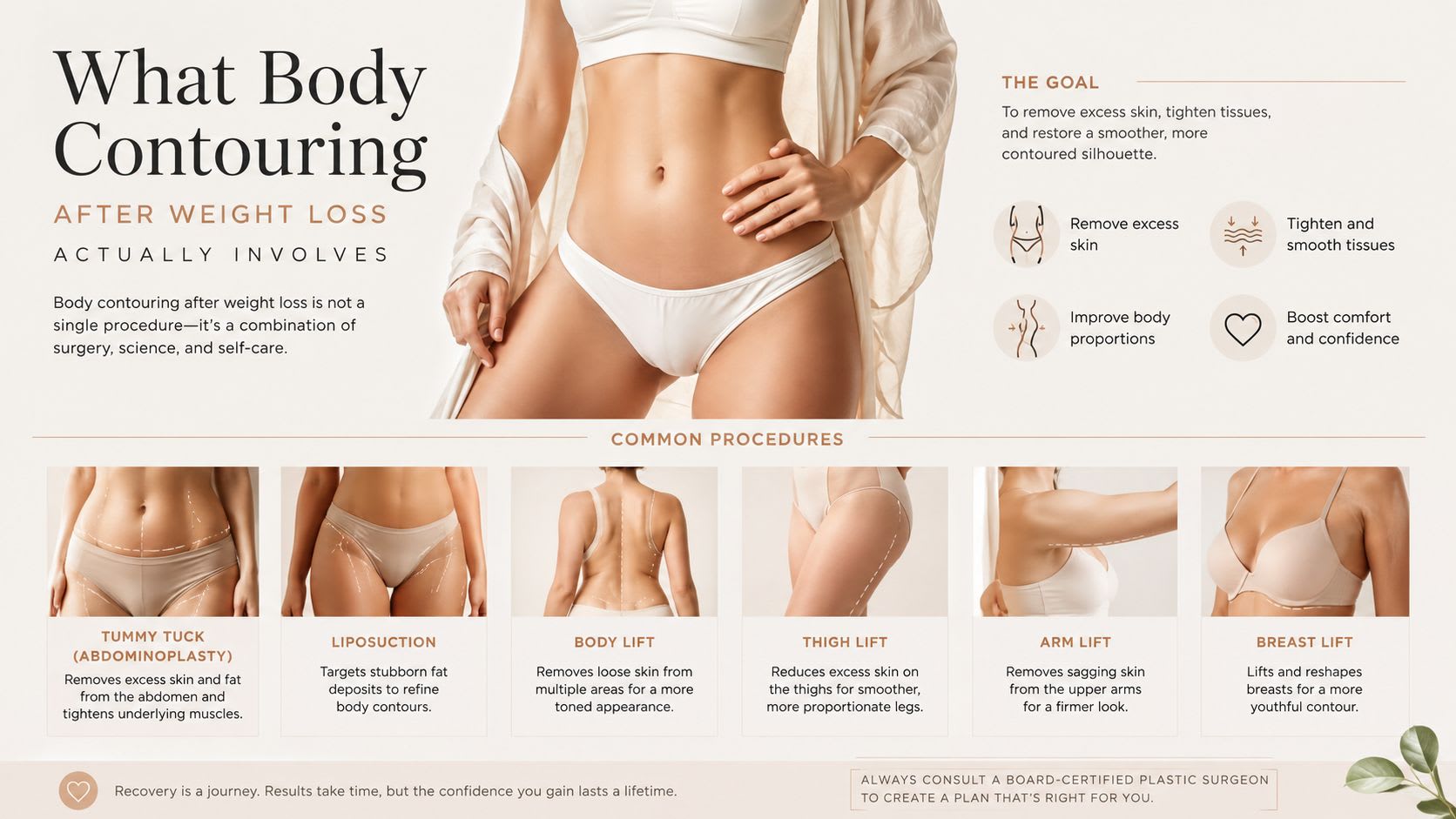
Body contouring after major weight loss is a group of operations, not one operation with a fixed pattern. Surgeons use it to remove redundant skin, reshape stretched tissue, and restore a more stable body outline after the weight-loss phase has ended. In practice, the plan is usually built area by area, because the trunk, arms, thighs, breasts or chest, and face or neck do not all age or heal in the same way after weight reduction.
The body areas are usually planned like a renovation
Renovating a house after the structure has already changed offers a useful comparison. You don't fix the kitchen, roof, and floor all in the same step unless the building and the budget really allow it. Post-weight-loss contouring works the same way; surgeons may stage an abdominoplasty, lower body lift, brachioplasty, thigh lift, mastopexy or chest correction, back lift, or face and neck contouring depending on which areas create the most functional or visual problem.
The point is not to collect procedures. It's to match technique to the anatomy that remains after weight loss. Some patients mainly need abdominal correction, while others need a circumferential approach because the looseness wraps around the torso.
If you want a plain-language primer on loose-skin management after major weight change, Trim's guide to firming skin is a useful general read. For a Switzerland-focused treatment overview, BeautyGuide also keeps a dedicated page on skin tightening options.
Staging is usually a safety decision, not a sales tactic
Surgeons often stage these operations because each area brings its own incision pattern, swelling, and recovery burden. Combining too much at once can make recovery harder to manage, especially when the tissue quality is still settling after weight loss. That is why post-weight-loss contouring is usually discussed as a planned sequence rather than a menu of add-ons.
The key mental shift is simple. This is not about choosing one “beauty procedure”. It is about deciding which areas still have a structural problem, and in what order they should be addressed.
Surgical and Non-Surgical Options Compared
The menu in Switzerland usually starts with surgery, because surgery is the only option that can remove a meaningful amount of excess skin. Abdominoplasty is used when the abdomen is the main problem. Lower body lift becomes relevant when looseness wraps around the waist, hips, and buttocks. Brachioplasty targets the upper arms, thigh lift addresses hanging inner or outer thigh skin, and mastopexy or chest procedures help when the breasts or chest have lost volume and shape.
What each option can and can't do
Surgery solves a tissue-excess problem. Non-surgical devices mainly try to stimulate tightening in skin that is only mildly loose. That's a very different use case. Radiofrequency, HIFU, cryolipolysis, and injectables may have a place for modest refinement, but they rarely replace surgery after major weight loss, because the issue is often too much skin, not just skin quality.
For readers comparing technologies, it can help to look at device categories rather than brand promises. If you're trying to compare fat freezing devices in a general sense, the central limitation is still the same, fat reduction or modest contour change is not the same as removing redundant skin folds. In Switzerland, that means non-surgical treatment may suit small residual concerns, while surgery remains the realistic choice for large tissue excess. BeautyGuide's overview of cryolipolysis can help you understand where fat-freezing sits in the broader contouring field.
| Procedure type | Best indication | Scarring | Downtime | Realistic effect after weight loss |
|---|---|---|---|---|
| Abdominoplasty | Excess abdominal skin, central laxity | Visible scar | Substantial | Strong correction of abdominal skin excess |
| Lower body lift | Circumferential lower torso laxity | Visible scar | Substantial | Broad reshaping of waist, hips, and buttocks |
| Brachioplasty | Hanging upper-arm skin | Visible scar | Moderate to substantial | Useful for arm contour and clothing fit |
| Thigh lift | Inner or outer thigh laxity | Visible scar | Moderate to substantial | Helps with skin folds and friction |
| Radiofrequency or HIFU | Mild skin laxity | Minimal | Low | Modest tightening only |
| Cryolipolysis | Localised fat, not major loose skin | Minimal | Low | Limited for post-weight-loss skin excess |
| Injectables | Small-volume refinement | Minimal | Low | Limited, usually adjunctive only |
Scars are part of the decision
Every surgical option leaves scars. That isn't a side note, it's part of the trade-off. For many post-weight-loss patients, the question is not whether scarring exists, but whether the scar placement and the functional gain make sense compared with the skin that remains.
In other words, surgery can do much more than devices, but it asks more of the patient too. It asks for acceptance of scar lines, a real recovery period, and a clearer understanding of what problem is being solved.
Candidacy and Timing Around Weight Stabilisation
A Swiss clinic will usually start with a simple question, has your weight settled? That question matters more than enthusiasm. Body contouring works best when the body has stopped changing shape, because the surgeon can plan incisions and tissue removal around a stable frame rather than a moving target.
The practical timing rule is well established. A review in PMC says weight stabilisation typically takes 12–24 months after major weight loss, because the overall loss commonly continues for 1–3 years after bariatric intervention. Expert guidance also recommends that weight be stable within about 4.5 kg for at least 6 months, and usually at least 12 months after bariatric surgery, before contouring is planned. Those figures explain why a surgeon may say “not yet” even when the skin problem is obvious. PMC review on timing and stabilisation
Why timing changes surgical quality
If weight is still dropping, the amount of redundant skin can change again after surgery. That makes incision planning less accurate and can reduce the durability of the correction. It also means the surgeon cannot judge the final distribution of loose tissue, which is exactly what determines the shape of the operation.
This is a technical issue. Stable weight improves predictability, and predictability matters when surgery involves long incisions, drainage management, and a recovery period that can be substantial.
In a clinical cohort of 37,806 bariatric patients, only 5.58% later underwent a body contouring procedure, and the average time to plastic surgery was about 903 to 1,135 days depending on the bariatric operation. That tells you two things. First, many patients never reach surgery even when they might be eligible. Second, the pathway is usually measured in years, not weeks. PMC cohort and timing data
What surgeons usually want to know first
Before technique comes discussion of nutrition, smoking, and medical history. The reason is straightforward. Large contouring procedures ask the body to heal across long incisions, so the surgeon needs to know whether the patient can support that recovery.
Weight stability is a threshold, not a feeling. If the number is still moving, a good surgeon will usually slow the process down.
That can feel frustrating, but it protects the result. It also keeps the conversation honest about whether surgery is ready now or being considered too early.
Expected Outcomes, Recovery, and Real Risks
After major weight loss, body contouring is usually about function and daily comfort more than a dramatic medical “result” in the narrow sense. A review found 28.5% higher physical functioning, 45.7% higher psychological wellbeing, and 24% higher social functioning after body contouring in post-bariatric patients. Another review found a 2-point weighted mean reduction in BMI, but the broader conclusion was that the procedure does not offer a clinically significant sustained weight-loss benefit. PMC review of quality-of-life outcomes ASPS journal summary on weight-loss effects
Recovery is real and should be planned around
Recovery is not a small footnote. Most patients should expect drains, compression garments, limited lifting, and a period when ordinary routines need to be adjusted. In the first phase, the body is protecting the incision lines and moving fluid out of the tissues, so normal activity is not the right goal yet.
The burden of recovery also changes with the size of the operation. A single abdominal procedure is very different from a circumferential body lift or several staged operations. That is why surgeons usually discuss time off work, help at home, and follow-up visits before they talk about the final shape.
The complications worth naming at consultation
Complications deserve a direct discussion. In a classic retrospective series of 30 patients, reported issues included seroma, wound breakdown, haematoma requiring drainage, and lymphocele after brachioplasty, and the average hospital stay was 3 days. The same study recorded an average of 5.9 kg of tissue resected and a preoperative weight loss of 71 kg, which shows how substantial these operations can be. Classic retrospective series on operative burden and complications
That matters because complication counselling should be specific. Ask where seromas are most likely to occur, how drains are managed, when the clinic prefers to intervene, and what revision means if healing does not follow the usual course.
Standout point: the goal is improvement in comfort and function, not perfection. Scars remain, asymmetry can persist, and some irregularity is always possible.
Patients who accept that reality usually cope better with recovery. They are less likely to judge the operation by early swelling and more likely to assess it by the longer-term change in daily life.
Cost Drivers in Switzerland Without False Precision
Swiss patients often want a number first, but body contouring doesn't have a sensible single price. Two clinics in Zurich or Geneva can quote very different totals because they may be offering different surgeons, different anaesthesia models, different operating facilities, and different degrees of follow-up. A lower quote can mean fewer included services.
What usually drives the bill
The biggest cost drivers are the surgeon's experience, anaesthetist fees, the operating setting, whether the procedure is done in hospital or as day surgery, how many body areas are treated, and whether the operation is staged. Recovery support matters too. Compression garments, wound supplies, and any post-operative lymphatic drainage may not be bundled into the first quote.
A quote should be itemised enough to show what is included and what is not. If the clinic can't explain the facility fee, anaesthesia coverage, follow-up schedule, and revision policy clearly, the headline figure isn't useful yet.
Why cheap isn't automatically better
Post-weight-loss contouring is not a treatment where you want to save by trimming away basics. A carefully planned operation with proper aftercare can be more valuable than a lower price that hides missing elements. In practical terms, the question is whether the quote reflects the true complexity of your case, not whether it looks smaller on the first page.
That's also why supplement costs deserve attention. Time off work is part of the actual budget, even if no clinic invoice lists it. So is the possibility of staged procedures, which can change the financial picture even when the first operation seems manageable.
A sensible consultation outcome is not “the cheapest option”. It's a transparent estimate from a team that can explain why the number is what it is, and what happens if the surgical plan changes.
How to Choose a Qualified Swiss Clinic
In Switzerland, clinic selection should start with credentials, not branding. A clinic in Bern or Lugano can look polished on the outside and still be a poor fit if the surgeon's training, supervision model, or facility standards aren't clear. The first step is to verify the physician in MedReg, then check whether the surgeon holds an FMH specialist title in plastic, reconstructive and aesthetic surgery where applicable.
What to verify before booking
Look for the person who will perform the operation, not just the clinic name. Ask where the surgery takes place, who provides anaesthesia, and who is responsible for overnight monitoring if the procedure isn't a true day case. Those details matter more than the brochure photos.
BeautyGuide's clinic directory is one place to start shortlisting providers across Zurich, Geneva, Basel, Lausanne, Bern, Zug, Lucerne, St. Gallen, Winterthur, and Lugano, but the directory should support your own checks, not replace them. The right use of a directory is to narrow the field, then confirm the surgeon and facility directly.
Questions that separate experienced teams from polished marketing
- Credentials first: Is the surgeon MedReg-listed, and do they hold the relevant FMH specialist title?
- Anesthesia model: Who gives anaesthesia, and where is the patient monitored afterwards?
- Staging plan: Which areas would be done first, and why?
- Complication management: How are seroma, wound separation, or delayed healing handled?
- Revision policy: If contour correction needs adjustment, what does the clinic do?
Red flags are easy to spot once you know what to listen for. Time-limited pricing, vague answers about who operates, pressure to combine too many areas at once, or no real discussion of scars and complications all deserve caution.
The right clinic in Switzerland should make the process feel slower, not faster. That's a sign the team is taking the technical and recovery burden seriously.
Making the Decision and Next Steps
A good decision starts with three facts. Your weight must be stable enough for surgery to be planned accurately. Your symptoms need to be clear enough to justify the operation. And the clinic needs to be credible enough to manage the procedure and the recovery without guesswork.
A consultation checklist that stays practical
Bring a short list of questions and keep the answers specific.
- Credentials: Who is the operating surgeon, and what specialist title do they hold?
- Procedure plan: Which areas would be done together, and which should be staged?
- Complications: What problems do you see most often in patients like me?
- Revision policy: What happens if healing or contour doesn't settle as expected?
- Anaesthesia and follow-up: Who supervises the anaesthesia, and what does post-op review look like?
The quality of the answers matters more than the polish of the clinic. If the surgeon talks about scars, downtime, and uncertainty, that usually tells you more than a perfect before-and-after gallery.
How to interpret the consultation
A strong consultation should leave you with a clearer view of what surgery can solve, what it can't, and what you'd need to do before booking. If the conversation stays focused on function, scar placement, staging, and safety, you're probably in the right place. If it stays focused on excitement and speed, keep looking.
For Swiss patients, the best next step is usually to shortlist a few verified clinics, compare the surgeon credentials, and then choose the consultation that explains the trade-offs most clearly. That approach is slower, but it's also safer and more honest.
BeautyGuide is built for exactly that kind of search, helping you compare Swiss clinics for body contouring after weight loss with credential-led listings and treatment information in one place. If you're ready to start narrowing your options, visit BeautyGuide and use it to identify qualified Swiss clinics, then verify the details directly before you book.
This article is for informational purposes only and does not replace professional medical advice.