
Swiss hair transplant pricing usually starts at CHF 3.78 per graft, with a benchmark of CHF 9,456 for 2,500 grafts in Switzerland. That gives you a realistic reference point before clinic fees, technique choice, and aftercare change the final bill (medihair's 2025 country comparison).
If you've been comparing clinic websites and seeing vague “starting from” offers, you're not alone. Hair transplant pricing in Switzerland is easiest to understand when you look at the total cost for a defined graft count, not just the headline price.
Understanding Hair Transplant Costs in Switzerland
A hair transplant quote in Switzerland only becomes useful when it reflects the specific treatment plan. A low entry price tells you very little on its own. You need the graft count, the method, and a clear breakdown of what the clinic includes and excludes. Without that detail, one offer can look cheaper at first glance while another is easier to compare and more transparent in practice.
A reliable Swiss reference point is the average total price of CHF 9,456 for 2,500 grafts, which works out to CHF 3.78 per graft (medihair's 2025 country comparison). That figure gives you a real unit for comparison instead of a vague “starting from” price that may not match your case. The same source also places Switzerland above its broader country average of EUR 7,371 for 2,500 grafts, which is consistent with Switzerland sitting in a higher-cost European tier.

Why the graft count matters more than the headline price
A Swiss consultation should start with the hair loss pattern, not the price list. Mild recession may require far fewer grafts than crown restoration or a broader rebuild, and that changes the final bill sharply (IFUE Haartransplantation).
Practical rule: Ask for the quote to be broken down by graft count. A fair comparison in Zurich, Geneva, Basel, or Lausanne only works when you know what the clinic is planning to transplant.
That standardised graft count gives Swiss patients a common language for comparing clinics, methods, and follow-up expectations. It also helps you separate a strong competitive offer from one that lacks enough detail.
Pricing Models Per Graft vs All-Inclusive Packages
Swiss clinics usually present pricing in two ways. Some charge per graft, while others bundle the work into a package. Both models can be legitimate, but they serve different patient priorities. A key consideration is how much clarity you want before treatment, and how much flexibility you are willing to accept if the surgical plan changes after consultation.
Per graft pricing gives you the clearest scaling logic
Per-graft pricing is the more clinically transparent model because it follows the actual size of the procedure. In the Swiss and German market, the price per graft is typically around €3 to €5, and the final cost rises with the size of the bald area rather than with the time spent in surgery. A minor recession may need 400 to 800 grafts, while advanced loss can require 2,000 to 3,000 grafts, which places patients in very different cost brackets. The same source also shows why this matters for planning. Once the graft estimate shifts, the financial picture shifts with it, so the quote should reflect the treatment area and not just a broad headline figure. (IFUE Haartransplantation)
That structure is useful if precision matters to you. You can see how the quote changes when the plan changes, and you can discuss whether the front hairline, the temples, or the crown are being treated first. For a Swiss patient, that kind of detail helps separate a serious medical proposal from a simple sales number.
Packages trade detail for predictability
All-inclusive pricing is easier to budget for, especially if you want fewer surprises. The trade-off is that the package can hide limits, such as a capped graft count, separate follow-up charges, or medication that is not included. A package is only useful when the inclusions are written down clearly, because the true cost of ownership is broader than the surgery day itself.
| Hair loss pattern | Typical graft need | Financial effect |
|---|---|---|
| Minor recession | 400 to 800 grafts | Lower overall quote, usually focused on the frontal hairline |
| Moderate thinning | around 1,500 grafts | Mid-range bill, often the point where method choice starts to matter |
| Advanced loss | 2,000 to 3,000 grafts | Materially higher total, especially if multiple zones are treated |
For Swiss patients, the best model depends on how much certainty you want before treatment. If a clinic offers a package, ask whether the same quote still applies if the graft plan changes after examination. If it does not, you are comparing a fixed offer with a moving target. In practice, that difference can matter more than the headline price.
Key Factors That Influence Your Final Quote
The final quote usually reflects more than just graft volume. In Switzerland, the clinic's location, surgeon reputation, staffing model, and the chosen technique all influence what you pay. That is why one quote can look dramatically higher than another even when both sound similar at first glance.

Location and market positioning matter
Price differences by location are real. In the NDR overview, Turkey is shown at EUR 1,500 to 4,500, while a complete hair transplant session in Switzerland can reach over EUR 18,600 (NDR). That gap reflects the Swiss cost base, higher operating costs, and surgeon fees, not just the procedure itself.
For a patient in Switzerland, that means a clinic in a premium urban setting may price differently from one in a smaller canton. The higher price is not automatically better, and the lower price is not automatically more efficient. What matters is whether the quote is consistent with the level of medical oversight, consultation depth, and aftercare you are receiving.
Experience and infrastructure affect the bill
A highly experienced surgeon, a larger support team, and a clinic that handles more complex cases will usually price accordingly. That can be reasonable if it comes with stronger planning, cleaner documentation, and more thorough follow-up. It becomes less defensible when the price only reflects branding.
A transparent quote should let you see what you're paying for. If the clinic cannot explain the fee structure in plain language, ask for a revised written breakdown before you commit.
For Swiss patients comparing clinics, the key question isn't whether the quote is high. It's whether the quote is intelligible.
Cost Differences Between FUE and FUT Procedures
A clinic may quote two patients very differently even when the graft number looks similar. Technique is one of the main reasons. It changes the time the team needs, how much manual work is involved, what equipment is used, and how much precision is required during harvesting and implantation. In real terms, that affects the final bill almost as much as graft count does.
FUE, or Follicular Unit Extraction, removes grafts one by one. FUT, or Follicular Unit Transplantation, uses a strip-based approach. FUE is the method patients hear about most often because it avoids a linear donor scar, while FUT can still make sense in selected cases depending on the surgeon's assessment and the patient's donor supply.
The price gap becomes wider once the clinic uses advanced FUE variants. DHI and robotic-assisted workflows can cost more because they require specialised equipment and more labour. Independent German medical price guides say DHI can cost 20 to 25% more than standard FUE, and robotic procedures may add a further per-graft surcharge (Wiseranker). That premium does not guarantee better results. It does mean you should ask what the extra fee covers, whether it is tied to the device, the staffing model, or the post-operative process.
For patients comparing providers, the method description should also be checked against a real clinic profile. BeautyGuide's directory page for a Swiss hair transplant specialist clinic shows how treatment pages are typically presented and helps you see whether the clinic explains its technique in a concrete way.
What to ask before you choose a method
- Harvesting approach: Ask whether the clinic recommends FUE, FUT, or a hybrid plan, and why.
- Implantation style: Find out whether the team uses standard placement or DHI-style implantation.
- Cost logic: Confirm whether the premium is tied to equipment, staffing, or post-op support.
- Scar trade-offs: Ask what visible donor-area trade-off the method leaves behind.
The lower-priced method is not automatically the better value if it needs revision later. The more practical choice is the one that fits your hair loss pattern, donor capacity, downtime tolerance, and the total cost of ownership, including follow-up care and the possibility of touch-ups.
What Is Typically Included in a Swiss Quote
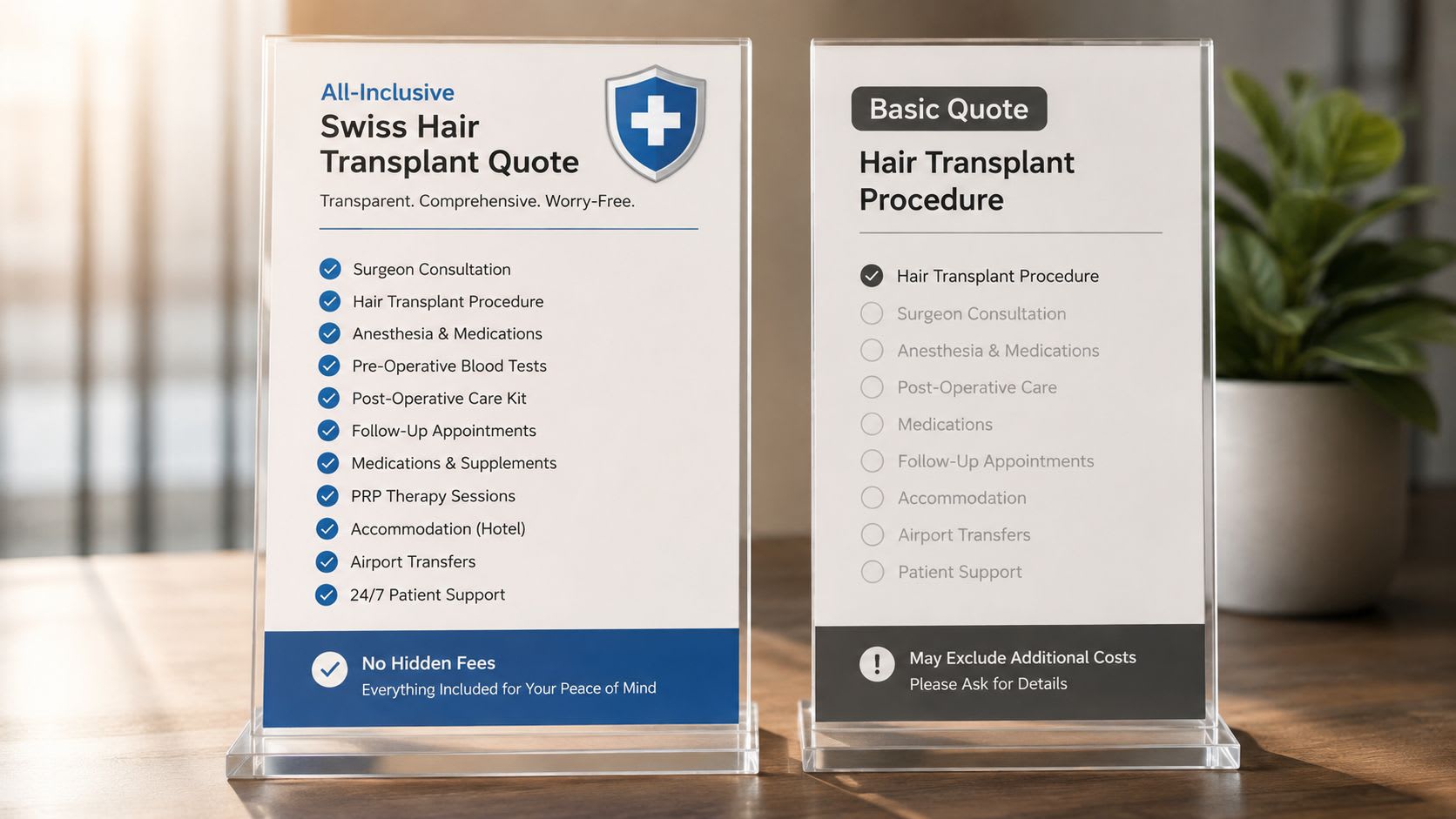
A clean Swiss quote should read like a medical plan, not a marketing flyer. If the figure is high, that is easier to accept when you can see exactly what it covers. If the figure is low, the missing items usually show up later in the process.
What should be written into the quote
A transparent Swiss quotation should name the consultation, the procedure itself, the hair transplant method, anaesthesia, and the expected follow-up plan. It should also say whether medication after surgery is included or billed separately. That matters because online price summaries often stop at the operation and leave out the rest of the bill, as discussed on drserkanaygin.com.
A proper quote should also say who performs the work, whether the plan includes the surgeon's review before and after surgery, and whether the clinic expects any revision discussion if growth is less dense than planned. Patients often focus on the graft price first, but the financial picture in Switzerland includes specialist time, post-op care, and the chance that a touch-up may be needed later. For a concrete clinic example, see the treatment information on clinique du cheveu at BeautyGuide.
What often becomes an extra cost
Separate billing is common for items that are easy to miss during a consultation. These can include follow-up appointments, special aftercare products, post-operative medication, or pre-op checks if they are not bundled into the package. In Switzerland, where a procedure can exceed CHF 18,600, those additions can change the practical out-of-pocket total quite a lot.
A separate cost can also appear after surgery if the clinic recommends targeted care for the donor area or the transplanted grafts. Patients sometimes ask about shampoos for hair growth and thickness, but the clinic's own aftercare protocol should still be the first reference point because the right product and timing depend on the surgical plan.
If you are speaking with a clinic in Lausanne, Bern, or Zurich, ask for the total cost in writing before you book. A good coordinator should be able to tell you whether the quote is procedure-only or all-inclusive, and whether any future review visits are treated as part of the original plan or as an added charge.
Ask this directly: “Does this include consultation fees, follow-up care, and any post-operative medication, or are those separate?”
Sample Cost Scenarios for Common Hair Loss Patterns
The quickest way to make the numbers feel concrete is to tie them to common hair loss patterns. The graft count drives the bill, and the size of the treatment area drives the graft count. Two patients in the same city can still receive very different quotes because the clinical plan is different.
Scenario 1, a receding hairline
A patient with mild recession usually falls into the lower graft range, often around a few hundred grafts in standard Swiss and German medical guidance. That kind of case is often planned as a focused FUE procedure, because precise placement matters more than covering a large area.
Financially, this is usually the most contained type of restoration. The final figure still depends on how the consultation is billed and what the clinic includes, but lower graft demand usually keeps the quote comparatively modest.
Scenario 2, a thinning crown
A crown case usually asks more of the clinic than a simple hairline correction, because the area is harder to make look dense. Patients in this group often need a mid-range graft count, and that is the point where technique differences become easier to see in the quote. If the clinic recommends DHI or a more labour-intensive workflow, the price can rise because the process requires more time and handling (Wiseranker).
That is also where total ownership cost starts to matter. A lower sticker price can look attractive, but if follow-up visits, medication, or a later touch-up are treated as extras, the actual outlay is higher than the first line on the estimate suggests.
Scenario 3, broader restoration
More advanced loss can require a much larger graft count, which moves the case into a very different financial bracket. The surgery takes longer, the planning is more complex, and aftercare becomes more closely tied to the final result.
Patients sometimes also ask about topical support once they have settled on surgery. Some review maintenance products such as shampoos for hair growth and thickness, but that should sit alongside, not instead of, the clinic's own aftercare plan.
In all three scenarios, the quote should be read as a package of graft count, method, and included services. A practical comparison also means checking whether consultation fees, post-op checks, and possible future touch-ups are part of the same plan. For patients comparing providers, a clinic directory can help you line up those details in writing before you commit.
Financing Your Procedure and Choosing a Verified Clinic
Hair transplantation is usually treated as an elective aesthetic procedure, so Swiss patients should not expect routine insurance coverage. That makes personal budgeting important from the first consultation. If a clinic offers financing, it should still give you a full written breakdown of the total amount due, not just the monthly instalment.
The bigger issue is provider selection. A well-priced procedure is not enough if the clinic cannot show who is responsible for planning, harvesting, implantation, and follow-up. In Switzerland, it makes sense to check surgeon credentials, look for FMH-listed specialists where applicable, and confirm that the consultation feels medically serious rather than sales-driven.

A strong clinic conversation should cover three things. First, the graft plan should be coherent. Second, the quote should state what is included. Third, the follow-up process should be clear enough that you know who you'll contact if healing questions come up. If any of those are vague, keep looking.
BeautyGuide's clinic directory is built for that kind of comparison, especially for patients in Zurich, Geneva, Basel, Lausanne, Bern, Lucerne, Lugano, and Zug who want to review verified aesthetic providers in one place. It's a practical starting point when you want to move from cost research to a real shortlist.
If you're comparing hair transplant prices in Switzerland, use BeautyGuide to review verified clinic profiles, check who offers the method you're considering, and compare what each quote really includes. Visit BeautyGuide to continue your search with a clearer view of clinics, treatments, and transparent patient information.
Explore More
This article is for informational purposes only and does not replace professional medical advice.