
The impressive transformations seen in beard hair transplant before and after galleries are not magic. They are the result of a highly precise medical procedure that provides a permanent solution for a patchy or thin beard by skillfully transplanting healthy hair follicles.
Understanding Beard Transplantation: Realistic Results in Switzerland
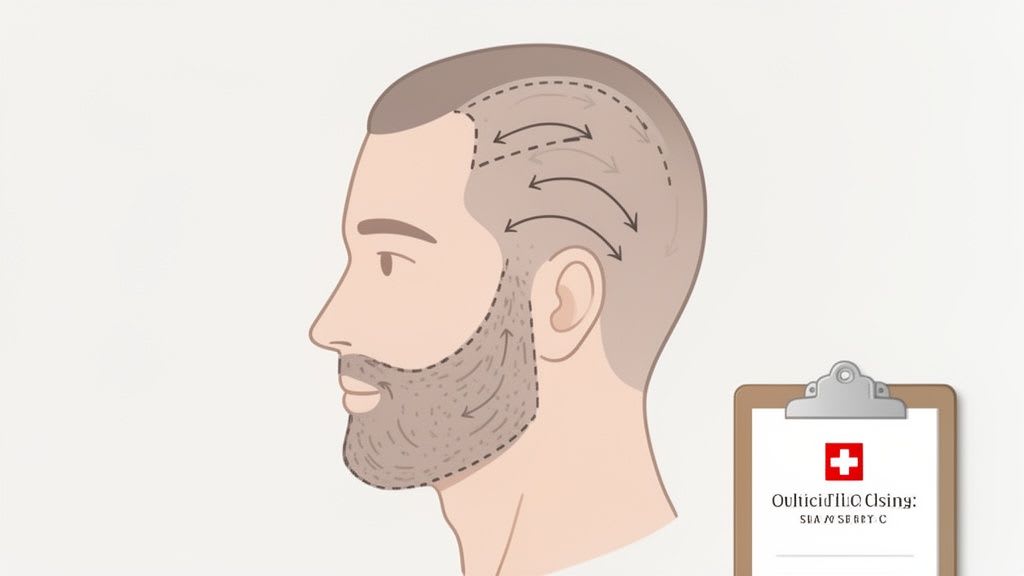
Before you scroll through "before and after" galleries, it is important to understand what a beard transplant actually is. It is less of a construction project and more of a form of artistic hair surgery performed by a specialist. The process involves the careful extraction of healthy hair follicles from a dense "donor area" – typically the back of the head – and their transplantation into the areas of the face that require more fullness.
The goal is not to create an unnaturally looking beard from scratch. Rather, it is about artistically enhancing the natural beard line or filling in gaps with the utmost precision. This requires a solid understanding of both facial anatomy and natural hair growth patterns.
Leading Techniques in Switzerland
In Switzerland, leading clinics focus on techniques that deliver the most natural and precise results. The two most established methods are Follicular Unit Extraction (FUE) and Direct Hair Implantation (DHI).
Follicular Unit Extraction (FUE): This is a proven and widely used method. The surgeon extracts individual hair follicles one by one from the donor area using a micro-punch instrument. These follicles are then carefully placed into tiny incisions in the beard area.
Direct Hair Implantation (DHI): DHI can be seen as an advancement of FUE. A special tool, the Choi Implanter Pen, is used, allowing the surgeon to extract and implant each follicle in a fluid motion. This provides maximum control over the depth, angle, and direction of each hair.
It is crucial to understand that the final "after" result does not occur overnight. It is a gradual process, and the impressive transformations are based on the high medical standards in Switzerland and, equally important, on the patience of the patient.
A Gradual and Natural Process
Unlike a hair transplant on the scalp, where density is the main goal, a beard transplant is about artistry. Each hair follicle must be placed at the perfect angle to mimic the natural whorls and growth direction of the existing beard. Only then can it be ensured that the new hair integrates seamlessly. Many of the same principles for a successful scalp hair transplant apply here as well and require the same expertise. Learn more about the similarities in our guide to hair transplantation before and after results.
This careful approach, for which Swiss specialists are known, creates the subtle yet effective enhancements you see in authentic beard hair transplant before and after photos. It is a path based on medical expertise aimed at giving you a beard that feels and looks entirely like your own.
The Path to Beard Transplantation: A Step-by-Step Overview
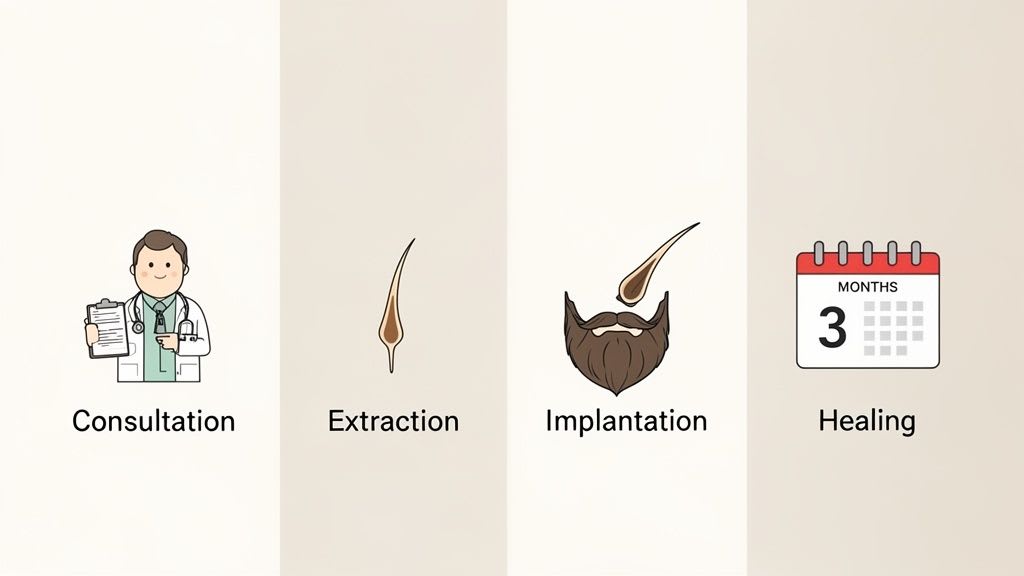
Knowing exactly what to expect on the day of the procedure can make a significant difference. It helps demystify the process, which is far less intimidating than it may sound. The entire process is designed for precision and your comfort, but it begins long before you enter the treatment room with a thorough consultation at a specialized Swiss clinic.
This initial conversation is crucial. Your doctor needs to assess the quality of your donor hair – typically from the back of the head – and, equally important, understand your desires. This is a partnership. Together, you will design a realistic beard that fits your facial features.
The Procedure Day in Detail
On the day of your transplant, the atmosphere in the clinic is calm, and the process is surprisingly straightforward. Everything follows a logical, step-by-step plan to ensure safety and achieve the best possible result.
Preparation: First, both the donor area (your scalp) and the recipient area (your face) are prepared. Local anesthesia is then administered to ensure that you feel no pain during the procedure.
Extraction: The specialist then begins to extract individual hair follicles from the donor area. This is done with extremely fine micro-instruments, one follicular unit at a time. It is a delicate task that requires a steady hand and much experience to keep each transplant healthy.
Implantation: This is where the true artistry comes into play. The extracted follicles are not simply placed in. Each one is carefully positioned in the beard area at a precise angle and in a specific direction to perfectly mimic natural hair growth.
Imagine it like a jeweler setting a gemstone. The success of a beard transplant hinges on this final, meticulous step. An experienced Swiss doctor acts like a sculptor, placing each hair to create a seamless, completely natural-looking pattern that harmonizes with your existing beard.
The Swiss Quality Standard
The entire procedure can take several hours, depending on how many transplants are needed, but the focus is always on careful, patient-centered care. Swiss clinics adhere to exceptionally strict hygiene and safety standards, allowing you to feel secure in a sterile, professional environment.
Ultimately, the goal is to demystify the transplantation and transform it into a clear, manageable process. From the initial design to the final placement of each hair, every step is carried out by highly qualified professionals. This commitment to detail is behind the impressive beard hair transplant before and after results seen from leading Swiss providers.
Your Before-After Timeline: From Procedure to Full Beard Growth
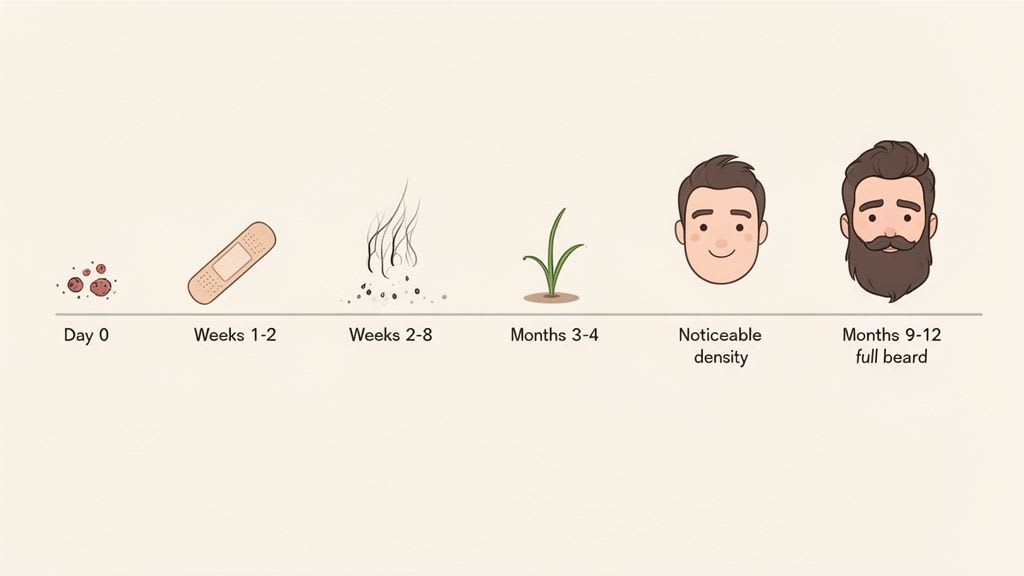
Everyone looks forward to seeing the end result in a beard hair transplant before and after gallery, but achieving a thick, natural-looking beard is a process. It does not happen overnight. Knowing the growth timeline is one of the most important steps in setting realistic expectations and feeling confident throughout the entire process.
Patience is your best friend here. The transformation occurs in clear phases, and each is a step closer to your goal. Knowing what to expect helps you avoid unnecessary worries and appreciate the gradual changes as they happen.
To illustrate your journey, we have compiled a clear timeline. It shows what you can expect month by month as your new beard takes shape.
Recovery and Growth Timeline After Beard Transplantation
| Timeframe | What to Expect | Important Recommendations |
|---|---|---|
| Day 1 - Week 2 | Redness, slight swelling, and tiny crusts around each new follicle. This is the initial healing phase. | Follow your aftercare plan closely. This means gentle cleansing and absolutely no rubbing or bumping. |
| Week 2 - Week 8 | The transplanted hairs begin to fall out. This is a normal, expected phase of "Shock Loss." | No panic! The follicles are safe and are just readjusting before producing new, permanent hair. |
| Month 3 - Month 6 | New, fine hairs begin to sprout. The growth may initially be patchy but will become significantly more visible. | Here you will see the first real progress. The hairs will thicken towards the end of the sixth month. |
| Month 9 - Month 12 | The hair matures, becomes thicker and stronger. The density continues to improve significantly. | Your final result will be visible. You can now style and care for your new beard just like any other hair. |
When you see the phases laid out so clearly, the process feels much more manageable. The key is to trust the process and give your body the time it needs.
The Immediate Phase After the Procedure (Day 1 to Week 2)
Immediately after your procedure at the Swiss clinic, the treated area will be slightly red and feel a bit swollen. You will also notice tiny crusts forming around each of the newly implanted hair follicles. All of this is completely normal – it is just your body’s initial healing response.
During these first two weeks, it is crucial to follow your surgeon's aftercare instructions closely. This typically involves very gentle cleansing and avoiding any rubbing or bumping that could disturb the delicate new transplants. By the end of this period, most redness and crusts should have disappeared.
The Rest and Shedding Phase (Week 2 to Week 8)
This next phase may surprise some people. At some point between Week two and Week eight, you will likely notice that the tiny transplanted hairs are falling out. While this can feel a bit unsettling, this shedding phase – often referred to as "Shock Loss" – is a completely normal and necessary part of the hair growth cycle.
Think of it this way: the follicles are simply readjusting at their new location before they begin to grow permanent hair. Shedding does not mean the transplant has failed; it is a sign that the follicles are setting themselves up for the long haul.
While this is happening on the surface, your skin continues to heal, and underneath, the follicles are preparing for the active growth phase that is just around the corner.
New Growth and Early Results (Month 3 to Month 6)
This is where it starts to get exciting. Around the third or fourth month, you will see the first signs of real progress as new, fine hairs begin to sprout from the transplanted follicles. Initially, the growth may look a bit sparse or patchy, but these new shoots are the foundation of your future beard.
By the end of the sixth month, the growth will be significantly more substantial. The hairs will be longer and start to thicken, leading to a noticeable improvement in density. This is often the point where you will see a clear difference from your "before" photos and get a fantastic preview of what is yet to come.
Maturation and Final Density (Month 9 to Month 12)
The final chapter of your beard hair transplant before and after story unfolds between nine and twelve months after the procedure. During this time, your new beard hairs continue to mature, becoming thicker, stronger, and taking on the natural texture of your existing beard.
Overall density will continue to improve as more and more follicles complete their growth cycles. By the one-year anniversary of your procedure, you can expect to see the full, final result. Your new beard is now a permanent part of you, ready to be styled, trimmed, and cared for just like any other hair.
How to Critically Assess Before-After Photos
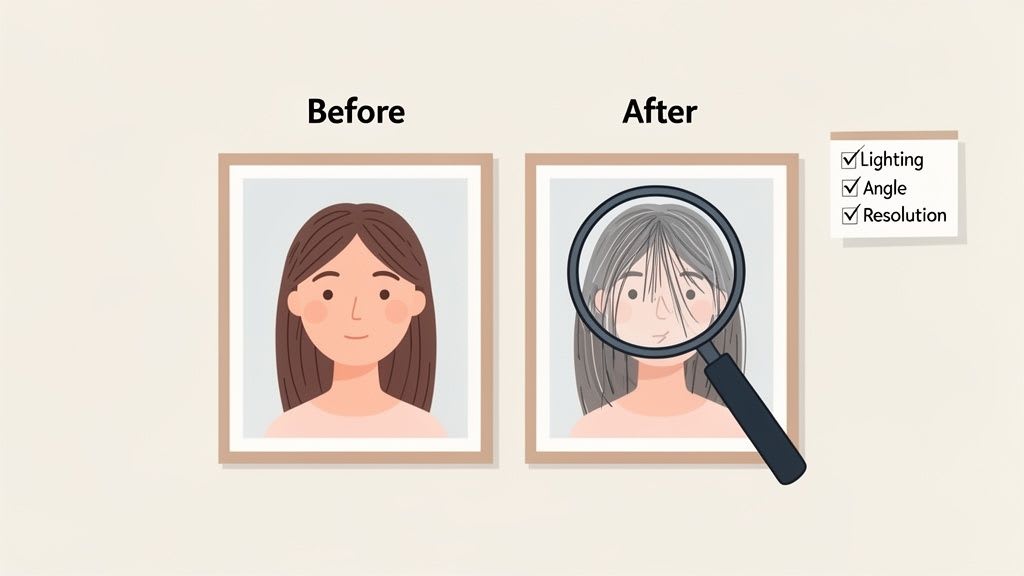
When looking at clinics, their gallery of beard hair transplant before and after photos is likely the first thing that catches your eye. And for good reason – they are meant to be proof of their work. But you need to know how to look at these images, as it is surprisingly easy to be misled by clever photography.
What you really want to do is look beyond the marketing. You want to assess the actual ability of the surgeon, both medically and artistically. This requires just a little practice and the knowledge of what to look for.
The Checklist for Authentic Results
The first clue to a professional clinic is the consistency of their photos. Good clinics take pride in their results and present them honestly, allowing you to make a fair comparison between the "before" and "after" shots.
Here’s what to look for:
Consistent Lighting: Is the lighting the same in both images? It’s a classic trick: harsh shadows in the "before" photo to make gaps look worse, and then soft, bright light in the "after" to make the new beard appear much denser.
Identical Camera Angle: The patient’s head should be in exactly the same position. Even a slight tilt of the chin can drastically change how full or well-shaped the beard appears.
Stable Posture and Expression: A neutral facial expression is crucial. If the patient is smiling in the "after" photo, the stretched skin can alter the appearance of beard density.
Think of it this way: you need to compare apples to apples. Any of these inconsistencies should raise suspicion, as they are common methods to manipulate the appearance of a result.
A trustworthy clinic takes pride in their work and has no need to hide details. They provide high-resolution images that allow you to zoom in and examine individual hairs, their texture, and growth direction.
What to Look for in High-Quality Photos
Once you have confirmed that the photos are consistent, it’s time to take a closer look at the details. This is where you can really see the difference between average work and true artistry.
Pay close attention to the natural hair growth direction. The implanted hairs should follow the natural growth patterns and whorls of a real beard. If they look like they have been planted in neat, even rows, that is a sign of an inexperienced practitioner. It takes an artistic eye to get this right.
Next, examine the hairline transition. Where the new hairs meet your skin or existing beard, the line should be soft and slightly irregular, just like a natural beard. A hard, sharp edge is a telltale sign of a transplant. Blurry or distant photos can easily hide this, so clear close-ups are a must.
Finally, a leading Swiss clinic will not just show one or two success stories. Their portfolio should be diverse, showcasing patients of different ages with varying beard goals and degrees of patchiness. This proves that their expertise is reliable and that they can deliver excellent, natural-looking results for everyone, not just the straightforward cases.
Are You a Suitable Candidate for a Beard Transplant?
Deciding to undergo a beard transplant is significant. A successful beard hair transplant before and after result begins with a simple question: Is this procedure suitable for you? Swiss doctors do not take a one-size-fits-all approach; they have clear criteria to ensure that a transplant is both a safe and effective choice for your specific situation.
First and foremost, it all depends on your donor area. This is the hair on the back and sides of your head that will serve as the "bank" for your new beard. A specialist must carefully assess whether you have enough dense, healthy hair that can be harvested without making your scalp noticeably thinner.
Key Factors for Suitability
In addition to a strong donor area, several other factors play a role during your initial consultation at a Swiss clinic. It’s about painting a realistic picture of what is possible.
Sufficient Donor Hair: This is the non-negotiable starting point. Without a healthy supply of follicles that can be transplanted, a transplant is not an option.
Age and Beard Maturity: Your beard can continue to develop and thicken into your late twenties. For this reason, reputable Swiss doctors often advise younger men to wait until their natural beard pattern has stabilized before making a decision.
Good Overall Health: You need to be in good health to ensure a smooth procedure and a quick, uncomplicated recovery.
Realistic Expectations: This is crucial. A good candidate understands that the final, dense result does not occur overnight. It is a gradual process that can take up to a year to be fully completed.
Consider your consultation with a qualified specialist in Switzerland as a medical assessment, not a sales pitch. The goal is to determine whether the procedure can truly meet your goals, with your long-term health and satisfaction as the top priority.
Understanding the Risks
While beard transplantation is a very safe procedure with high success rates, it is still a medical treatment. Like any procedure, there are potential risks such as infections, scarring, or an unnatural appearance if not performed by an experienced doctor.
Here, the exceptionally high medical standards of Switzerland make a real difference. By choosing a doctor with an FMH specialist title (Swiss Medical Association) in dermatology or plastic surgery, you are placing yourself in the hands of a true expert. These specialists have undergone rigorous training, which drastically minimizes the risks. Their focus is always on achieving a safe, aesthetically pleasing result that looks completely natural.
Finding a Qualified Clinic for Beard Transplantation in Switzerland
Choosing the right clinic and surgeon is arguably the most important decision you will make. A fantastic beard hair transplant before and after result depends not only on the procedure itself but on the skill and artistic ability of the person performing it. Let’s go through how to find a true professional in Switzerland.
Your search should begin with a non-negotiable qualification: the FMH title (Swiss Medical Association). Look for a specialist in dermatology or plastic, reconstructive, and aesthetic surgery. This is not just a fancy certificate; it is proof of years of dedicated and rigorous training in Switzerland. That is the absolute minimum requirement.
Verifying Qualifications and Finding Clinics
So where to start? Verified directories like BeautyGuide.ch are a good starting point, offering curated lists of clinics in cities like Zurich, Geneva, and Basel.
But don’t stop there. Consider it your due diligence. Take the names of the doctors you are interested in and check them in the official MedReg register. This government register is your ultimate tool for confirming a doctor’s qualifications and specialization, giving you complete confidence in their competence.
It is wise to book consultations at two or three different clinics. This is not about finding the lowest price but about finding the right fit. You can compare professional opinions, see the clinics firsthand, and most importantly, find a doctor whose approach gives you confidence.
Important Questions for Your Consultation
When you sit down with a potential surgeon, you need to be prepared. This is your chance to question them. Sharp, specific questions are crucial to assess their expertise.
Here are some questions you should ask:
How many beard transplants do you personally perform each year?
Which technique, FUE or DHI, would you recommend based on my facial structure and hair type, and why?
Can you show me a portfolio of your own work, particularly from patients with similar goals to mine?
What does the aftercare process look like here? Who can I contact with questions?
These questions cut through the marketing and get straight to the heart of what matters: experience and results. These conscious steps ensure that you can confidently choose a top-tier Swiss provider who will give you the beard you desire.
In your search, our list of top clinics for beard transplantation in Zurich can be an excellent resource for finding qualified specialists.
Your Questions About Beard Transplantation in Switzerland, Answered
Even after the basics are covered, you probably still have some practical questions. Let’s address some of the most common inquiries from patients considering a beard transplant.
Is the procedure painful?
This is one of the biggest concerns, and the good news is: The procedure itself is not painful. Thanks to local anesthesia, you will feel neither the extraction nor the implantation. Most people describe the sensation as light pressure or movement, but there is no real pain.
Any discomfort afterward is usually quite mild and can be well managed with the pain medications provided by your clinic.
When can I shave after the transplant?
Patience is key here. You need to be extremely careful with your newly placed transplants as they grow in. Most specialists in Switzerland recommend waiting at least 10 to 14 days before even thinking about trimming the area, and even then, only very cautiously with scissors.
For proper shaving with an electric razor or a wet blade, you will need to wait several weeks – often a full month. This gives the follicles the best chance to take root without being accidentally pulled out.
Are the results permanent?
Yes, the results are absolutely permanent. This is one of the biggest advantages of a hair transplant. The follicles are taken from a donor area of your scalp that is genetically programmed to be resistant to hair loss.
Once these resilient follicles are transplanted into your beard area and establish a new blood supply, they will remain for a lifetime.
The success of your beard hair transplant before and after journey truly depends on choosing a top-notch specialist and closely following their aftercare instructions. It is an investment in a result that lasts a lifetime.
To gain a better understanding of how clinics price this procedure, read our detailed guide on hair transplant costs in Switzerland, which breaks down all contributing factors.
Explore More
This article is for informational purposes only and does not replace professional medical advice.