
When you search for "brust op heilungsverlauf bilder" (breast surgery healing process pictures), what you are really seeking is reassurance. You want a visual roadmap to confirm that your recovery is proceeding as it should. This healing journey, from the first day after your operation to the final, settled result, follows a predictable pattern. Understanding these stages is key to a confident recovery, supported by the high standards of medical aftercare provided by specialist surgeons in Switzerland.
Your Visual Roadmap to Breast Surgery Healing
The recovery after breast surgery can seem mysterious, but your body's healing process is a logical and predictable journey. Think of it as a clear roadmap, guiding you from the moment you leave the operating theatre to your final outcome. Whether you have undergone breast augmentation, a lift, or reconstruction, your body will move through a series of distinct stages.
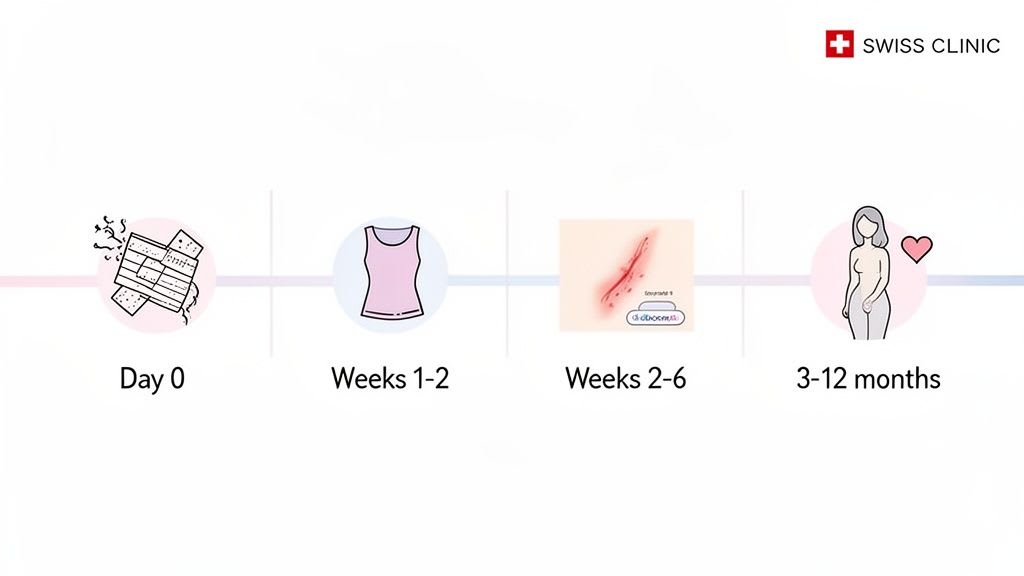
Having this timeline in mind helps demystify what you will see and feel along the way. It prepares you for the initial swelling and bruising, the subsequent weeks of careful movement, and the months required for scars to mature and tissues to settle completely.
To provide a clearer picture, the following table breaks down typical milestones. It serves as a quick reference for what you can generally expect to see and feel as you heal.
Typical Breast Surgery Healing Stages At a Glance
| Timeframe | What You Might See (Bilder/Photos) | Common Physical Sensations | Activity Level |
|---|---|---|---|
| Week 1 | Significant swelling, bruising, surgical dressings. Breasts will appear "high" and feel tight. | Soreness, tightness, discomfort (managed with medication). Feeling tired is normal. | Strictly rest. No lifting, driving, or strenuous activity. Short, slow walks are encouraged. |
| Weeks 2–3 | Swelling and bruising begin to subside. Incisions appear as red or purple lines. | Itching around incisions is common as they heal. Less general soreness, more localised sensitivity. | Light desk work may be possible. No lifting over 2-3 kg. Driving may resume if off pain medication. |
| Weeks 4–6 | Breasts begin to soften and settle. Swelling is noticeably reduced but may still be present. | Random "zings" or sharp pains are normal as nerves reconnect. Sensation may start to return. | Can begin to introduce lower body exercise. Avoid upper body workouts and high-impact activities. |
| Months 3–6 | The shape continues to refine. Scars start to fade from red/purple to pink. Implants "drop" into place. | Most discomfort is gone. Breasts feel much softer and more natural. | Gradual return to all normal exercise, including upper body, as cleared by your surgeon. |
| Months 6–12 | Final shape and position are achieved. Scars have faded significantly, often to fine, pale lines. | Numbness has mostly resolved. Tissues are fully settled and soft. | No restrictions. Full activity and exercise are typically permitted. |
Remember, this is a general guide. Your personal recovery will depend on the specifics of your surgery and your body's unique healing response. Always follow the specific advice from your surgeon.
The Key Phases of Recovery
While everyone heals at their own pace, the journey can be broken down into key milestones. Knowing what is normal at each stage provides peace of mind. Swiss clinics are known for their rigorous medical protocols and provide detailed aftercare instructions tailored to these phases.
Here’s a closer look at what to expect:
The Acute Phase (First 2 Weeks): This is when your body requires the most rest. You will experience significant swelling, bruising, and discomfort, which is why activity is highly restricted. Wearing your post-operative compression garment faithfully is absolutely essential during this time.
The Early Recovery Phase (Weeks 3-6): You will notice a significant reduction in swelling and soreness. As your incisions heal and become early-stage scars, you can slowly and carefully reintroduce light activities.
The Maturation Phase (Months 2-6): The healing process becomes more refined. Swelling continues to decrease, and the final shape of your breasts emerges. Scars begin to fade and flatten. Many people start to feel much more like themselves again during this period.
The Final Settling Phase (6-12 Months): This is when long-term results become apparent. Implants settle into their final, more natural position—a process often called "dropping and fluffing"—and autologous tissue softens. Your scars will continue to mature, becoming much less noticeable.
A crucial piece of advice for every patient is that the Heilungsverlauf, or healing process, is a marathon, not a sprint. Patience is an essential tool, combined with the expert aftercare provided by a qualified surgeon in Switzerland. They will monitor your progress to ensure you are healing as expected.
The First Two Weeks After Your Surgery
The first 14 days after your breast surgery are the most critical part of your initial healing. Your body is working hard during this primary recovery phase, and your main responsibility is to rest and follow your surgeon's instructions precisely. Knowing what is normal—from the appearance of incisions to the sensations you'll feel—can significantly reduce anxiety.
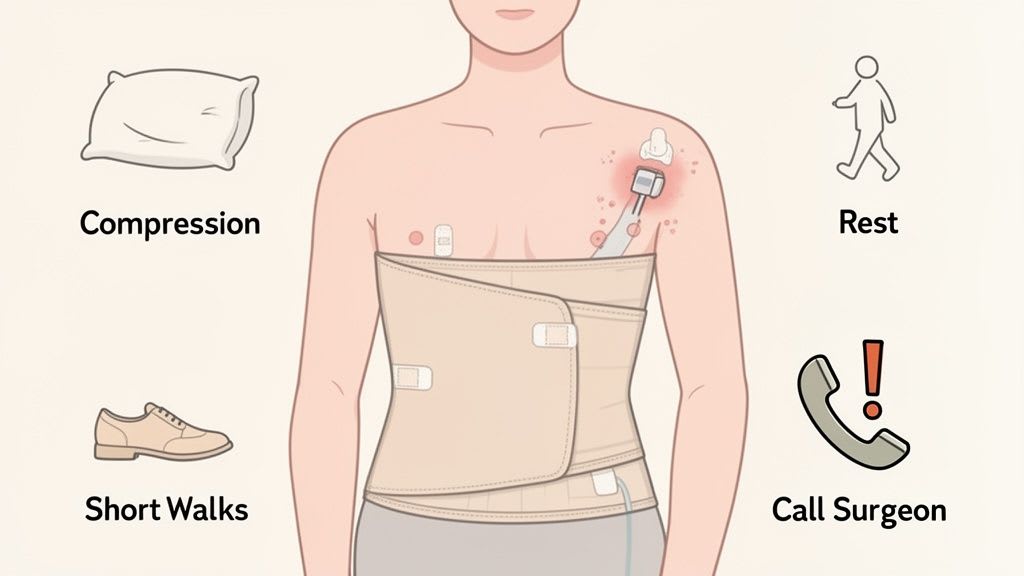
This period is defined by three elements: careful discomfort management, diligent aftercare, and strict activity limitations.
What to Expect Visually in the First Week
If you are not prepared, the first few days can be visually surprising. It is often at this stage that people search for "brust op heilungsverlauf bilder" (breast surgery healing process pictures) to determine if what they are seeing is normal. Right after your operation, your breasts will likely appear high on your chest, feel very firm, and be significantly swollen. This is completely normal and expected.
Bruising is also very common, ranging from minor discolouration to deep purples and blues. Do not be surprised if these bruises appear to migrate down your torso; this is a result of gravity. Your incisions will be covered with sterile dressings or surgical tape, appearing as clean red or purplish lines. Some surgeons also place small surgical drains near the incision to prevent fluid accumulation; these are usually removed within the first week.
The most important thing to remember is that swelling and bruising are normal and expected. They tend to peak around day 3 or 4 before they start to slowly subside. The initial "operated on" appearance is temporary and a necessary part of the healing journey.
Managing Discomfort and Wearing Your Compression Garment
Soreness, tightness, and general discomfort are typically at their most intense for the first 3-5 days. Your FMH-certified surgeon in Switzerland will create a personalised pain management plan to keep you comfortable. It is vital to take your prescribed medication on schedule to stay ahead of the pain.
Your post-operative compression garment is essential. You will be instructed to wear it 24 hours a day, removing it only for very brief periods if your surgeon permits.
This special garment is non-negotiable for several key reasons:
Controls Swelling: It provides constant, even pressure to minimise fluid buildup (oedema).
Supports Tissues: It holds your breasts—and implants, if applicable—securely, reducing strain on your healing incisions.
Reduces Bruising: The pressure helps to limit bleeding into the surrounding tissue.
Improves Comfort: By keeping everything stable, it reduces pain associated with movement.
Activity Restrictions and Self-Care
Your surgeon will provide a strict list of dos and don'ts regarding your activity level. Following these rules is essential for achieving a good result and avoiding complications. For these first two weeks, your focus should be on rest and very light movement.
What You Must Do:
Sleep on your back with your upper body propped up at a 30-45 degree angle. This position is effective for helping reduce swelling.
Take short, gentle walks around your house every few hours to promote good circulation and help prevent blood clots.
Stay well-hydrated and focus on a healthy, protein-rich diet to provide your body with the fuel it needs to heal.
What You Must Avoid:
No Lifting: Do not lift anything heavier than approximately 2-3 kilograms. This includes groceries, laundry baskets, and small children or pets.
No Reaching: Avoid reaching your arms above your head. This action stretches your chest muscles and puts tension on your incision lines.
No Driving: You cannot drive while taking prescription pain medication, as it can impair your reflexes.
No Strenuous Activity: All forms of exercise, heavy housework, and physically demanding tasks are off-limits.
Normal Healing Signs vs Warning Signs
Knowing the difference between a normal healing sensation and a potential problem is key to your peace of mind.
Perfectly Normal Signs:
Itching around the incisions as the skin heals.
Patches of numbness or, conversely, hypersensitivity in the breasts or nipples.
Random, sharp, shooting pains that last only a second (often called "zings"). This is a positive sign that nerves are regenerating.
Slight asymmetry, where one breast seems more swollen or sits higher than the other for a time.
However, you must call your Swiss clinic or surgeon immediately if you notice any of the following, as they could indicate an infection or a hematoma (a collection of blood under the skin).
Red Flags Requiring an Immediate Call:
A fever higher than 38°C.
Pain that is sudden, severe, or worsens dramatically, especially if confined to one breast.
Excessive swelling on one side that makes one breast look significantly larger than the other.
Spreading redness, a feeling of intense warmth, or any pus-like fluid from an incision.
Shortness of breath or new chest pain.
These first two weeks set the foundation for your entire Brust OP Heilungsverlauf. By listening to your body, following your aftercare plan, and being an observant partner in your recovery, you can navigate this phase safely.
Navigating Weeks Two to Six of Your Recovery
This next chapter in your recovery, from the second to the sixth week, is often when you begin to feel much more like yourself. The initial discomfort subsides, and you will likely see real, day-to-day progress, which can replace post-op anxiety with confidence in your body's healing ability.
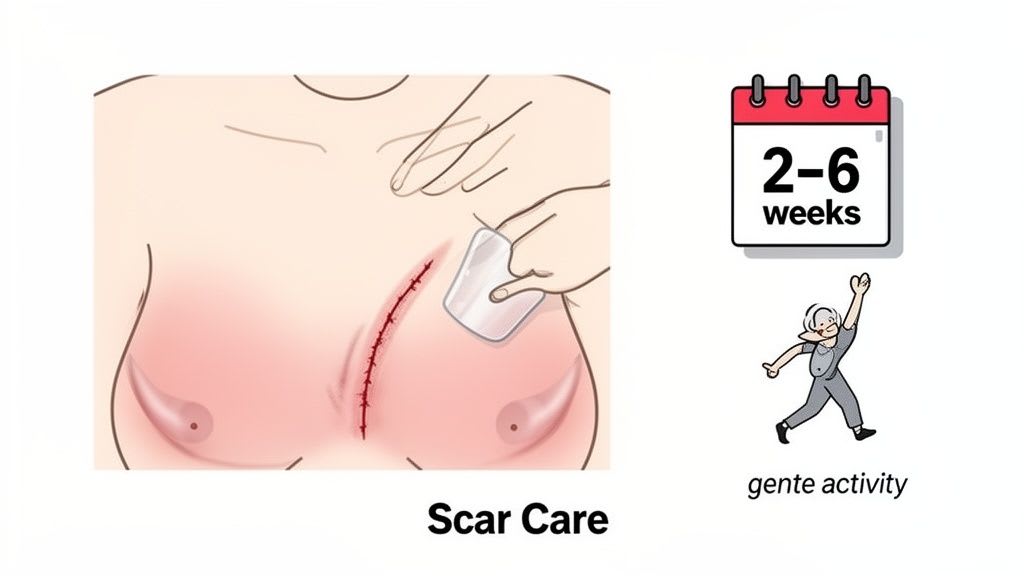
During these weeks, swelling will noticeably decrease, and your focus will shift to caring for your scars and carefully resuming your daily life. Adhering closely to the advice from your Swiss clinic during this period is key to a smooth recovery and achieving the desired outcome.
How Your Scars Will Change
Once your surgeon removes any surgical tape—usually around the two-week mark—your scars enter the next stage of healing. This is a long process, sometimes taking a year or more, but the most significant changes occur at the beginning. If you have searched for "brust op heilungsverlauf bilder," you have probably seen many images from this timeframe.
Initially, the incisions will look like raised lines, often red or purplish. This is normal and indicates your body is healing. Over the next few weeks, as new collagen forms, you will see them transform:
Colour: The intense red or purple will soften to a much lighter pink.
Texture: The initial puffiness will begin to settle, and the scar will flatten.
Sensation: Itching is very common around healing incisions and is a positive sign of nerve and tissue regeneration.
Expert Tip on Scar Care: This is an ideal time to discuss a scar management plan with your surgeon. Most FMH-certified plastic surgeons in Switzerland have preferred, evidence-based treatments they can recommend to help minimise the final appearance of your scars.
Swiss-Approved Scar Management Techniques
Your surgeon's specific instructions are paramount, but once your incisions are fully sealed, the advice is often consistent. Common recommendations include:
Silicone Gels or Sheets: These are a cornerstone of modern scar therapy. They create a hydrated, protected environment for the healing skin, which helps flatten scars and reduce redness.
Gentle Massage: After receiving clearance from your surgeon, gently massaging your scars with a simple, neutral moisturiser can help break down firmness in the scar tissue, making it softer and more pliable.
Sun Protection: This is critical. New scars are highly sensitive to sunlight. UV exposure can cause permanent darkening (post-inflammatory hyperpigmentation). For at least the first year, you must be diligent about applying a high-SPF sunscreen (SPF 50+) to your scars whenever they might be exposed to the sun.
Following a consistent scar care routine, as advised by your medical team in Zurich or Geneva, will have a significant impact on how your scars look one year later.
Watching Swelling Go Down and Feeling Return
While some swelling will persist, you should see it steadily decrease. The majority of the puffiness resolves in the first six weeks, but do not be surprised if subtle, residual swelling remains for a few months. Your compression garment is still important, though your surgeon may adjust how many hours a day you need to wear it.
This is also when nerves start to regenerate, which can lead to some unusual but positive sensations. Many patients describe feeling:
Tingling or a "pins and needles" sensation.
Quick, sharp "zings" that vanish in a second.
Sensation slowly returning to the skin and nipples. Some numb patches might linger, which is completely normal.
All of these are positive signs that your nerves are repairing themselves.
Safely Getting Back to Activity and Exercise
Patience is still necessary, but you can begin to expand your activities. Your follow-up appointments, a standard part of all Swiss aftercare protocols, are where you will receive personalised advice and clearance for what comes next.
Generally, between weeks two and six, most people can:
Return to a desk job or other work that is not physically demanding.
Start taking longer, more frequent walks.
Introduce lower-body exercises like a stationary bike or leg workouts, as long as you are not tensing your chest or upper body.
It is absolutely crucial that you continue to avoid any heavy lifting (anything over 3–5 kg), high-impact cardio, or any targeted upper-body workouts until your surgeon explicitly permits it. Doing too much too soon can put stress on your incisions and compromise your final result. This phase is about a gentle and controlled return to your normal routine, with your medical team guiding you.
The Long Haul: Settling In from Three Months to One Year
This is the refinement stage. While the first few weeks are about active healing, the period from three months to a full year is about the final transformation, where your post-op results slowly settle into their final form.
The most dramatic changes are behind you, but this longer phase is about subtle details: the final softening of tissues, the settling of implants, and the fading of scars.
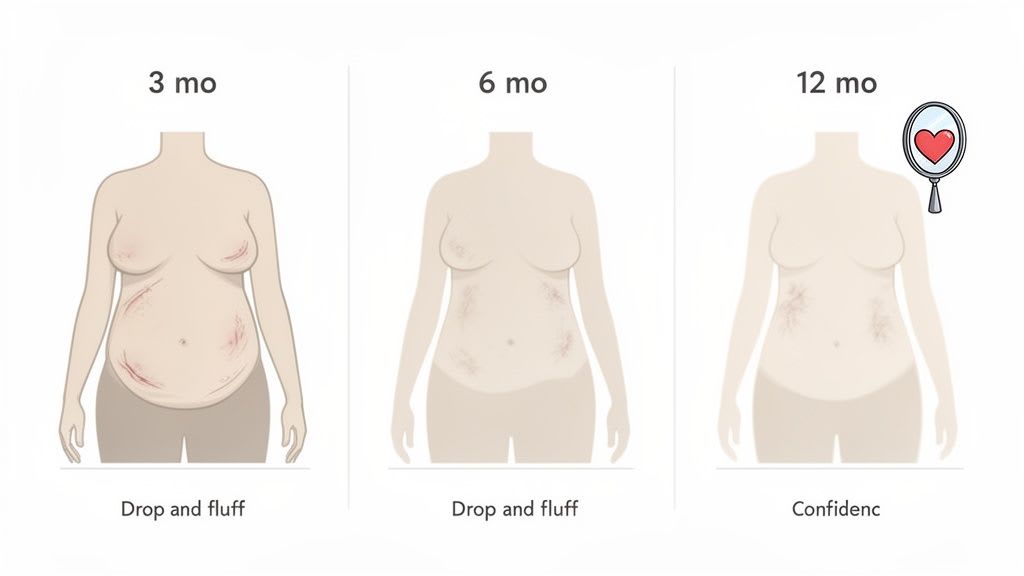
It is during these months that your patience is rewarded. The small shifts in shape, position, and feel are what create the natural-looking outcome you and your surgeon planned for. Understanding what to expect during this part of your brust op heilungsverlauf is key to appreciating the journey.
Hitting the Three-Month Milestone
By the three-month mark, you will feel a significant difference. The vast majority of the swelling is gone, and your breasts will feel much softer and more integrated with your body. Your surgeon has likely cleared you to return to all usual activities, including more strenuous workouts.
Visually, the shape is now very close to the final result. For those with implants, this is when the "drop and fluff" process becomes obvious.
Understanding the "Drop and Fluff"
Surgeons and patients often use the term "drop and fluff" to describe how breast implants settle into place, a critical part of achieving a natural look.
The "Drop": Immediately after surgery, implants tend to sit high on the chest because the pectoral muscle is tight. Over the following weeks and months, this muscle gradually relaxes and stretches, allowing the implant to gently descend—or "drop"—into a more natural position in the lower part of the breast.
The "Fluff": As the implant drops, the breast tissue, especially at the bottom of the breast, starts to expand and round out. This gives the breast a softer, fuller, teardrop shape, moving away from the firm, high-and-tight appearance of the first few weeks. Essentially, the skin is stretching and adapting to the implant’s new position.
This entire process is gradual and can take up to six months or longer, depending on the individual. It illustrates why early post-op photos are just a snapshot in time, not the final destination. If you have had an autologous reconstruction (using your own body tissue), you will experience a similar settling-in period as the transferred tissue softens and finds its final shape.
By the six-month mark, about 80-90% of the "drop and fluff" is complete. Your breasts will look and feel much more natural, giving you a very clear picture of your final size and shape.
Advanced Scar Care: The Six- to Twelve-Month Push
By six months, your scars will have changed dramatically. They should be much flatter and have faded from a bright pink or red to a lighter shade. However, the healing is not finished. The full maturation process can take up to 18 months.
Consistency is key now. Sticking to a good scar care routine will help them fade to be as faint as possible.
Your Long-Term Scar Strategy:
Stay Out of the Sun: This is the single most important action you can take. UV rays can permanently darken a new scar. For at least one full year after surgery, you must protect your scars with SPF 50+ sunscreen or keep them covered with clothing or tape.
Keep Massaging: Continue to gently massage your scars daily with a neutral moisturising cream or oil. This keeps the scar tissue soft and pliable, which can significantly improve its final colour and texture.
Be Patient: Scar healing is a slow biological process. It is tempting to compare your progress to online photos, but genetics, skin type, and surgical technique all affect the outcome. Trust the process and the advice from your Swiss medical team.
The One-Year Anniversary: Your Final Result
Most surgeons consider the one-year mark as the point of "final results." By now, any lingering swelling has disappeared, your implants or tissues have fully settled, and your scars have completed most of their fading.
This is also a significant psychological milestone. It often takes a full year to become accustomed to your new body. Your final follow-up with your surgeon in Switzerland is the perfect time to review your before-and-after photos, appreciate the outcome, and officially conclude your surgical journey. It demonstrates that a successful result is a partnership between a skilled surgeon, your body’s ability to heal, and your own patience.
Understanding Complications from a Swiss Safety Perspective
While a smooth recovery is the most common outcome, it is wise to be informed about potential complications. Understanding the difference between normal healing and a potential issue is empowering. In Switzerland, clinics operate under exceptionally high standards, and your surgeon will discuss all potential risks with you. This transparent communication is fundamental to excellent medical care.
Common vs. Serious Complications
It is helpful to categorise potential issues into two groups: those that are more common and easily managed, and those that are rare but require immediate attention.
Infection: While incisions may be slightly pink, look for spreading redness, skin that feels unusually hot, pus-like discharge, or a fever over 38°C. Swiss clinics are meticulous about sterility, and a short course of antibiotics is often prescribed as a precaution, making this risk very low.
Haematoma: This is a collection of blood under the skin. The key sign is usually a sudden, noticeable swelling and pain, often on one side. Small haematomas may resolve on their own, but a larger one might need to be drained.
Seroma: This is a collection of clear body fluid that feels like a soft, localised swelling. Like a haematoma, it may need to be drained by your surgeon.
Capsular Contracture: This complication is specific to breast implants. The body naturally forms a scar tissue capsule around any implant. Sometimes, this capsule can tighten, making the breast feel firm or hard and occasionally causing a change in shape or discomfort. Modern implants and advanced surgical techniques have significantly lowered this risk.
The Importance of Surgeon Experience
The surgeon you choose and their technique directly impact your healing and potential for complications. More complex procedures carry different risk profiles. A retrospective study from the University Hospital of Basel (2011-2018) highlights this point. It found that patients who had nipple-sparing mastectomies experienced delayed wound healing at a much higher rate (32.7%) compared to those who had conventional mastectomies (5.8%).
This data shows why it is so important to choose a surgeon with extensive experience in the specific procedure you are having. A specialist who has performed your surgery hundreds of times knows how to handle delicate tissues to promote optimal healing. You can learn more about how Swiss medical standards are designed to protect patients in our detailed guide.
Your ability to recognise when something deviates from your expected Heilungsverlauf (healing process) is your greatest asset. Do not hesitate to contact your clinic. Any good surgeon would prefer you call with what turns out to be a minor concern than have you wait at home with a genuine issue.
Ultimately, while looking at "brust op heilungsverlauf bilder" can provide a general idea, understanding potential issues gives you a deeper sense of control. It means you can act quickly and confidently, supported by the Swiss medical system.
Finding Qualified Swiss Surgeons and Trustworthy Photos
When you search for "brust op heilungsverlauf bilder," you are seeking a preview of your own future. While the internet offers countless images, many are selectively chosen to show only the most ideal results and rarely depict the complete healing journey.
Sourcing Reliable Information
The most trustworthy before-and-after photos are found in the confidential setting of a surgeon's office. A board-certified surgeon in a city like Zurich, Geneva, or Basel will show you a realistic portfolio of patients with different body types, providing a genuine sense of their work. This is how you get a true picture of what is achievable for you.
The goal is not to find a perfect "after" photo online that matches your ideal. It is to find a surgeon who can show you realistic results for individuals with a similar anatomy, and then build your expectations from that honest starting point.
The Importance of a Verified Swiss Specialist
Choosing a local, verified surgeon is a critical decision for your health. A revealing study from the University Hospital Zurich found that 16% of their revision surgeries were needed to correct complications from procedures performed outside of Switzerland, with infections and poor healing being the main issues. You can read the study abstract yourself on PubMed.
This is precisely why platforms like BeautyGuide.ch exist. We simplify your search by verifying every surgeon against the official Swiss MedReg register and ensuring they hold specialist qualifications from the FMH (Swiss Medical Association). This connects you with professionals bound by Switzerland’s high medical and ethical standards, which positively impacts your heilungsverlauf.
When your surgeon is local, you have a built-in support system. Follow-up appointments are convenient, and if any concerns arise during your recovery, help is nearby. This continuity of care is just as important as the surgery itself.
For a complete picture, you might also be interested in our guide on what to expect from breast surgery costs in Switzerland.
Your Breast Surgery Recovery Questions Answered
Even with a detailed recovery plan, questions are bound to arise. Here are answers to some of the most common concerns to help you feel confident throughout your healing process.
When Can I See the Final Results of My Breast Surgery?
While you will see a major difference immediately after surgery, the final, settled result typically becomes apparent at around 6 to 12 months post-op. It takes this long for all residual swelling to resolve and for tissues or implants to fully "drop and fluff" into their final, soft position. Your scars follow a similar timeline, continuing to fade and mature for a year or more.
How Can I Minimise Scarring After My Operation?
Effective scar care begins with following your surgeon's instructions for keeping incisions clean and dry. Once the wounds have fully healed and your surgeon gives you clearance, you can take a more proactive role.
Silicone Products: Silicone-based gels and sheets are a standard recommendation. They keep the scar tissue hydrated, which helps it soften, flatten, and become less red over time.
* Sun Protection: This is non-negotiable. You must protect new scars from the sun for at least the first year. UV exposure can cause them to darken permanently. Using a high-factor SPF 50+ sunscreen is an essential habit.
Always consult your FMH-specialist in Switzerland before starting any scar treatments. They will advise you on the appropriate timing and products for your specific situation.
What Red Flags Should I Watch for During Recovery?
Knowing the difference between normal healing signs and potential problems is crucial. You should contact your clinic immediately if you notice any signs that might indicate a complication.
Key Warning Signs:
Be alert for a fever over 38°C, redness or heat that spreads from the incision, or any pus-like discharge. Other urgent signs include sudden, severe pain that is not relieved by medication, or if one breast suddenly becomes much larger or harder than the other, which could signal a hematoma.
Is It Normal for Breasts to Look and Feel Different from Each Other?
Yes, this is very common and a frequent concern for patients reviewing their "brust op heilungsverlauf bilder" (breast surgery healing progress photos). It is completely normal for your breasts to heal at slightly different rates.
In the first few weeks, it is typical for one side to appear more swollen, sit higher, or feel firmer than the other. This asymmetry is almost always temporary and will resolve as swelling subsides and tissues settle over the coming months. However, if you notice a sudden, dramatic change, it is always best to have it checked by your surgeon.
For those seeking high-quality care, you can browse our curated list of specialists for breast augmentation in Zurich and other Swiss cities.
This article is for informational purposes only and does not replace professional medical advice.