
Choosing a chirurgien esthétique lausanne often starts the same way. You search a few names, open several clinic pages, and quickly realise that most websites are designed to present treatments, not to help you compare qualifications. The result is confusion at the exact moment when you need clarity.
In Switzerland, credentials matter because the system is structured around recognised specialist titles, hospital privileges, and registries that patients can verify. Lausanne is not a minor outpost in that system. The history of plastic, reconstructive, and aesthetic surgery at CHUV shows why the city carries weight. In 1946, Professor Claude Verdan founded the Permanence et Clinique chirurgicale et permanence de Longeraie. In 1980, the Service de chirurgie plastique et reconstructive was officially established at CHUV under Professor Serge Krupp, creating Switzerland’s first academic chair in the specialty and integrating the Burns Center, according to the CHUV history of the service. That institutional depth still shapes how surgeons are trained and how patients assess credibility in Vaud.
This guide is built for comparison, not promotion. It focuses on surgeons and clinics in Lausanne that present identifiable qualifications, clear scope of practice, and verifiable positioning inside the Swiss medical framework. Some are private boutique practices. Others are embedded in larger hospital infrastructure. That distinction affects more than brand image. It influences operating environment, continuity of care, and how easily a patient can confirm a surgeon’s standing.
The practical question is not just who appears polished online. It is who gives you enough verifiable information to assess fit, safety, and expertise before you book a consultation. If you are also following broader aesthetic trends, the Swiss filter remains the same. Local credentials, local infrastructure, and local accountability come first.
1. Dr Sophie Nordback
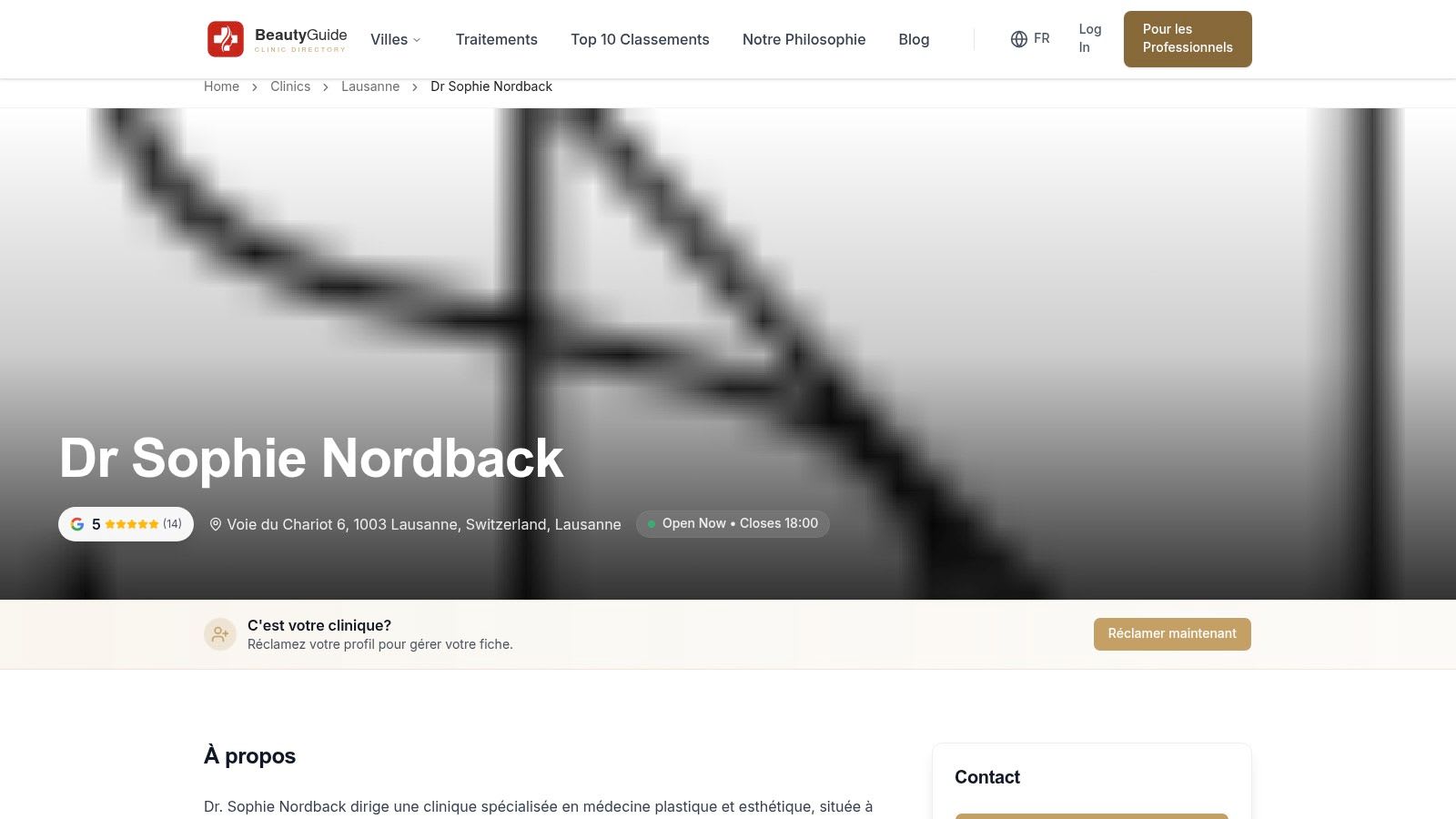
Website: beautyguide.ch/fr/clinic/dr-sophie-nordback
Dr Sophie Nordback stands out because the profile format is built around patient verification needs rather than pure branding. For someone searching “chirurgien esthétique lausanne”, that changes the experience immediately. Instead of starting with lifestyle imagery or broad promises, you begin with a structured directory entry that highlights professional scope, location in Lausanne, language information, and the fact that BeautyGuide verifies medical credentials through MedReg checks.
Why this profile is especially useful
The main strength here is not only that Dr Nordback is presented as a board-certified plastic and aesthetic surgeon. It is that the listing helps a patient compare surgical and non-surgical care in one place. That matters because many consultations are not binary. A patient may initially ask about a facelift, lip enhancement, fillers, or laser treatment without knowing which category is most appropriate. A surgeon who works across both surgical and less invasive options can assess escalation more neutrally than a clinic that only offers one pathway.
This profile also reduces a common Swiss patient problem. Many clinic pages tell you what can be treated, but not how to frame the practitioner’s role inside the Swiss system. BeautyGuide’s directory model is useful because it translates credentials into a more readable patient-facing format while still keeping the emphasis on verification. For readers who want a broader primer on how specialist standards work locally, BeautyGuide’s overview of Swiss plastic surgery adds helpful context.
Practical takeaway: a directory profile is most valuable when it shortens your verification work, not when it replaces it. Use it to identify the right consultation, then confirm details directly with the clinic.
How to read this listing analytically
Dr Nordback’s profile suggests a clinician suitable for patients who want integrated planning across face and body treatments. That does not mean every procedure is equally specialised. It means the breadth of services can support a more complete consultation, especially for patients deciding between staged treatment, maintenance work, or surgery.
A strong point is transparency at the directory level:
- Verified presentation: BeautyGuide’s model centres on credential checks through MedReg, which is more meaningful than anonymous review aggregation alone.
- Mixed treatment scope: The profile highlights both surgery and non-surgical treatments, useful for patients who want one specialist to assess several options.
- Lausanne relevance: Clear local information supports comparison for residents, expats, and patients seeking English-friendly discovery tools.
The limitations are equally important:
- Summary format: A directory profile cannot replace a procedure-specific consultation. You will still need detail on candidacy, incision planning, anaesthesia, recovery, and aftercare.
- Pricing transparency remains limited: The listing functions as a decision aid and contact point, not as an itemised quotation system.
- Availability questions remain clinic-dependent: Patients may need to contact the practice directly to understand consultation timing and operating schedules.
Who may find Dr Nordback a strong fit
This profile is particularly useful for people at the shortlist stage. If you already know you want a highly specific operation and need technical detail immediately, you will still need a direct consultation. But if you are comparing qualified Lausanne specialists and want an independently screened starting point, this is one of the clearest entries in the market.
The deeper insight is this. In a city where many clinics market treatments similarly, a key differentiator early in the journey is not branding. It is how efficiently a patient can move from interest to verified trust. Dr Nordback’s BeautyGuide profile does that well.
2. Centre de Chirurgie Plastique Lausanne
Website: swissaesthetic.ch
At Centre de Chirurgie Plastique Lausanne, the core differentiator is institutional integration. Dr Jean‑François Emeri leads a long-established private plastic surgery centre that operates within Clinique Cecil’s facilities. For patients, that signals a different model from the boutique single-room aesthetic clinic. The comparison point is not luxury versus simplicity. It is private specialist care combined with hospital-grade infrastructure.
What matters in this setup
A centre embedded in a larger clinical environment can make a practical difference before and after surgery. Pre-operative workup, access to operating facilities, and inpatient support are easier to picture when the practice is linked to an established hospital platform. That is particularly relevant for patients considering breast, face, or body surgery rather than small office-based aesthetic procedures.
The site also presents something many patients overlook. It is an ISFM-recognised postgraduate training centre. That does not automatically make a surgeon the right fit for your aesthetic goal, but it does indicate formal involvement in Swiss specialist training. In a market full of cosmetic messaging, educational recognition is one of the cleaner markers of professional standing.
A patient comparing Lausanne options should also note the CHUV connection in Dr Emeri’s background, because Lausanne’s academic foundation in plastic and reconstructive surgery remains one of the city’s strongest trust signals. If you want a practical framework for comparing this kind of clinic against smaller practices, BeautyGuide’s guide on how to select the right beauty clinic is a useful companion.
Best suited to which patient
This centre is a logical fit for patients who value formal structure and prefer surgery in an an established medical environment. That often includes people seeking more than a quick cosmetic fix. They may want a surgeon with reconstructive depth, a private setting, and a hospital operating platform in one pathway.
The strengths are fairly clear:
- FMH-led surgical profile: The centre is led by an FMH board-certified plastic surgeon.
- Institutional backing: Access to Clinique Cecil’s operating and support environment may appeal to patients who want a more formal perioperative setting.
- Wide procedural scope: The portfolio covers both aesthetic and reconstructive surgery.
The constraints are also worth stating plainly:
- Single lead operator model: Patients who want to compare several surgeons within one organisation may find fewer choices here.
- No public pricing: As with many Swiss aesthetic practices, detailed quotes generally follow consultation.
- Website-level information remains selective: You can assess positioning and credibility, but not every procedural detail.
If your priority is operating environment, ask exactly where surgery takes place, who manages anaesthesia, and how after-hours issues are handled. Those questions reveal more than a homepage ever will.
The broader conclusion is that Centre de Chirurgie Plastique Lausanne appeals to patients who read institutional affiliation as a safety signal. In Lausanne, that is a reasonable lens.
3. Clinique Bellefontaine
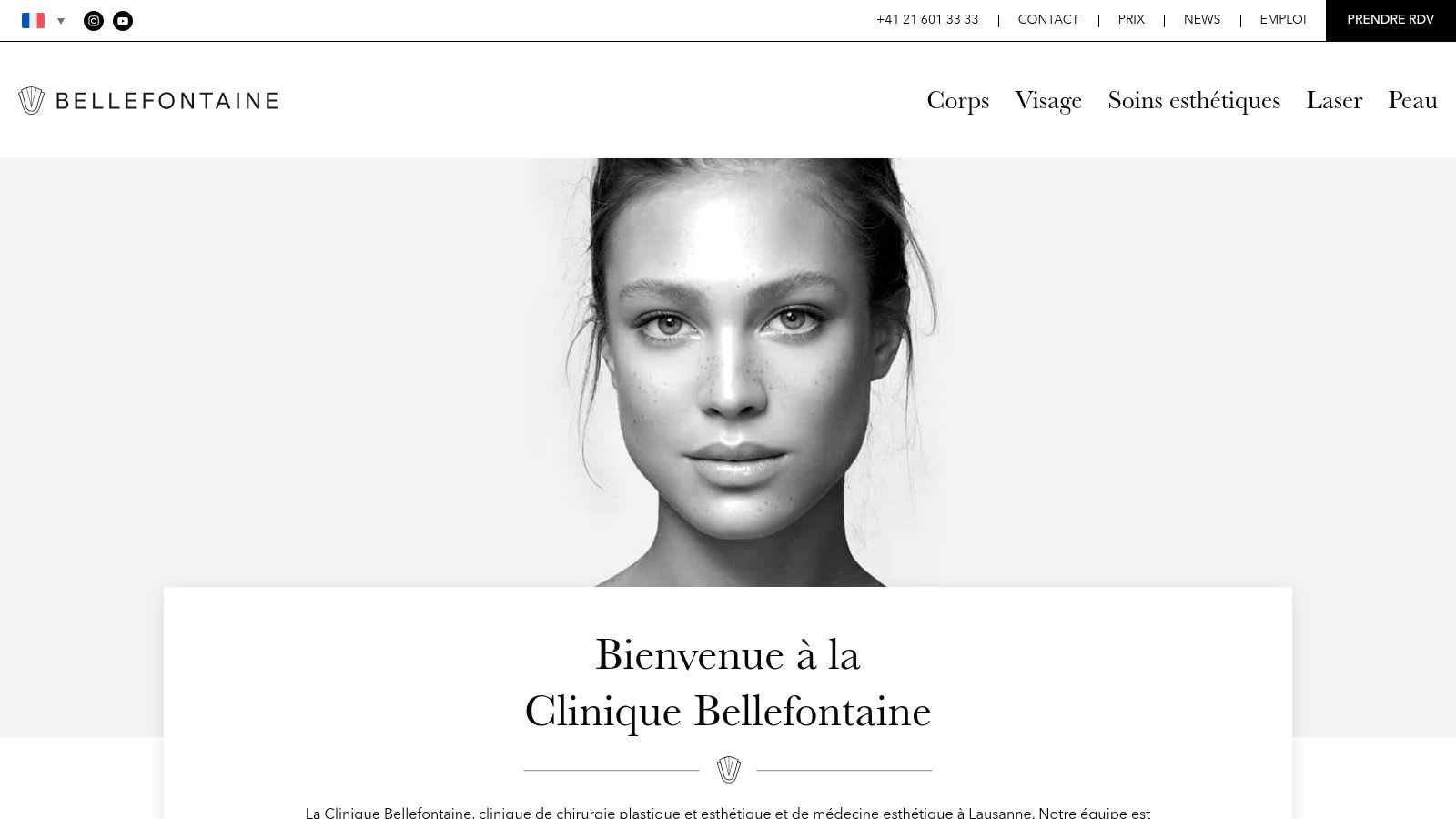
Website: belle-fontaine.ch
Clinique Bellefontaine is one of the clearer examples of a surgeon-led Lausanne clinic with a defined procedural identity. Dr Yann Favre’s profile combines FMH certification with EBOPRAS certification, which gives patients two distinct signals. FMH anchors the surgeon in the Swiss specialist framework. EBOPRAS points to a European benchmark that many patients may not know to look for, but should recognise as relevant when comparing plastic surgery credentials.
Where the clinic appears strongest
The clinic’s public positioning is strongest in body contouring, breast surgery, and adjacent aesthetic medicine. That matters because some surgeons present an extremely broad menu without showing where they have particular focus. Bellefontaine gives a stronger impression of procedural orientation, especially around high-definition liposuction, fat grafting, and composite breast approaches.
This is also where market context helps. Historical survey data cited in a Swiss academic source shows liposuction increasing from 35,780 cases to 81,869 cases, while breast augmentation rose from 93,652 to 108,655 cases in the surveyed period, according to the Université de Genève teaching archive on aesthetic surgery trends. Even with all the caution needed around broad survey interpretation, the takeaway is clear. Procedures involving body contour and breast reshaping remain central to patient demand, so a clinic that visibly concentrates on those categories is easier to evaluate than one that speaks in generalities.
Bellefontaine also bridges surgery and injectable medicine, which can be useful for staged planning. Patients exploring neuromodulators can review BeautyGuide’s Lausanne-oriented Botox treatment page if they want to compare non-surgical options before deciding on surgery.
How to compare it with other Lausanne clinics
What makes this clinic notable is not just certification. It is the coherence between credentials, procedure menu, and educational positioning. The site appears designed for patients who already have a category in mind and want a surgeon with a clear aesthetic focus.
Key advantages include:
- Dual credential signal: FMH plus EBOPRAS is a strong combination for Swiss patients comparing specialist status.
- Defined body and breast emphasis: The clinic is easier to read if those are your likely treatment areas.
- In-house non-surgical options: Fillers and other medical aesthetic treatments can support maintenance or staged care.
Limits are straightforward:
- No online tariff detail: Cost comparison remains difficult without direct consultation.
- Boutique capacity: Smaller surgeon-led clinics can have tighter scheduling windows for theatre dates.
- Public information still needs translation into your case: Technique names are not the same as evidence of suitability.
The deeper patient insight is this. Bellefontaine is one of the more legible options for someone who wants to compare not just “a surgeon in Lausanne”, but a surgeon whose public profile already aligns with specific aesthetic goals. That makes the first consultation more efficient.
4. Zanzi Clinic
Website: zanzi-clinic.ch
Zanzi Clinic is the most technology-forward option on this list. Its public positioning is centred on modern body contouring and skin-tightening tools such as Renuvion and VASER HD liposuction, alongside injectables and facial procedures. For some patients, that is attractive. For others, it creates an important evaluation challenge. Device names can dominate the conversation and obscure the surgeon question.
The technology question patients should ask
Aesthetic technology has marketing power. It also has clinical limits. The right way to assess a clinic like this is not to ask whether Renuvion or VASER sounds advanced. It is to ask how the surgeon uses those tools, in which indications, and in what setting.
Zanzi Clinic does one thing well in public communication. It appears active in patient education, with updated treatment articles and practical booking information. That can be helpful because many patients want to understand where surgery, body tightening, and injectables overlap. It is one of the better examples of a Lausanne practice trying to explain treatment categories in plain language.
The site also appears aligned with Swiss professional reference points, including links to recognised local organisations. Still, one analytical limitation remains: individual surgeon biographies and credentials are less prominent on public-facing pages than the treatment offer itself. In Swiss aesthetics, that matters. Technology should be secondary to operator qualification.
Who this clinic may suit best
Zanzi Clinic is likely to appeal most to patients comparing combined pathways, such as liposuction plus tightening, or injectables plus later surgery. It may also suit those who want a central Lausanne location with a broad menu organised by treatment area rather than by narrow subspecialty.
Its strengths include:
- Strong body-contouring identity: The clinic clearly communicates its interest in device-assisted shaping and tightening.
- Good patient communication cadence: Educational articles suggest active effort to answer common pre-consultation questions.
- Broad aesthetic range: Surgical and non-surgical treatments are both visible.
The caveats are equally relevant:
- Operator transparency is not as immediate: Patients may need to work harder to identify the exact surgeon and verify credentials.
- No public fee schedule: Cost discussion still begins after evaluation.
- Device branding can distract from fundamentals: Technique names should not replace questions about training, complications, and aftercare.
Good consultations translate device names into decision-making. Ask what the machine changes, what it does not change, and what alternatives the surgeon would recommend without it.
The most useful way to read Zanzi Clinic is as a modern mixed-modality practice. If you are drawn to newer body technologies, it belongs on a shortlist. If you prioritise surgeon biography above all else, you may want to verify those details before investing more time.
5. Dr Nicolas Chami
Website: drnicolaschami.com
Dr Nicolas Chami is a strong example of a Lausanne-area surgeon whose profile is defined less by a single branded clinic and more by professional network position. He is FMH-certified, trained at CHUV, and has operating privileges at several accredited clinics in Vaud, including Clinique de La Source and Clinique de Montchoisi. That multi-site model is easy to overlook, but it can be an advantage for the right patient.
Why multi-site practice can matter
When a surgeon works across more than one established clinic or hospital setting, the practical benefit is flexibility. Patients may have options around operating platform, scheduling, and occasionally support environment. For aesthetic surgery, that does not make outcomes better by itself. But it can simplify logistics and allow the surgeon to match the procedure to an appropriate facility.
Dr Chami’s profile is also notable for international aesthetic fellowship exposure, including Manhattan Eye & Ear in New York, while retaining a strong local base through CHUV-linked training and Swiss society memberships. That combination often appeals to patients who want both Swiss anchoring and broader aesthetic exposure, especially in facial and breast surgery.
The public website is restrained rather than expansive. Some patients will appreciate that. Others may find it light on procedural detail. As an analyst, that usually suggests a surgeon whose strongest credibility markers sit in training, affiliations, and hospital access rather than in digital content production.
Key signals to pay attention to
What works in Dr Chami’s favour:
- FMH specialist status: A core verification point for any patient searching for a chirurgien esthétique lausanne.
- CHUV training background: Relevant in a city where academic surgical lineage still carries weight.
- Professional memberships: SSCPRE, SSCE, ISAPS, and SVM add context to his integration in recognised professional circles.
- Multiple operating sites: Useful for patients who prefer institutional choice or scheduling flexibility.
What remains less transparent online:
- Limited procedural breakdown: You may need consultation to understand precise technique preferences.
- No published pricing: Standard for much of the Swiss market, but still a comparison obstacle.
- Location flexibility required: The operating site may vary depending on your case.
This type of profile suits patients who value formal qualification and hospital affiliation over heavy aesthetic branding. It is less immediately consumer-friendly than some clinic websites, but arguably more aligned with how many Swiss patients prefer to evaluate a surgeon. Credentials first. Marketing second.
6. Dr Stéphane Smarrito
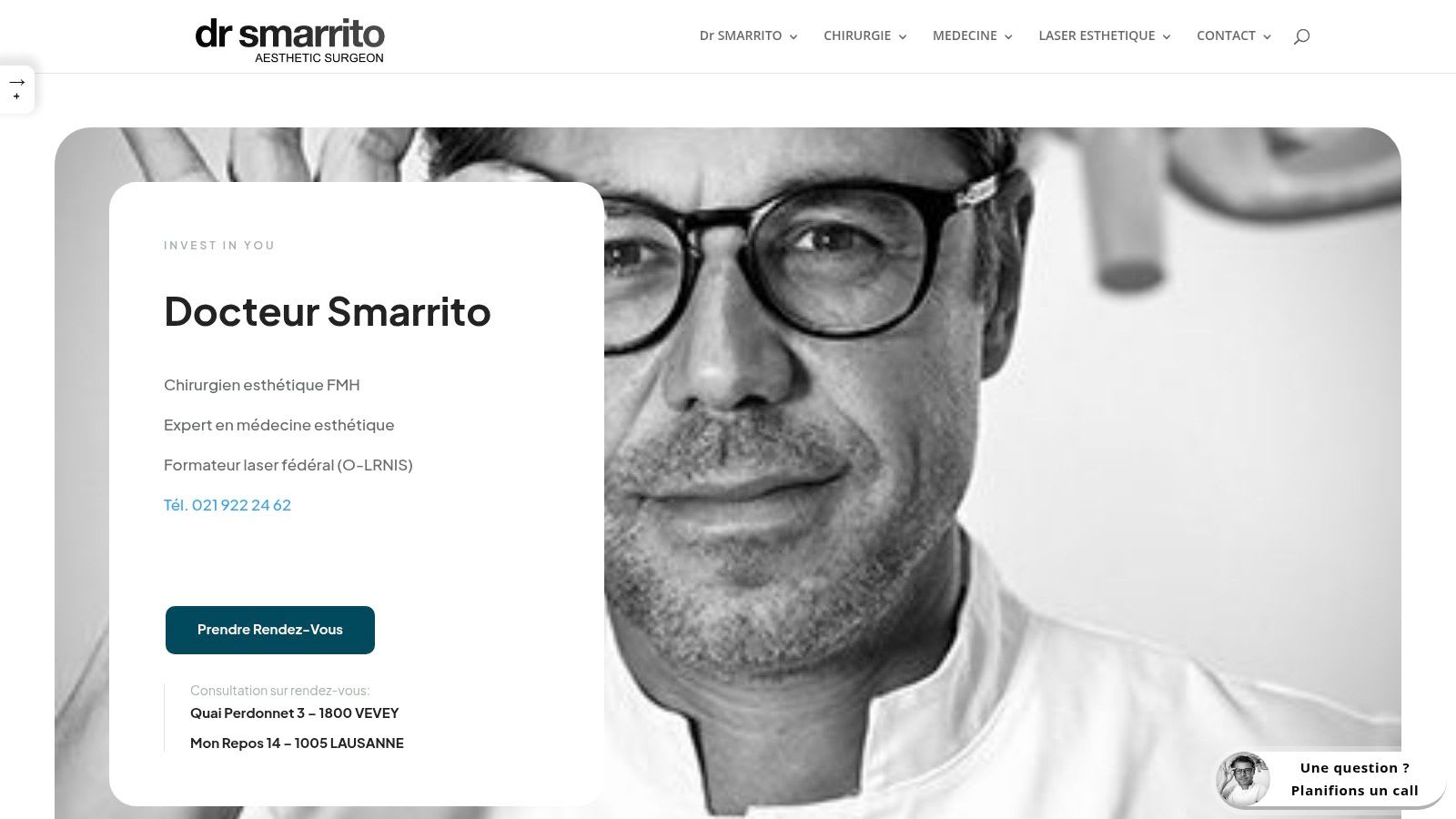
Website: drsmarrito.ch
Dr Stéphane Smarrito brings a different profile from the highly centralised Lausanne surgeon. He serves Lausanne and the Riviera, with bookings available in Lausanne via RivieraClinic, and presents a broad range of face, body, breast, hair, intimate, injectable, and laser treatments. The immediate question is whether this breadth is a strength or a dilution. In his case, it reads more like a mature practice model built around patient choice.
Breadth versus focus
A broad treatment menu can be useful when the patient is undecided between surgery and minimally invasive care. Dr Smarrito’s site reflects that reality more clearly than many narrower surgical pages. It includes educational material and dedicated information around liposuction, injectables, and laser-based options such as PicoSure.
That flexibility may matter in a Swiss market where patient demand spans both surgery and maintenance-oriented care. Publicly available discussion about pricing in Lausanne remains incomplete, and that gap affects decision-making across the board. The local market itself acknowledges the problem. There is a clear informational need for better itemised cost models and more explanation of what drives variation between providers, as noted in this Lausanne pricing transparency gap analysis. A broad practitioner portfolio can help during consultation because it allows comparison of several approaches before committing to one category.
Best reasons to shortlist him
Dr Smarrito may be especially relevant to patients who want one practitioner to discuss multiple pathways, not only one operation. That includes people comparing liposuction versus non-surgical contouring, surgery versus injectables for facial ageing, or hair restoration as part of a wider aesthetic plan.
His comparative strengths are clear:
- FMH board certification: Non-negotiable for trust in the Swiss context.
- Long experience profile: The site presents him as an established specialist with a wide clinical range.
- Educational support: Patients can review treatment explanations before consultation.
- Regional access points: More than one site can improve practical access.
The limitations are practical rather than disqualifying:
- Procedure location may vary: Not every operation may happen in central Lausanne.
- No online tariff detail: You still need consultation for specific cost information.
- Very broad service range: Patients seeking a surgeon with a narrow signature niche may want to probe where he operates most often.
The analytic takeaway is that Dr Smarrito fits patients who value versatility and access. He may be less attractive to those who want a tightly branded subspecialist identity, but more attractive to those who want a broad, real-world consultation across several treatment types.
7. Centre Médical Montchoisi
Website: swissmedical.net/en/hospitals/montchoisi/doctors-directory/le-huu-serge
Dr Serge Lê‑Huu’s profile at Centre Médical Montchoisi is the clearest example on this list of a surgeon positioned within a larger private hospital network. For many patients, that changes the feel of the decision. Instead of choosing a standalone brand first and a facility second, you are evaluating a surgeon and an established infrastructure together.
What stands out at Montchoisi
Dr Lê‑Huu is presented as an FMH-certified plastic, reconstructive, and cosmetic surgeon with EBOPRAS fellowship credentials and University of Lausanne training. The profile also highlights tools such as 3D and virtual planning for breast procedures. For patients, that combination matters because it links specialist training with procedural planning rather than relying only on marketing claims about precision.
The larger setting may also appeal to patients who want full perioperative support in one place. That is often relevant for breast surgery, facelifts, and eyelid procedures when patients feel more reassured by hospital-grade infrastructure than by a smaller private studio environment.
This item also intersects with a bigger patient issue that remains underexplained in Lausanne. Post-operative care standards are hard to compare publicly. A local gap analysis notes that clinic websites rarely provide detailed frameworks for follow-up schedules, recovery expectations, infection prevention, or emergency escalation, despite how important those issues are for patient decision-making, especially for international patients and expats, according to this review of post-operative care transparency in Lausanne. In a hospital-linked environment like Montchoisi, those are exactly the questions worth asking.
The practical comparison point
The strengths here are less about volume claims and more about system design:
- FMH and EBOPRAS-linked profile: Strong qualification signals for Swiss and international readers.
- Private hospital environment: Reassuring for patients who prioritise structured perioperative care.
- Planning tools for breast surgery: 3D and VR planning may support consultation clarity.
- Bilingual accessibility indicated: Helpful in Lausanne’s multilingual patient base.
The likely constraints are familiar:
- No public pricing information: Cost clarity still requires direct consultation.
- Hospital scheduling rhythms: Access to operating dates may be less spontaneous than in a small boutique clinic.
- More formal environment: Some patients may prefer a more intimate or single-surgeon private setting.
When comparing hospital-based aesthetic surgery with boutique clinics, ask the same aftercare questions to both. The more transparent provider usually becomes obvious very quickly.
The broader insight is that Montchoisi is well suited to patients who interpret infrastructure itself as part of safety. In Switzerland, that is a rational criterion, especially when post-operative support remains harder to compare than it should be.
Lausanne Aesthetic Surgeons, 7-Way Comparison
| Provider | Implementation complexity | Resource requirements | Expected outcomes | Ideal use cases | Key advantages |
|---|---|---|---|---|---|
| Dr Sophie Nordback – Aesthetic/Plastic Surgeon in Lausanne | Low–Moderate; profile-level summary, consult needed for plan | Local clinic offering surgical and non‑surgical options | Thorough aesthetic results subject to individualized care | Patients comparing vetted local specialists and booking consultations | Board‑certified; verified credentials; combined surgical & non‑surgical services; patient ratings |
| Centre de Chirurgie Plastique Lausanne, Dr Jean‑François Emeri | High for major procedures; institutional pathways | Clinique Cecil hospital‑grade OR, inpatient support, training centre resources | Strong reconstructive and aesthetic outcomes with hospital standards | Complex reconstructive cases and major aesthetic surgery requiring perioperative support | FMH leadership; ISFM training centre; direct access to hospital OR and support services |
| Clinique Bellefontaine, Dr Yann Favre (FMH, EBOPRAS) | Moderate–High for advanced body and breast work | Boutique clinic with advanced liposuction, fat grafting and in‑house aesthetics | High‑definition body contouring and composite breast results | Body‑contouring, composite breast augmentation and combined facial/body plans | EBOPRAS certification; focused procedural expertise; procedural media and education |
| Zanzi Clinic (Lausanne) | Moderate; technology‑assisted procedures with protocolized care | Advanced devices (Renuvion, VASER HD), clinic‑based support and clear booking | Effective technology‑driven tightening and sculpting outcomes | Patients seeking tech‑forward body contouring or staged combined care | Advanced body‑contouring tech; central location; active patient information |
| Dr Nicolas Chami (FMH) | Moderate; multi‑site practice may require coordination | Access to multiple accredited hospitals and fellowship experience | Strong facial and breast aesthetic outcomes with reconstructive capability | Patients needing hospital privileges or complex facial/breast procedures | FMH + international fellowship; multiple hospital privileges; strong society affiliations |
| Dr Stéphane Smarrito (FMH) | Low–Moderate; broad offering including minimally invasive options | Multiple regional clinics, lasers, dedicated liposuction services | Versatile outcomes across surgical and minimally invasive treatments | Patients comparing surgical vs minimally invasive approaches; education‑seeking patients | 20+ years’ experience; educational resources; multiple access points for appointments |
| Centre Médical / Clinique de Montchoisi, Dr Serge Lê‑Huu (FMH) | High for planned surgeries; hospital scheduling may add lead time | Swiss Medical Network hospital infrastructure; 3D/VR breast planning tools | Structured surgical outcomes with advanced preoperative planning | Patients desiring hospital‑based care and advanced breast planning | EBOPRAS fellowship; 3D/VR planning; bilingual consultations; private hospital integration |
Your Checklist for Choosing the Right Surgeon
A shortlist is useful, but it is not a decision. The consultation is where your comparison becomes real. That is especially true in Lausanne, where many surgeons can present strong qualifications on paper, yet differ meaningfully in specialisation, operating setting, communication style, and post-operative support.
Start with credentials. In Switzerland, this is more than a branding detail. A patient looking for a chirurgien esthétique lausanne should confirm the FMH specialist title in plastic, reconstructive, and aesthetic surgery in the official registry and use platforms that cross-check MedReg information. BeautyGuide’s model is helpful because it reduces the risk of confusing cosmetic marketing with specialist recognition. That distinction matters in a city shaped by a serious academic tradition in plastic surgery and by a Swiss patient culture that expects verifiability.
Then move from title to fit. A surgeon may be fully qualified and still not be the right match for your procedure. One may lean more heavily toward breast surgery, another toward face, another toward combined surgical and non-surgical planning. The smartest patient question is not “Who is the best?” It is “Who does the kind of work I need, in the environment I am comfortable with, and with an explanation I understand?”
Before-and-after photographs still matter, but use them correctly. Ask to see examples relevant to your anatomy and your intended procedure. Generic image galleries are less useful than a focused discussion of what was technically possible, what was limited by tissue characteristics, and what the recovery involved. The best consultations usually explain why a result was chosen, not only what it looked like.
Safety questions should be direct. Ask where surgery takes place, who provides anaesthesia, what emergency protocols exist, how after-hours issues are handled, and how follow-up is scheduled. This is one of the least transparent parts of the Lausanne market. Public information often tells you who performs procedures, but much less often tells you how aftercare is organised. That gap is especially relevant for international patients, expats, and anyone comparing a hospital-based setting with a boutique clinic.
Costs deserve the same level of discipline. Swiss aesthetic practices rarely publish full online pricing, so your goal is not to force a quick figure from a homepage. Your goal is to obtain a written quote after consultation that explains what is included. That means surgeon fees, facility costs where relevant, anaesthesia if applicable, and follow-up arrangements. If one quote is noticeably higher, ask what drives the difference. Experience, infrastructure, technique, and aftercare may all be factors. Vague answers are a useful signal in themselves.
One final point is often missed. Good decision-making is not just about choosing a qualified surgeon. It is about choosing a surgeon whose communication reduces uncertainty rather than increasing it. If you leave a consultation with clearer expectations, a better grasp of risks, and a realistic sense of alternatives, that is a strong sign. If you leave with polished language but little practical clarity, continue your search.
BeautyGuide.ch works best as a neutral first filter. It helps patients identify verified professionals, compare Lausanne options, and approach consultations better prepared. From there, the responsibility is shared. The surgeon must explain. The clinic must be transparent. The patient must verify, ask, and compare carefully. If you do that, you are far more likely to choose a chirurgien esthétique lausanne who fits Switzerland’s high standards and your own priorities.
For clinics and patients alike, reputation increasingly depends on clear communication and transparent expectations, including how teams handle feedback and managing online reviews.
This article is for informational purposes only and does not replace professional medical advice.