Many clinics still sell HIFU in Switzerland as a quick “non-surgical facelift”, but that framing usually oversells what the treatment can do. In Swiss practice, HIFU is better understood as a tissue-remodelling procedure with gradual change, not a dramatic lift, and the most useful question is not whether it is “anti-ageing”, but whether the expected result justifies the cost in your case.
That distinction matters because Swiss patients often see polished before-and-after photos without seeing the actual timeline behind them. In local clinic care, the visible change is usually delayed, collagen builds over months, and the value of treatment depends on area treated, skin quality, and how carefully the practitioner plans energy delivery. For readers who want a broader view of current aesthetic and medical updates, health topic updates and articles can be a useful place to compare how procedures are discussed across reputable patient resources.
Why HIFU Marketing Often Misleads Swiss Patients
The phrase “non-surgical facelift” sounds neat, but it can hide the core comparison Swiss patients need to make. HIFU does not replace surgery, and it does not create the same structural change a facelift can produce. In Swiss aesthetic medicine, patients are usually weighing result size, downtime, and cost-per-result, so the more useful question is whether a modest tissue change is worth the fee in your case.
What the marketing leaves out
HIFU works by creating controlled thermal injury in targeted tissue, which triggers a repair response rather than an immediate lift. Swiss clinic information describes the process as delayed, with only a slight firming effect right after treatment and collagen building over the following weeks and months Swiss skin clinic information on HIFU. That is very different from the promise many people hear when they are told a treatment “lifts”.
The other common omission is that the treatment effect is usually modest and selective. It may suit people who want refinement of early laxity, but it is not a substitute for volume restoration, skin resurfacing, or surgery when those problems are the main concern. A practical way to judge it is to compare the likely change against the total outlay, including the fact that some patients need a carefully planned treatment course rather than a single session.
Practical rule: if a clinic promises a visible “lift” on the day of treatment, ask exactly what kind of change they mean, and when it should appear.
Swiss providers also tend to stress that HIFU has no downtime, which is true in the sense that patients can return to normal activities quickly. That said, “no downtime” can distract from the more important question of whether the eventual result is strong enough for the price you pay. If you want a patient-facing explanation of how the treatment is positioned in Switzerland, BeautyGuide's HIFU overview in Switzerland is a useful point of reference. The better evaluation is often whether the plan makes sense for your skin, not whether the appointment is convenient.
For readers who want a broader view of current aesthetic and medical updates, health topic updates and articles can be a useful place to compare how procedures are discussed across reputable patient resources.
How Ultrasound Energy Remodels Your Skin
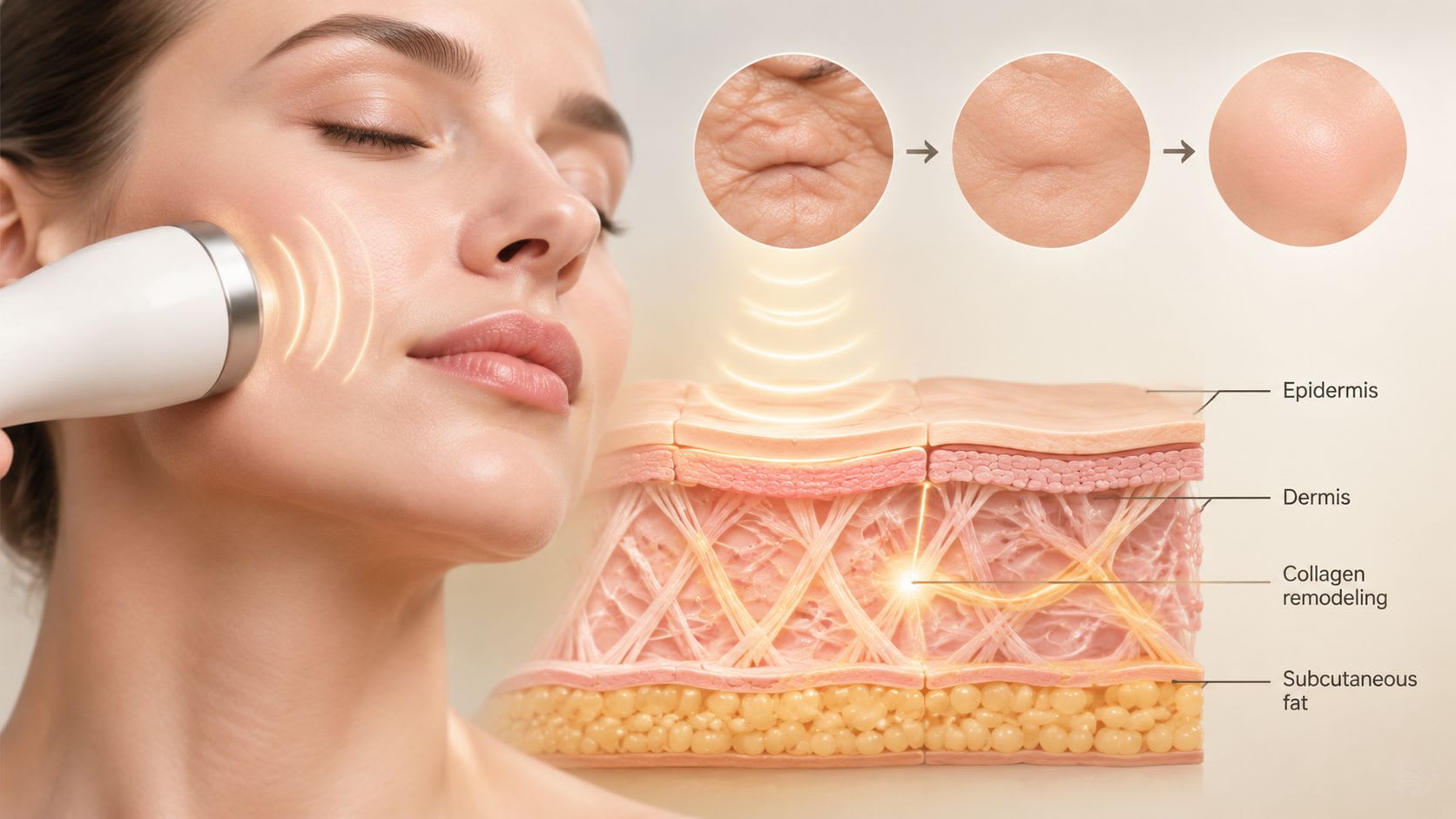
HIFU stands for High-Intensity Focused Ultrasound. The mechanism is straightforward: ultrasound energy is concentrated at a precise depth, much like a magnifying glass concentrating light onto one spot, while the surrounding tissue is left comparatively untouched. In Swiss clinical sources, focal temperatures can reach up to 90°C University Hospital Zurich HIFU information, while aesthetic clinic sources describe treatment zones commonly heated to 70 to 80°C Swiss aesthetic HIFU information.
Why depth and frequency matter
The treatment is not one uniform blast. Swiss market devices commonly use cartridges at 1.5, 3.0, 4.5, 6.0, 9.5, and 13.0 mm, with frequencies in the 2 to 9 MHz range Swiss HIFU device listing. That range lets the practitioner place energy at different depths, from more superficial layers to deeper support structures.
Depth changes the biological response. Superficial settings are used for fine, targeted work, while deeper settings are chosen where more structural support is needed. Facial protocols therefore differ from body protocols, and a credible clinic should explain which layer is being targeted in each zone rather than presenting one standard plan for every patient.
The most useful question is not “Does HIFU work?”, but “Which layer is my practitioner targeting, and why?”
The treatment also fits better under the description of thermomechanical tissue remodelling than simple skin tightening. The device deposits energy in narrow focal spots, the tissue responds with repair, and collagen remodelling develops later. For a patient-facing overview of facial ultrasound treatment in Switzerland, BeautyGuide's HIFU treatment page is a useful reference point.
Who Benefits Most from HIFU Treatment
HIFU is usually most sensible when a patient has mild to moderate laxity, wants a non-surgical option, and understands that the effect is subtle rather than dramatic. In that setting, it can be a reasonable choice for people who are not ready for surgery but still want a structured treatment plan. It is less convincing when the main concern is heavy skin laxity, major volume loss, or a need for reshaping that ultrasound energy alone cannot deliver.
Swiss outcome data and what it signals
Swiss clinicians are not relying on marketing language alone. Kantonsspital Baden cites a large English cohort of 625 patients treated between 2006 and 2015, with a median follow-up of 56 months Kantonsspital Baden HIFU report. In that dataset, the continence rate was 98% without pads and potency was preserved in 86% of patients, which helps explain why HIFU has gained credibility in a cautious medical environment. The same report also lists a 5-year overall survival of 99% and metastasis-free survival of 99%, with a 5-year failure-free survival of 87% for Gleason score 7 tumours and 88% for intermediate-risk patients by D'Amico classification.
Although those numbers come from prostate treatment rather than aesthetics, they matter for Swiss patient confidence because they show HIFU is not viewed as fringe technology in the country. It is a mainstream energy-based approach whose usefulness depends on indication and careful selection.
How candidacy is usually judged
In cosmetic practice, the first filter is usually skin quality. A practitioner will look at laxity, fat distribution, age-related tissue changes, and whether the patient expects lifting, tightening, or contour refinement. HIFU is rarely the right answer for someone seeking a big change in a single session.
A useful self-check looks like this:
- Mild laxity: HIFU may be worth discussing if your main complaint is early loosening along the jawline, cheeks, or neck.
- Advanced ageing: if skin is very loose, the result is often too limited on its own.
- Volume loss: HIFU does not replace fillers, fat grafting, or surgical lift options.
- Expectation of instant change: the delayed collagen response makes this a poor match for anyone seeking immediate transformation.
HIFU Versus Alternative Skin Tightening Options
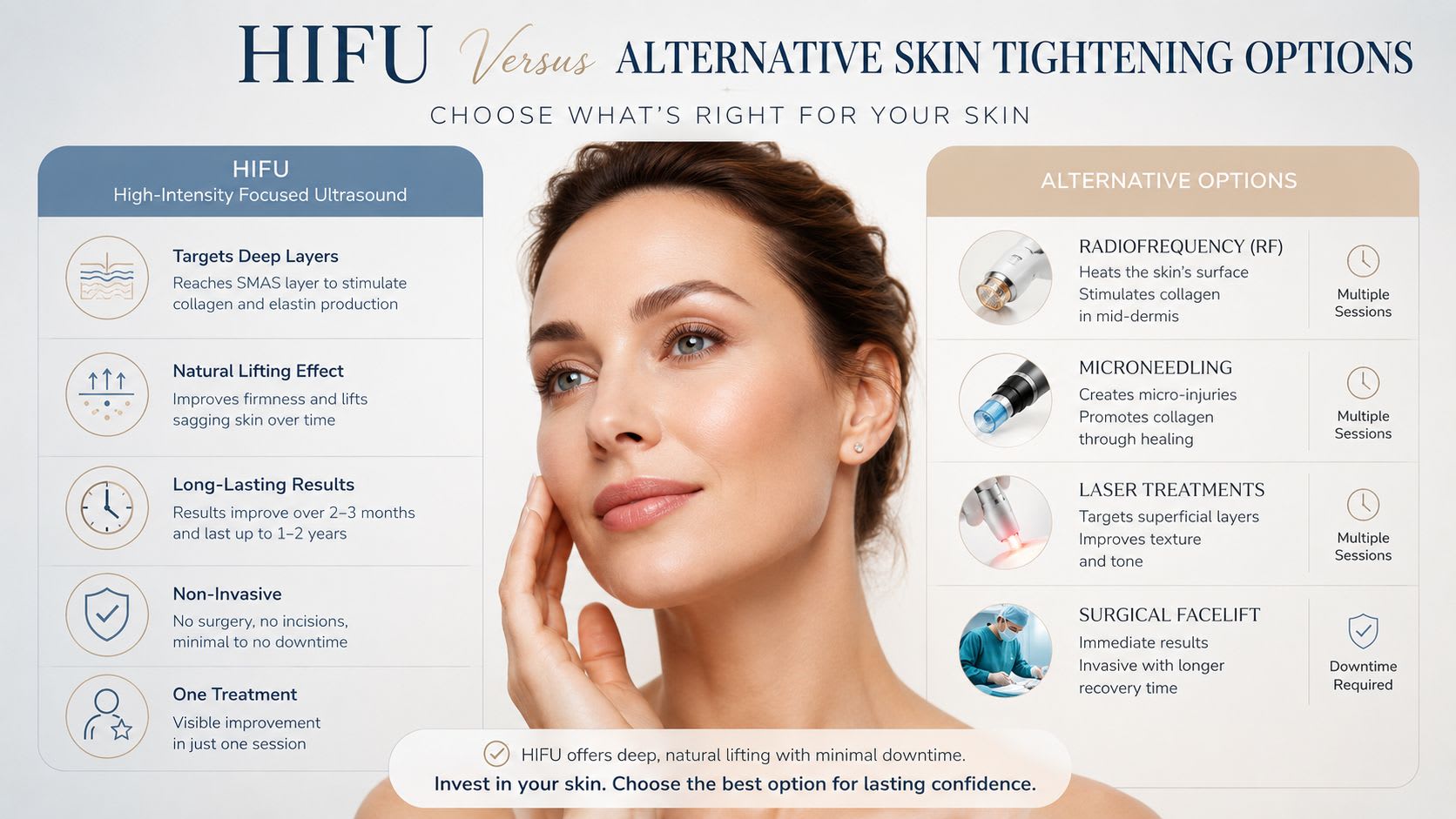
HIFU sits in the middle of the tightening spectrum. It reaches deeper than many superficial devices, but it still doesn't behave like surgery, and that's where comparison becomes useful. In Swiss clinics, the choice is often between subtle lifting, surface refinement, and structural correction, not between “good” and “bad” treatments.
Where HIFU fits, and where it doesn't
Compared with radiofrequency microneedling, HIFU generally targets deeper tissue planes. That can make it more relevant for a patient whose concern is support and laxity rather than texture alone. By contrast, RF microneedling is often discussed for surface quality, fine lines, and dermal remodelling, so it may be preferred when the issue is skin texture rather than lifting.
Compared with lasers, HIFU does not try to resurface the skin in the same way. Lasers are often chosen for pigmentation, texture, or sun damage concerns, while HIFU is selected when the question is more about tightening than resurfacing. Surgery remains the most decisive option when tissue descent is significant, but it also comes with a different recovery profile and a higher procedural commitment.
For patients looking at broader tightening options in Switzerland, non-surgical skin tightening in Beaconsfield is an example of how clinics often frame these decisions around treatment goals rather than a single device.
The decision rule that usually helps
A sensible way to compare options is to ask what layer each treatment affects.
- HIFU: deeper support and gradual tightening.
- RF microneedling: skin quality and dermal remodelling.
- Laser treatments: texture, tone, and surface change.
- Surgery: larger structural correction.
If you want a broader treatment overview that sits alongside HIFU in Swiss clinic planning, BeautyGuide's skin tightening treatment page is a natural next reference. For many readers, the question is not which technology sounds most advanced, but which one matches the actual problem.
Treatment Timeline and What to Expect
A HIFU appointment is usually short compared with surgery, but the effect is rarely immediate in the way advertising sometimes suggests. The skin may feel a little firmer straight after treatment, yet the main change depends on new collagen forming over time. That is why many Swiss clinics explain the result as gradual rather than instant, and why a first session can feel underwhelming if a patient expects a visible lift on day one.
The usual sequence
The consultation comes first. A practitioner should identify the treatment area, the depth being targeted, and what your skin can realistically achieve, because HIFU does not produce the same degree of change in every face. The procedure itself usually takes 30 to 90 minutes, depending on the area treated. After that, most patients notice only mild, short-lived sensations rather than a recovery period that interrupts daily life.
One Swiss provider notes that results can last up to two years Swiss skin clinic information on HIFU, but that should be treated as an upper-end expectation, not a promise. In practice, durability depends on age, skin quality, the treatment area, and how much correction was possible at the start. A younger face with mild laxity may hold the result longer than a face with more advanced tissue descent, just as a small repair lasts longer than a structural rebuild.
Short version: HIFU is a slow-burn treatment. Judge it too early, and you may miss the improvement that develops later.
Maintenance and multiple sessions
Some patients benefit from more than one session, especially if the first treatment is deliberately conservative or if the concern spans several facial zones. A good clinic should explain whether the plan is a single treatment, a staged approach, or a combination with other modalities. That discussion is more useful than a general promise of “lasting lifting” because the cost-per-result changes once you look at the size of the correction, not just the price of one session.
Recovery is usually straightforward, but expectation management is the main aftercare task. Patients tend to do better when they know in advance that the change builds gradually and peaks later, rather than trying to judge success after a few days. That is the practical difference between a treatment that is subtle and one that has not had enough time to declare itself.
Understanding Swiss HIFU Pricing Structures
Swiss HIFU pricing is rarely flat, and that is often the first sign that a clinic understands the treatment in practical terms. Price depends on the treated area, the depth chosen, the number of passes or shots, and the device in use. City, coverage size, and whether the plan targets one zone or several zones also matter, so a small facial area can cost very differently from a full-face treatment.
For patients, that matters because HIFU is sold too often as a single “lifting” offer, while the treatment plan is more like tailoring a suit. The visible result depends on how much tissue is treated and how precisely the energy is delivered, not just on the sticker price.
What Swiss clinics actually charge
One Zurich provider says single face regions start at CHF 190, a full HIFU face treatment can be CHF 1,500, and a body-lift treatment can reach CHF 1,540 for an extra-large zone Zurich HIFU pricing overview. Another Swiss clinic lists HIFU at CHF 600+ Swiss clinic HIFU pricing overview. A third Zurich source reports that facial treatment may start at CHF 190, while larger areas such as thighs may reach CHF 1,690 Zurich HIFU body and face pricing.
| HIFU Treatment Costs by Area in Switzerland | Price Range (CHF) | Treatment Duration | Sessions Typically Needed |
|---|---|---|---|
| Single facial zone | 190 and up | Varies by zone | Often one, sometimes more |
| Full face | 1,500 | Varies by plan | Often one planned session |
| Face and neck | 2,490 | Varies by plan | Often one planned session |
| Extra-large body zone | 1,540 | Varies by area | Often one, sometimes staged |
| Larger areas such as thighs | 1,690 | Varies by area | Often one, sometimes staged |
These figures are useful because they show the difference between a limited-area treatment and a broader plan. A small zone may be cheaper, but it can also produce a smaller change. A larger treatment can cost more because it covers more tissue and usually requires more energy delivery, so the price per result can be more meaningful than the price per session.
Reading price as value, not just a number
The better comparison is not just session price. A lower-priced treatment that changes little may be poorer value than a more expensive plan that is better matched to the problem. A premium quote does not automatically mean better outcomes either, so patients should ask what the fee includes, which device is being used, and how many shots or lines are planned.
The most transparent clinics explain pricing by treated area and energy delivery, not by vague package names. If a clinic cannot explain why one zone costs more than another, that usually says more than the number on the quote. For readers comparing clinics in a structured way, a Swiss clinic directory on BeautyGuide can help sort providers by scope and language before you book.
Choosing a Qualified Swiss HIFU Provider
A qualified Swiss provider should be able to explain HIFU as a medical treatment plan, not a sales offer. That means clear discussion of candidacy, device choice, expected change, side effects, and what happens if the response is weaker than hoped. If the consultation feels like a product pitch, the process is already off track.
What to verify before booking
Swiss patients should check who is performing the treatment and whether the clinic is medically supervised. BeautyGuide's clinic directory is built for that kind of comparison, because it helps readers look at listed clinics, languages, and treatment scopes in one place. You can also ask for the practitioner's medical registration, whether they are FMH-listed where relevant, and which HIFU device they use.
Before you book, ask a few direct questions:
- Which device do you use? Different systems and cartridges affect depth and precision.
- How many HIFU treatments have you personally performed? Experience matters more than a polished website.
- What result should I realistically expect? A credible answer should sound measured, not promotional.
- How do you manage complications? Every clinic should have a clear process for unexpected reactions.
Red flags that deserve attention
Before-and-after photos can be useful, but only if they appear consistent and clinically plausible. If lighting, angles, or retouching make the change look exaggerated, the photos aren't helping you make a medical decision. The same caution applies if the clinic avoids discussing limitations, recovery, or who is not a candidate.
Language also matters in Switzerland, especially for expats. A consultation should be clear enough that you can repeat back the plan in your own words, because if you can't explain the treatment after the appointment, you probably haven't been given enough information.
BeautyGuide helps you compare HIFU in Switzerland with qualified clinics, transparent treatment scopes, and practical selection criteria that fit Swiss patient expectations. If you're weighing cost against likely result, visit BeautyGuide to continue your search with a clearer view of clinics, treatments, and what a proper consultation should cover.
This article is for informational purposes only and does not replace professional medical advice.