
You're probably in the same position as many patients I meet in Switzerland. You've noticed that your jawline looks softer, the skin around the lower face or neck isn't as firm as it used to be, and you want improvement without surgery. Then you start researching, and two names keep appearing: HIFU and Morpheus8.
At first glance, they can sound similar. Both are non-surgical. Both aim to tighten skin. Both are offered in aesthetic clinics in cities such as Zürich, Geneva, Basel, and Lausanne. But they don't do the same job in the same way, and choosing well depends on what you want to improve.
For a quick broader overview of non-surgical options, some patients also like comparing these devices with other top skin tightening treatments for 2026, especially before a consultation.
Choosing Your Path to Firmer Skin
The most common confusion in HIFU vs Morpheus8 is simple. People ask one question, but they often mean three different things.
They may say, “Which one tightens better?” What they really want to know is whether the treatment lifts sagging tissue, improves crepey skin, or also refines texture such as pores, fine lines, and acne marks. Those are not identical goals.
In Swiss practice, that distinction matters because patients usually want a treatment plan that fits real life. Someone working face to face in Zürich's financial district may strongly care about downtime. Someone in Geneva preparing for an event may prioritise lifting. Another patient in Bern may want one treatment that addresses looseness and surface quality together.
Here's a practical early comparison.
| Feature | HIFU | Morpheus8 |
|---|---|---|
| Main strength | Structural lifting | Tightening plus texture improvement |
| Energy type | Focused ultrasound | RF microneedling |
| Main target | Deeper support layer | Dermis at adjustable depths |
| Best for | Mild laxity, especially when no downtime is important | Moderate to more advanced laxity, texture concerns, acne scarring, jawline blur |
| Sessions | Typically fewer | Usually a course |
| Recovery | Minimal to none | Short social downtime is common |
| Swiss decision point | Good if you need to go straight back to work | Good if you want broader rejuvenation |
Consultation rule: Don't choose the machine first. Choose the outcome first, then match the device to the anatomy and your tolerance for downtime.
A good consultation in Switzerland should separate your concerns into categories. Is the main issue lifting, texture, or both? Once that's clear, the decision becomes much easier.
How The Technologies Fundamentally Differ
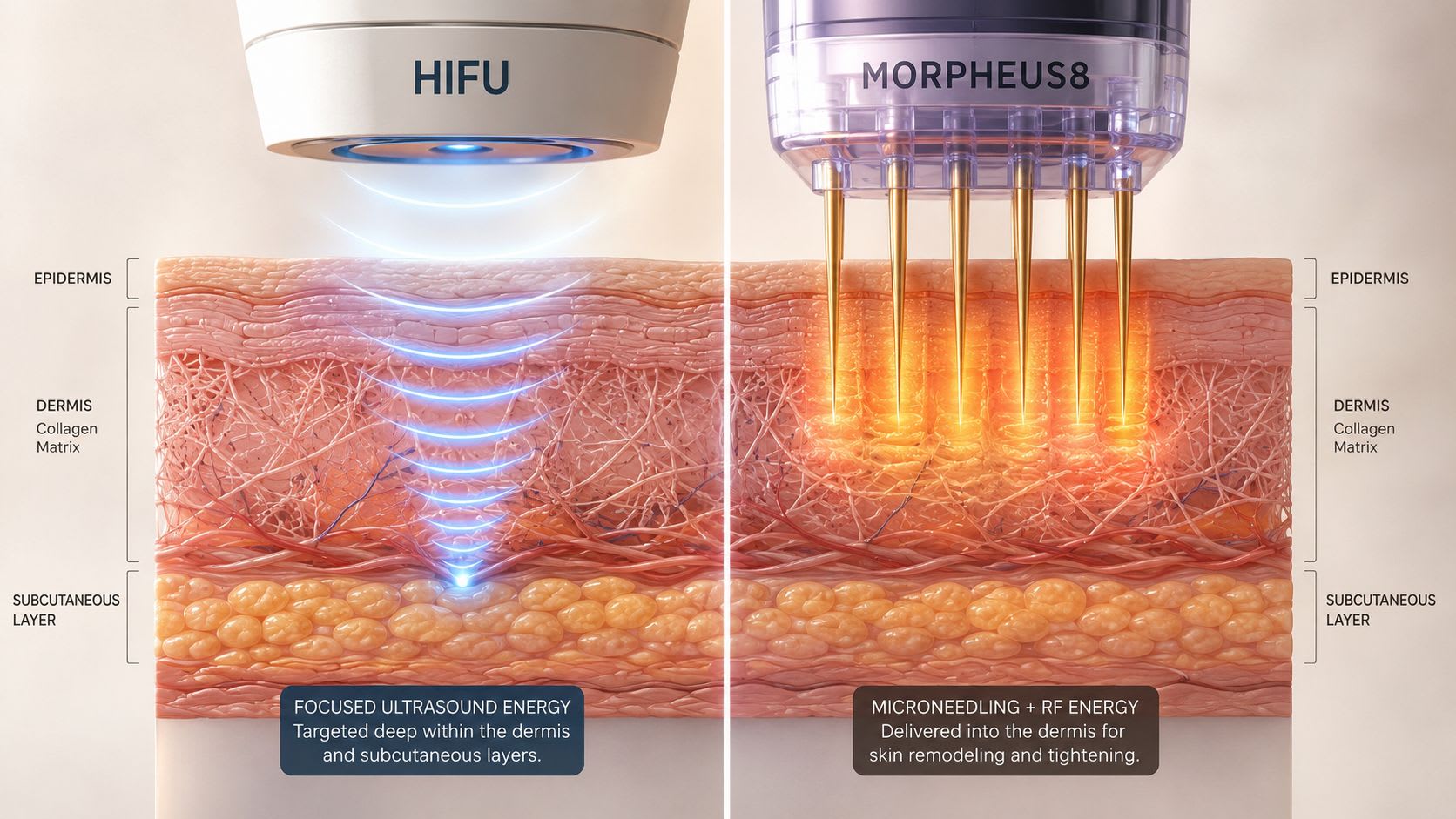
The biggest difference between HIFU and Morpheus8 is where the energy goes and what kind of response it creates in the tissue.
How HIFU works
HIFU stands for High-Intensity Focused Ultrasound. It sends ultrasound energy to a chosen depth below the skin surface. The skin above remains intact, but the energy reaches deeper support structures and creates small points of thermal injury.
Its best-known target is the SMAS, or superficial musculo-aponeurotic system. That's the same foundational layer surgeons pay attention to during a facelift. If you want a simple analogy, HIFU is like tightening support cables beneath the surface rather than resurfacing the visible skin.
For readers comparing related lifting technologies in Switzerland, BeautyGuide's overview of Ultherapy and HIFU treatments can help place HIFU in the wider category.
How Morpheus8 works
Morpheus8 combines microneedling with radiofrequency energy. Fine needles enter the skin, and the device delivers RF heat at controlled depths. One useful overview of how the treatment is presented in a high-demand aesthetic market is this page on Morpheus8 in Beverly Hills, which shows the kind of concerns people commonly bring to consultations.
The key practical point is that Morpheus8 can work at programmable depths of 1 to 8 mm and creates a more continuous field of stimulation in the dermis, rather than isolated focal points. That means it doesn't only tighten. It also pushes collagen remodelling in layers that influence skin texture and surface quality.
Why patients mix them up
Both treatments are described as “collagen stimulators”, which is true but incomplete. The problem is that this phrase obscures the key distinction.
- HIFU is usually the more structural option
- Morpheus8 is usually the more extensive remodelling option
- HIFU leaves the skin surface largely untouched
- Morpheus8 directly engages the tissue layers involved in pores, fine lines, and textural irregularity
HIFU is usually chosen for lift-first goals. Morpheus8 is usually chosen when the patient wants tightening and better skin quality at the same time.
A simple clinical analogy
If a face has started to descend slightly, HIFU works more like deep anchoring.
If the face shows loosening plus roughness, crepiness, or acne marks, Morpheus8 works more like renovation across several layers.
That difference is why one patient may leave a consultation in Lugano or Lucerne with a recommendation for HIFU, while another with superficially similar concerns is advised to consider Morpheus8 instead.
Comparing Results for Lifting Texture and Longevity
When patients ask which treatment is “better”, I usually narrow the answer to three criteria: lifting, texture, and how long the result tends to last.
Lifting and facial laxity
For non-surgical skin tightening, one published comparison reports that HIFU demonstrates skin laxity improvements ranging from 18% to 30%, particularly in the lower face, neck, and periorbital region, while Morpheus8 achieves 70% to 85% improvement in facial laxity through deeper collagen remodelling in the reticular dermis, according to this Morpheus8 vs HIFU comparison.
That doesn't mean HIFU is ineffective. It means the treatment tends to be more selective. If the problem is mainly early sagging at the jawline or neck, HIFU can fit the brief well. If the laxity is more established, Morpheus8 tends to offer a broader tightening effect.
Texture and skin quality
Many online comparisons are too vague. Surface quality matters. Patients don't only want firmer tissue. They also want the skin to look smoother and more refined.
Morpheus8 generally has the advantage when the treatment goal includes:
- Fine lines
- Visible pores
- Acne scarring
- Uneven texture
- Crepey skin quality
HIFU doesn't usually serve as the first-choice treatment for those concerns. Its core role is deeper lifting, not extensive surface remodelling.
A good way to understand this is to compare HIFU with treatments in the microneedling family. If you'd like background on that category, microneedling treatments help explain why devices that work directly in the dermis often have more visible influence on texture.
Longevity of results
This is often the deciding factor for Swiss patients who are thinking not just about the first treatment, but about maintenance over time.
According to the same published comparison, patients maintain 60% to 70% improvement at the three-year mark with Morpheus8 compared with 20% to 30% for HIFU, and Morpheus8 results typically persist for 2 to 5 years while HIFU results generally last 12 to 18 months.
That longer durability changes the conversation. Some patients in Zürich or Geneva are comfortable with a treatment course if the result is more thorough and lasts longer. Others prefer the simplicity of HIFU because it involves less immediate disruption, even if maintenance comes sooner.
Practical takeaway: If your priority is isolated lifting with the lightest interruption to daily life, HIFU often makes sense. If you want stronger tightening plus visible improvement in skin quality, Morpheus8 usually becomes the more convincing option.
What this means in real decision-making
For mild laxity, HIFU can be a very reasonable choice.
For moderate or broader ageing changes, especially when texture and definition both matter, Morpheus8 usually matches the brief more completely.
That's the central answer to HIFU vs Morpheus8. They overlap, but they don't replace each other.
Who Is The Ideal Candidate for Each Treatment
The right candidate isn't defined by age alone. It's defined by pattern of ageing, treatment goals, and how much downtime fits your life.
A typical HIFU candidate
HIFU tends to suit the patient who sees early softening rather than major tissue descent. The lower face looks a little heavier, the jawline is less crisp, or the neck has started to loosen, but the skin surface is still in relatively good condition.
This often fits someone who wants:
- A lift-focused treatment
- Little or no visible recovery
- A session that fits around work or social plans
- A conservative, stepwise approach before considering stronger interventions
In Swiss cities where patients often return straight to meetings, school runs, or client-facing work, that no-downtime advantage matters.
A typical Morpheus8 candidate
Morpheus8 tends to suit the patient who isn't only bothered by sagging. They also notice textural ageing. The skin may look rougher, pores more visible, lines more etched, or old acne scarring more obvious.
A published comparison notes that for moderate-to-severe laxity (grades II to III) with double chin, jawline blur, or platysma bands, clinics in Zürich and Geneva prefer Morpheus8 because it simultaneously treats fat deposits, laxity, and surface texture, while HIFU remains superior only for mild laxity where zero downtime is critical, as described in this Swiss-relevant treatment comparison.
That profile is common in practice. Morpheus8 often makes more sense when the lower face needs reshaping and the skin itself also needs renewal.
A useful way to self-sort before consultation
If you're unsure where you fit, these questions usually help:
- Is your main concern lifting only? HIFU may be enough.
- Do you also want smoother, more refined skin? Morpheus8 is more likely to fit.
- Do you need to look socially presentable immediately? HIFU is easier.
- Are you willing to accept short recovery for broader change? Morpheus8 may be worth it.
Many patients aren't choosing between a “good” and “bad” treatment. They're choosing between a narrower treatment with convenience and a broader treatment with more recovery.
When neither should be oversold
If laxity is advanced, a good Swiss practitioner should say so clearly. Non-surgical tightening can improve the situation, but it won't reproduce the result of surgery in someone with marked tissue descent. Honest candidacy matters more than device branding.
The Treatment Experience Pain Recovery and Cost
The treatment itself often feels less mysterious once you break it into three parts: how many sessions, what recovery looks like, and what drives cost in Switzerland.
Sessions and timing
One practical distinction is treatment schedule. A published protocol comparison states that Morpheus8 requires 3 sessions spaced approximately 6 weeks apart, with visible skin tightening within a few days and continued improvement for 3 months, while HIFU typically requires 1 to 2 sessions spaced 6 months apart with no downtime, according to this treatment protocol overview.
That alone changes expectations. HIFU often appeals to patients who want a simpler calendar. Morpheus8 usually asks for more commitment up front.
What the appointment feels like
Both treatments are usually performed with topical numbing. In many Swiss clinics, the experience is carefully paced, and the comfort strategy is adjusted to the area treated and the patient's tolerance.
Patients often describe HIFU as a deeper internal heat or pulse. Morpheus8 can feel more intense at the skin level because of the needles and thermal energy, but the sensation varies by depth, area, and anaesthetic preparation.
A serious consultation should tell you what the clinic does for comfort. Don't assume all providers use the same protocol.
Recovery in daily life
HIFU is popular because many patients can return to routine activities immediately. The skin may feel tender or look slightly flushed, but there usually isn't obvious downtime.
Morpheus8 is different. You should expect some visible reaction for a short period. In practice, that may mean redness, swelling, a rougher skin feel, and tiny marks for a few days. For patients with office work from home, that's often manageable. For those with public-facing schedules in Zürich, Geneva, or Basel, timing matters.
A practical Swiss planning checklist
- Work schedule: If you have presentations, meetings, or events, HIFU is easier to hide.
- Season: Many patients prefer Morpheus8 when they can control sun exposure and social plans more easily.
- Family logistics: Short but visible recovery can still be inconvenient if your week is already tightly organised.
- Patience: Morpheus8 usually suits patients willing to treat in a series rather than expect everything from one visit.
Cost structures in CHF
Swiss patients naturally ask, “Which one costs more?” The honest answer is that cost depends on the clinic, city, treatment area, physician involvement, device settings, and whether you're paying for a single session or a full course.
It's reasonable to expect variation between Zürich, Geneva, Lausanne, Zug, and smaller markets. A physician-led clinic with stronger medical oversight may price differently from a high-volume aesthetic centre. HIFU can look simpler financially because it often involves fewer sessions. Morpheus8 may represent a larger total investment because it is usually performed as a course.
What matters is value for your goal, not only the cheapest starting quote.
If a clinic discusses price before examining your anatomy, that's not a strong sign. The treatment plan should come first. The quote should follow the plan.
Questions worth asking about cost
- What area is included in the quote?
- Is physician supervision included?
- How many sessions are realistically recommended?
- Are review appointments part of the package?
- What happens if the result is incomplete?
Those questions are often more useful than comparing headline prices alone.
Potential Risks and How to Ensure Safety
Both treatments are widely used, but neither should be treated as casual beauty maintenance. They are energy-based medical procedures, and safety depends heavily on device choice, settings, anatomy knowledge, and operator skill.
Common short-term effects
The usual temporary effects are straightforward.
- After HIFU: tenderness, mild redness, and temporary swelling can occur
- After Morpheus8: redness, swelling, pinpoint marks, and occasional bruising are more typical
- For both: the treated area can feel warm or sensitive for a short time
These effects are usually expected rather than alarming, provided they are explained properly in advance.
The risks patients should know about
With HIFU, the key concern is depth and placement. Poor technique can lead to excessive discomfort and, in rare situations, burns or temporary nerve irritation.
With Morpheus8, the main safety questions involve skin preparation, sterile handling, aftercare, and pigment response. If aftercare isn't followed carefully, infection or post-inflammatory darkening can become more likely in susceptible skin.
The safest route in Switzerland
The most important protective step is choosing a medically credible provider. In Switzerland, I'd strongly favour a clinic where treatment is performed by, or directly supervised by, a physician with relevant anatomical training, ideally with an FMH specialisation in dermatology or plastic surgery where appropriate.
A safe consultation should include:
- A proper skin and laxity assessment
- Discussion of realistic limits
- A review of previous treatments
- Clear aftercare instructions
- A plan for follow-up if healing isn't straightforward
The device matters. The practitioner matters more.
If a clinic talks only about “glow”, “snatching”, or “instant sculpting” and avoids discussing risks, that's a reason to pause.
How to Choose a Qualified Clinic in Switzerland
Choosing between HIFU and Morpheus8 is only half the decision. The other half is choosing who should perform it.
In Switzerland, that means looking past polished social media and checking medical substance. A serious clinic in Zürich, Geneva, Basel, Lausanne, Lugano, or Bern should be able to explain why a specific device fits your anatomy, not just why it is popular.
What to verify before booking
Start with credentials. In Switzerland, a physician's licence can be checked via MedReg, and FMH titles give useful context about formal specialisation. Beyond that, ask who performs the treatment, who sets the parameters, and what happens if you need medical review afterwards.
You can compare providers across Switzerland through BeautyGuide's clinic directory, which is useful when you want to narrow your shortlist by city and medical focus.
What a strong consultation looks like
A good consultation should feel measured, not theatrical. The practitioner examines skin thickness, degree of laxity, jawline anatomy, and whether the concern is mostly descent, texture, or both.
Look for these signs:
- Individual recommendation: the clinic explains why HIFU or Morpheus8 suits you specifically
- Own patient photographs: not stock imagery, not vague promises
- Clear risk discussion: especially healing, pigmentation, and realistic limits
- No pressure to book immediately: good clinics don't rush this decision
Red flags worth noticing
If every patient is told the same device is “best”, that's not personalised care. If there's no meaningful consultation and no discussion of downtime, aftercare, or candidacy limits, I'd keep looking.
In Swiss aesthetic medicine, caution is a strength. The clinic that sounds slightly more conservative is often the clinic thinking most carefully about your face.
HIFU vs Morpheus8 Frequently Asked Questions
Can HIFU and Morpheus8 be combined
Yes, they can be combined in selected treatment plans. In practice, some clinicians use HIFU for deeper structural lift and then add Morpheus8 later to improve texture and reinforce tightening. The exact sequence and spacing should be decided medically, not copied from social media.
This approach is usually reserved for patients with more than one problem to solve. If your concern is simple mild laxity, combining treatments may be unnecessary.
Which is better for the body
Morpheus8 is generally the more natural fit when the goal includes skin quality and laxity on areas such as the abdomen, arms, or thighs. HIFU can also be used beyond the face, but it is less often the first option when larger treatment zones or texture changes matter.
The same principle applies as on the face. If the issue is mainly structural tightening, HIFU may be considered. If the issue also includes crepiness or textural decline, Morpheus8 is usually the more versatile discussion.
How soon will I see results
With HIFU, some patients notice an early tightening impression, but the full effect develops gradually as collagen response builds. With Morpheus8, initial visible change can appear relatively soon, while fuller improvement continues to develop over the following months.
That delayed progression is important. Neither treatment should be judged too early.
Which one is more practical if I can't take time off
HIFU is usually easier if your schedule doesn't allow visible recovery. That's one of its clearest advantages and one reason it remains popular even when Morpheus8 may offer broader improvement.
Which one should I ask about in a Swiss consultation
Ask about both if you're unsure. A proper consultation should compare them objectively, explain where each one is limited, and tell you if neither is the ideal answer. That last point is often the sign you're in safe hands.
BeautyGuide helps patients in Switzerland compare aesthetic treatments and find medically credible clinics with greater confidence. If you're considering HIFU or Morpheus8 in Zürich, Geneva, Basel, Lausanne, Bern, Zug, Lucerne, St. Gallen, Winterthur, or Lugano, start with BeautyGuide to explore qualified providers, review treatment categories, and book consultations with a clearer idea of what to ask.
Explore More
This article is for informational purposes only and does not replace professional medical advice.