
You're probably looking in the mirror and asking a very ordinary question, does my face have high or low cheekbones, and if it matters, what can be changed in a Swiss clinic without overpromising on the result? The useful answer starts with anatomy, not attractiveness. Cheekbone position is a matter of where the bone sits in relation to the eye socket and nose, while the soft tissue over it can change the look quite a lot.
| Option | What it changes | Main limitation |
|---|---|---|
| Hyaluronic acid fillers | Adds or repositions volume in the midface | Does not raise the bone itself |
| Fat grafting | Uses your own tissue to build contour | Retention can vary |
| Cheek implants or osteotomy | Changes structural projection | Involves surgery and recovery |
| Makeup and styling | Changes the visual impression only | Temporary and light-dependent |
What High vs Low Cheekbones Actually Means
Stand in front of a mirror, keep your face neutral, and look at where the widest point of the cheek sits relative to your eye and nose. If the zygomatic prominence sits at or above the lower eye socket or bridge of the nose, it is usually described as high cheekbones. If it sits closer to the nostrils or lower midface, it is usually described as low cheekbones. That's a landmark test, not a beauty judgement.
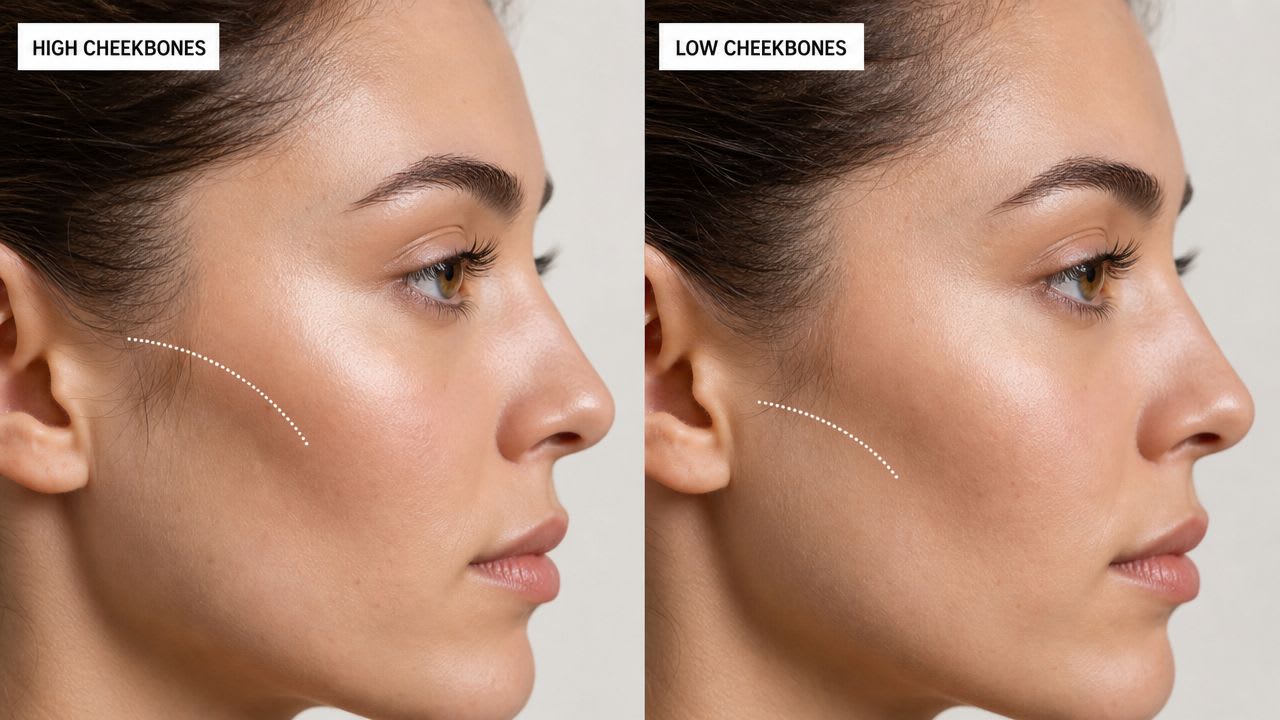
That distinction matters because the bone position is skeletal. It doesn't change just because lighting is flattering, makeup is clever, or the face looks fuller on a given day. In Swiss aesthetic practice, that is the key point for patients thinking about fillers, fat transfer, or surgery, the bone height itself stays put unless a surgeon changes it.
A simple way to think about it
A high cheekbone is not “better” and a low cheekbone is not “worse”. They are different placements of the same facial structure. One face may read as more angular because the prominence sits higher, while another may read as softer because the prominence sits lower.
A clinician will often describe this in plain landmark language rather than in emotional terms. That helps keep the conversation focused on what can be changed and what can't.
Practical rule: if the question is about the bone, you're discussing anatomy. If the question is about how full or sculpted the face looks, you're often discussing soft tissue.
How to Assess Cheekbone Position Accurately
Self-checks are useful, but they're only reliable if the setup is controlled. Use a front-facing mirror, a neutral expression, and soft lighting. Selfies, chin-up poses, and harsh overhead light can all make cheekbones look higher than they really are.
The easiest landmark check is to find the outer corner of the eye and compare it with the highest point of the cheek. Some clinicians also use a reference line from the tragus to the nostril to reduce pose-related error. If the prominence sits clearly above that line, it tends to read as higher. If it sits below it, the face usually reads as lower in the cheek.
A three-quarter view can help you understand projection, but it can also mislead you. Angle changes the shadow break under the cheek, and that shadow is part of what your eye uses to decide whether the cheekbone is high or low. Weight change can also alter the soft-tissue drape, so the same skull can look more or less defined at different times.
Useful caution: a selfie is not a consultation. It's a snapshot with lighting, lens distortion, and head angle baked in.
That's why borderline cases often need an in-person view. Two trained clinicians can disagree when the anatomy sits between categories, especially if the soft tissue is full or the face is still changing with age. In consultation, palpation and direct visual assessment usually tell you more than comparing your face with social-media examples.
Why Cheekbone Position Influences Aesthetic Perception
Cheekbone position changes how light falls across the midface. When the prominence sits higher, the upper cheek often catches light more clearly and the area beneath it forms a more distinct shadow. That creates a sharper visual break between the cheek and the lower midface, which many people interpret as more definition.
The same face can look different depending on soft tissue. Fat pads, skin quality, and age-related change all affect how strongly the bone shows through. That's why two people with a similar skeletal height can still look different in a photograph. One may have firmer overlying tissue and a more obvious contour, while another may have softer volume that blurs the bone line.
Bone sets the frame, tissue changes the read
The skeletal structure creates the framework. The tissue over it decides how clearly that framework appears. This is why the face can look fuller, flatter, or sharper without any change in the actual bone.
That distinction matters in Swiss aesthetic consultation because it shapes the treatment question. If the bone is already reasonably positioned but the cheek lacks definition, volume placement may help. If the concern is a low bony point, a non-surgical option can change appearance but not the underlying height.
The practical result is simple. A patient isn't choosing between “high” and “low” as if the face were fixed by labels. They're choosing whether they want a visual contour change, a volume change, or a structural change.
Non-Surgical Options for Reshaping the Midface
For many Swiss patients, the first discussion is not surgery. It's whether fillers, fat grafting, or a reducing procedure like buccal fat removal can make the midface look more defined. These approaches can improve contour, but they don't raise the bone itself. They reshape what sits on top of it.
| Option | Mechanism | Typical longevity | Downtime | Reversibility |
|---|---|---|---|---|
| Hyaluronic acid fillers | Adds or supports volume over the cheekbone area | Temporary | Usually limited, but varies by product and placement | Often reversible with hyaluronidase |
| Fat grafting | Transfers your own fat into the midface | Longer lasting than fillers, but retention varies | More recovery than fillers | Not simply reversible |
| Buccal fat removal | Reduces fullness in the lower cheek | Permanent tissue reduction | Surgical recovery | Not reversible |
Hyaluronic acid fillers are the most direct non-surgical contour option in Swiss clinics, and BeautyGuide lists cheekbone contouring with hyaluronic acid among its treatment categories. They can create the impression of a higher or more projected cheek by adding volume where the face needs more structure. They are still a contour tool, not a bone tool.
Fat grafting, also called lipofilling, uses your own tissue. It can suit patients who want a softer, more organic addition of volume, but the result depends on how much fat survives after transfer. That makes planning important, because the final shape may differ from the immediate post-treatment look.
Buccal fat removal works in the opposite direction. It reduces lower cheek fullness, which can make the cheekbone area read more clearly. It's a surgical approach, so the decision should be made with caution, especially in faces that may naturally thin over time.
For readers comparing non-surgical midface reshaping, cheek fillers in Switzerland are usually the most accessible starting point.
Surgical Options for Structural Cheekbone Change
If the main concern is structural projection, the discussion shifts to surgery. Malar implants can add persistent cheek projection, while zygomatic osteotomy changes the bone position itself in selected cases. In Swiss practice, those options are usually discussed only after careful assessment, because they alter anatomy in a way fillers can't.
Implants are commonly made from materials such as silicone or porous polyethylene. Surgeons place them through incisions chosen to hide access as much as possible, often inside the mouth or in the lower eyelid region, depending on the approach and anatomy. Fixation matters because a stable implant is part of a predictable result.
Surgery comes with a different trade-off profile than injections. Swelling can be more prolonged, and the final contour settles gradually rather than immediately. Risks include asymmetry, infection, implant displacement, and nerve irritation. Those are not reasons to panic, but they are reasons to choose a surgeon who does these procedures regularly and explains the recovery clearly.
Patients in Zurich, Geneva, or Lausanne often ask whether a stronger cheek can be created without looking overdone. The answer depends on the starting bone shape and the surrounding tissue. If the under-projection is mild, surgeons in Switzerland often prefer less aggressive options. If the under-projection is pronounced, structural surgery may be the more logical route.
For a broader surgical consultation context, the Centre for Plastic Surgery in BeautyGuide is one place to compare verified clinic profiles. If you want to understand how contour decisions differ across the face, browse fat freezing chin options as a related example of how surgeons think about reducing rather than adding volume.
Choosing a Verified Swiss Clinic for Cheekbone Treatment
A safe clinic choice in Switzerland starts with verification, not with photos. First, confirm the practitioner in MedReg, then check whether the doctor is FMH-listed in plastic surgery or dermatology where that applies. That tells you whether you're dealing with a regulated medical provider rather than a cosmetic-only operator.
What to ask before you book
- Who performs the treatment? You want the actual injector or surgeon named, not a vague clinic brand.
- Where does the procedure take place? Ask whether it is done in a medical setting with proper support, not a casual treatment room.
- What product or implant is used? For fillers, ask about CE-marked products. For implants, ask for the exact brand and material.
- What happens if there's a complication? A real clinic should explain its emergency protocol without hesitation.
Red flag: if nobody takes a medical history, the consultation is too thin.
Pressure to book immediately, no discussion of risks, and prices that seem implausibly low are all warning signs. In cheek treatment, these problems matter because the face is unforgiving of poor placement or weak planning.
In Zurich, Geneva, Basel, Bern, and Lausanne, patients should also look at follow-up arrangements. A careful clinic explains who checks you after treatment, how swelling is handled, and what happens if the result needs review. BeautyGuide's clinic directory is designed to help readers compare that kind of transparency before they decide.
Makeup Styling and Non-Invasive Visual Strategies
If you're not ready for treatment, you can still change how cheekbones read in a mirror or on camera. The key is to work with the same landmark logic used in clinical assessment. Place contour slightly below the area you want to emphasise, then blend upwards rather than dragging the colour low across the face.
A small shift in placement often matters more than the product itself. Highlighter belongs on the upper part of the cheek where light naturally lands, not spread across the whole cheek. Blush can sit a touch higher on the face if you want a lifted effect, while softer placement lower down tends to make the midface look rounder.
Lighting still changes everything. Natural or even light gives a more reliable result than harsh overhead or fluorescent light, which can flatten or overstate the contour. That's why mirror checks in a bathroom with strong ceiling light often look different from the same face outdoors.
For readers who enjoy visual refinement in other parts of life, luxury watchmaking in Paris is an example of how precision and detail matter in another field too. In facial styling, that same logic applies, small changes in placement create the biggest visible difference.
Avoid any product that requires self-injection or claims to behave like a medical filler at home. Unregulated kits, dermal stampers, and at-home needle devices are not the same as a clinic procedure, whatever the marketing says. If it needs needle access, it belongs in a medical setting.
Matching Priorities to the Right Option in Switzerland
The right choice depends on what you want to change. If you want a temporary visual lift, fillers usually fit that brief. If you want a longer-lasting volume change without changing bone, fat grafting may be discussed. If you want structural change, surgery is the category to consider. If you mainly want to refine what you see in the mirror, styling may be enough.
Recovery tolerance matters just as much as the goal. Someone who needs minimal downtime usually starts with non-surgical options. Someone who wants a more permanent anatomical change and accepts surgical recovery may be better suited to an implant or bone-based approach. If you take anticoagulants, have had facial trauma, or are considering any structural change, consultation is not optional.
A simple decision frame
- Want subtle and reversible? Start with fillers.
- Want your own tissue and longer carry-over? Ask about fat grafting.
- Want to reduce lower cheek fullness? Discuss surgical reduction carefully.
- Want actual skeletal change? Speak with a qualified surgeon about implants or osteotomy.
The most useful consultation is the one that separates bone, volume, and skin quality before anyone recommends a product. That's the standard Swiss patients should expect, whether they're comparing clinics in Geneva, Basel, or Zurich. BeautyGuide helps readers browse verified Swiss clinics by city and treatment area so they can keep the search grounded in credentials, not marketing.
A CTA for BeautyGuide.
Explore More
This article is for informational purposes only and does not replace professional medical advice.