
A rhinoplasty in Switzerland generally costs CHF 9,000 to CHF 14,000. The final price depends on the procedure’s complexity, the surgeon’s qualifications, the clinic setting, and whether your quote includes the full cost of care or only the operation itself.
If you’re researching the kosten einer nasenkorrektur, you’re probably finding the same problem most patients do. One clinic gives a broad range, another advertises a starting price, and very few explain what is included.
That’s where budgeting often goes wrong. The useful question isn’t only “What does a nose job cost?” It’s “What exactly am I paying for in Switzerland, what might be billed separately, and when is a higher quote justified?”
Planning Your Rhinoplasty Budget in Switzerland
A realistic budget starts with one principle. Don’t judge a quote by the headline number alone. In Swiss aesthetic surgery, the most important financial difference is often not the base fee, but whether the clinic has priced the procedure as a complete treatment pathway.
Many patients begin with a rough internet search, then assume every quote refers to the same thing. It rarely does. One quote may include anaesthesia, clinic stay, routine follow-up care, and splints. Another may leave room for separate consultation fees, imaging, or more extensive aftercare.
Start with the total treatment pathway
When patients ask about the kosten einer nasenkorrektur, I usually advise them to separate the decision into three layers:
- The core operation
- The clinical setting and safety standard
- Everything before and after surgery
That third category is where expectations often need adjustment. In Switzerland, many people also factor in time off work, travel between cantons, and the practical realities of living costs around major treatment centres. If you’re new to the country or comparing budgets across regions, this guide to understanding Swiss residency and costs gives useful context on the broader cost environment patients are operating within.
Practical rule: If a clinic can’t explain the full financial pathway in plain language, the quote isn’t clear enough yet.
What works when budgeting
A sensible budget process usually includes:
- Comparing like with like: Ask every clinic for the same level of detail before you compare prices.
- Leaving room for extras: Even well-organised quotes may not include every pre-operative step.
- Paying attention to complexity: A nose that needs functional correction, structural support, or revision work won’t sit in the same cost bracket as a simpler cosmetic adjustment.
The Swiss premium can feel steep at first glance. In practice, patients are paying for a tightly regulated clinical environment, higher specialist standards, and a level of peri-operative care that tends to be more extensive than many expect.
Rhinoplasty Price Ranges Across Switzerland
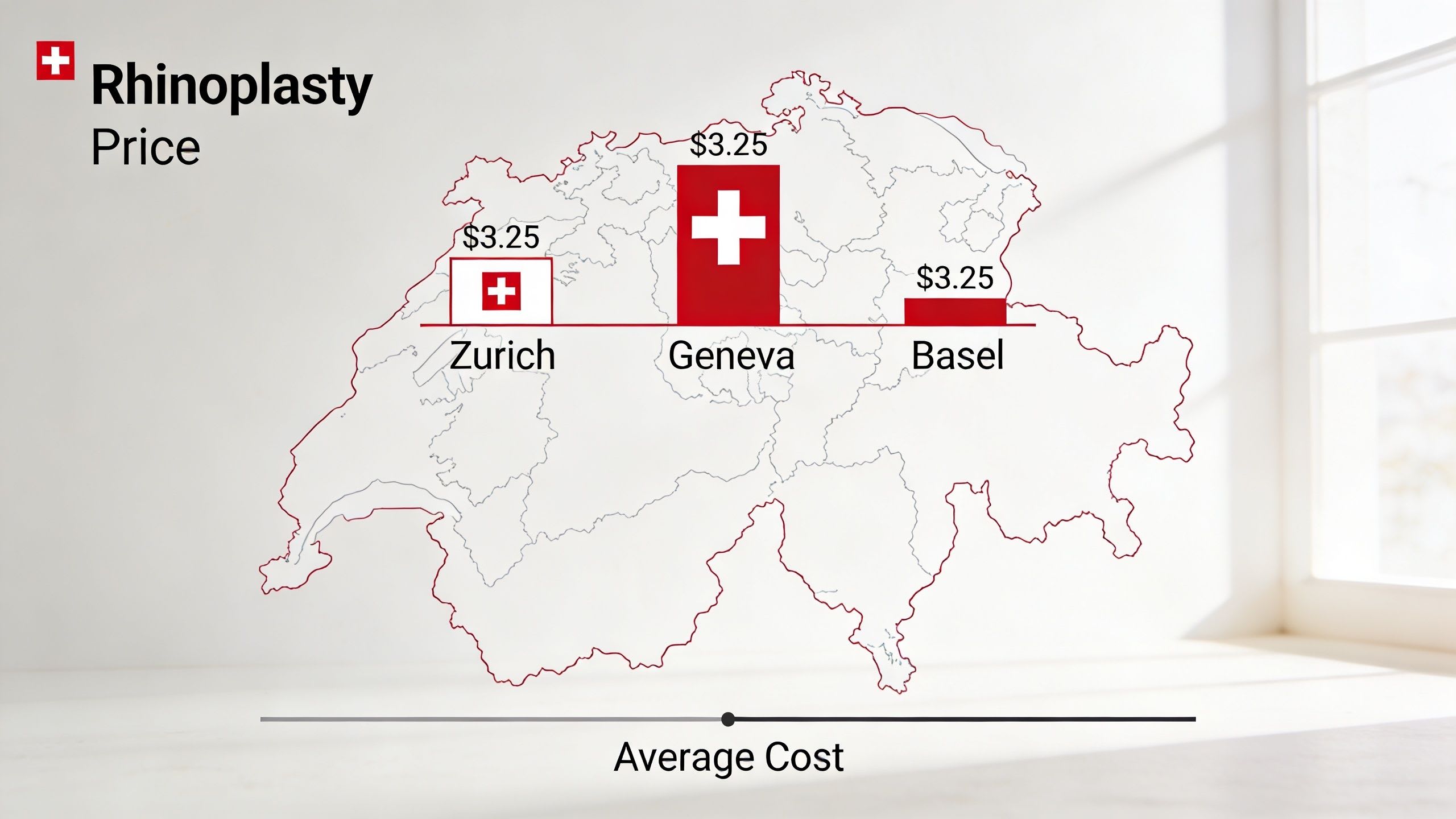
The broad national benchmark is clear. In Switzerland, rhinoplasty typically ranges from CHF 9,000 to CHF 14,000, with pricing above neighbouring Germany and Austria. The same source notes that Zürich clinics averaged CHF 11,500 and Geneva CHF 12,200 in a 2023 comparison, reflecting local demand and the Swiss premium linked to medical standards, facilities, and specialist qualifications, as outlined in this Swiss rhinoplasty price overview.
What the Swiss range actually means
That national range is best understood as a mid-to-upper market expectation for surgical rhinoplasty in Switzerland, especially in established urban clinics. It doesn’t mean every patient will receive the same operation for that amount.
A straightforward aesthetic case may sit differently from a nose that requires structural grafting, septal work, or correction after a previous operation. Geography also matters. Zürich and Geneva tend to price at a premium because they combine high clinic overheads with strong domestic and international demand.
Basel, Bern, Lausanne, Zug, and Lucerne can also vary, but the useful point is this: patients shouldn’t assume that moving from one city to another automatically creates a major saving once surgeon expertise and clinic standard are matched properly.
Why Switzerland costs more
The comparison with neighbouring countries is often the first thing patients notice. The same Swiss source places Germany at €6,000 to €9,000 and Austria at €6,500 to €9,500. Switzerland sits higher, and that difference isn’t random.
Several trade-offs sit behind the premium:
- Stricter specialist expectations: Patients in Switzerland often prioritise clearly verifiable qualifications.
- Higher facility standards: The operating environment is part of the total price.
- More expensive peri-operative infrastructure: Staffing, anaesthesia, and clinic overheads are generally higher.
- Urban demand effects: Especially in Zürich and Geneva, clinic pricing reflects location and patient volume.
A low quote only helps if it still delivers the right expertise, planning, and follow-up care.
Regional thinking for Swiss patients
If you live in Zürich, Geneva, Basel, Bern, Lausanne, or Lugano, your practical comparison should include more than clinic fees. Consider travel for consultations, ease of follow-up visits, and whether the surgeon regularly handles your specific anatomical concern.
A patient from Bern may decide that a local clinic is more practical for aftercare. Someone in Geneva may accept a higher local quote because they want a surgeon with very specific revision experience. Neither decision is automatically right or wrong.
Here’s the simplest way to read Swiss pricing:
| Region or context | What patients are usually paying for |
|---|---|
| Major city clinic | Convenience, brand positioning, high-demand scheduling, urban overheads |
| Highly specialised surgeon | Experience with difficult anatomy, revisions, or combined functional work |
| Full-service private setting | Anaesthesia coordination, clinic stay, structured aftercare, more comprehensive planning |
| Lower advertised starting price | Often a narrower case type, or a quote that may not include all cost components |
For most patients, the right question isn’t whether Switzerland is expensive. It is whether the quote reflects the level of safety, planning, and surgical judgement they want for a permanent facial procedure.
The Anatomy of a Quote A Detailed Rhinoplasty Cost Breakdown
The biggest source of confusion around the kosten einer nasenkorrektur is simple. Many online price references don’t itemise the bill clearly. This overview of missing cost transparency in rhinoplasty pricing notes that many sources fail to address Swiss-specific cost amplifiers such as premium facility fees, higher anaesthesiologist rates, and possible separate billing for 3D imaging or more complex post-operative care.
That’s why an apparently fair quote can still leave patients exposed to extra costs. What matters is whether the clinic has separated each cost component clearly enough for you to understand the total commitment.
What a complete quote should show
A serious quote should make it obvious who is doing what, where the surgery takes place, and what follow-up is included. If one line says “rhinoplasty package” without explanation, that’s not transparency.
Here is a practical way to read a quote.
| Cost Component | Typical Price Range (CHF) | What It Covers |
|---|---|---|
| Initial consultation | CHF 200 to CHF 500 | Assessment, discussion of goals, examination, treatment planning |
| Surgeon’s fee | Qualitative, varies by case | Surgical planning, operative work, technical complexity, specialist expertise |
| Anaesthesia | Qualitative, may be included or separate | Anaesthesiologist, monitoring, medication, recovery supervision |
| Facility or clinic fee | Qualitative, may be included or separate | Operating theatre, nursing team, equipment, room use, possible clinic stay |
| Imaging or planning tools | Qualitative, sometimes separate | Photography, 3D planning, case documentation |
| Post-operative care | Qualitative, may be included or limited | Routine follow-up visits, splint care, dressing changes, healing checks |
| Medication and aftercare supplies | Qualitative | Prescriptions, nasal care products, practical recovery items |
| Revision policy | Qualitative | Clarifies whether any corrective work is included, excluded, or assessed separately |
Where hidden costs usually appear
Patients tend to focus on the surgery itself. In reality, the less visible items often matter just as much. Common pressure points include:
- Separate consultation billing: The first visit may not be deducted from surgery.
- Imaging fees: Advanced planning tools may sit outside the main quote.
- Aftercare limits: Some clinics include routine follow-ups, but not prolonged care.
- Anaesthesia structure: It may be bundled, or billed in a separate line item.
- Facility charges: Premium clinic environments can change the final number materially.
What to look for: Ask whether the quote is all-inclusive for the expected treatment course, not only for the day of surgery.
How to compare two quotes properly
A lower quote isn’t automatically cheaper in real terms. If one clinic includes theatre use, anaesthesia, standard follow-up, and routine post-operative care, while another doesn’t, the apparent saving may disappear quickly.
When you review pricing, ask for written confirmation of:
- What is definitely included
- What may be added later
- Which events would trigger a new bill
- Who handles aftercare if recovery isn’t completely straightforward
Before and after galleries can also help you judge whether a quote aligns with the level of refinement you expect. Beauty-focused examples are only one part of the decision, but they’re often useful for understanding a surgeon’s style. You can review practical examples in this guide to rhinoplasty before and after results.
A simple test for quote quality
A strong quote answers basic financial questions without forcing the patient to guess. You should be able to understand the proposed operation, the treatment setting, the expected recovery support, and any likely exclusions in one clear document.
If you leave the consultation still unsure what the number covers, the quote isn’t ready for a decision.
Key Factors That Influence Your Final Rhinoplasty Cost
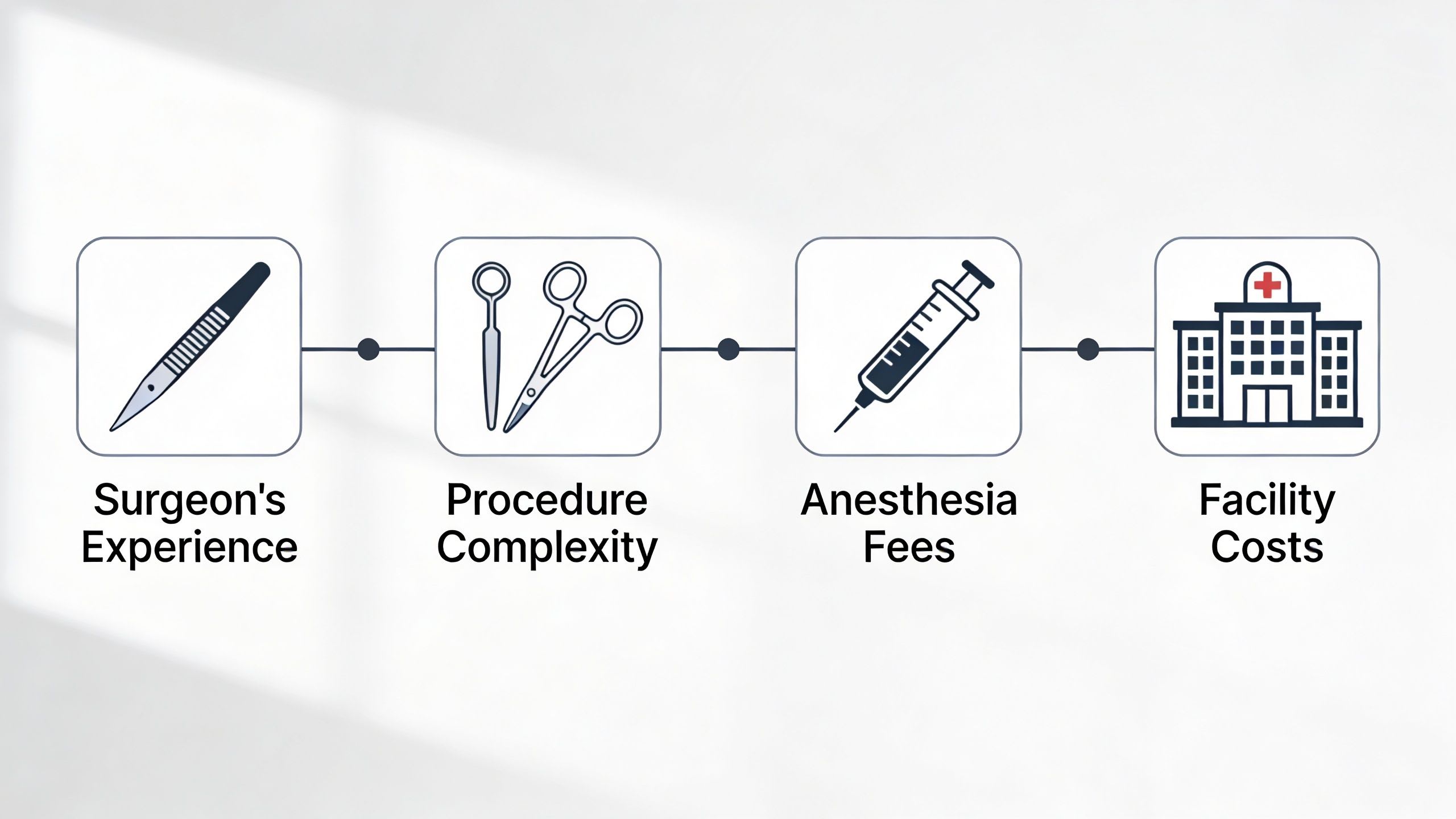
Swiss rhinoplasty pricing isn’t random. It follows complexity. The more demanding the anatomy, the more operative planning, technical difficulty, and surgical responsibility are involved.
This rhinoplasty pricing breakdown by procedure complexity outlines a clear tiered structure. Minor tip refinements can start at CHF 2,000 to CHF 5,400, complex functional-aesthetic cases can range from CHF 8,000 to CHF 15,000, and revision rhinoplasties often start at a minimum of CHF 9,000 to CHF 12,000 because of scar tissue, altered anatomy, and greater surgical difficulty.
Procedure type changes everything
A patient who wants a small adjustment to the nasal tip isn’t asking for the same operation as someone with collapse, asymmetry, breathing issues, or a previous unsatisfactory surgery. These are different categories of work.
The broad tiers usually look like this:
- Minor tip refinement: Lower complexity, limited reshaping, narrower operative scope
- Full aesthetic reshaping: Wider structural changes to the bridge, profile, or base
- Functional-aesthetic surgery: Breathing correction combined with appearance change
- Revision rhinoplasty: Secondary correction after prior surgery
That’s why “starting from” prices can be misleading. They often reflect the simplest case category, not the average real-world treatment need.
Revision surgery is in a different class
Revision cases deserve special attention because patients often underestimate them. A second operation usually involves scar tissue, less predictable anatomy, and the need to rebuild support rather than reshape visible contours.
This affects cost for a practical reason. The surgeon isn’t only changing the nose’s appearance. They may be solving structural problems created by the first operation, and doing so with less margin for error.
Revision rhinoplasty should never be judged by the logic of a simple cosmetic first procedure. It’s often reconstructive in its planning, even when the patient’s goal sounds aesthetic.
Surgeon qualification affects price for good reason
The surgeon’s background is one of the strongest cost drivers in Switzerland. In facial surgery, experience matters because small technical decisions have permanent consequences. The difference between a competent general cosmetic surgeon and a practitioner with deep rhinoplasty experience isn’t theoretical. It affects planning, judgement, and the ability to manage difficult anatomy.
Patients sometimes ask whether choosing a less expensive provider is reasonable for a “small change.” The honest answer is that nose surgery rarely behaves like a small change once healing, structure, airflow, and symmetry are involved.
Other cost variables patients should expect
Even within the same city, quotes move for reasons that are entirely legitimate:
| Cost driver | Why it changes the price |
|---|---|
| Anatomy | Thick skin, asymmetry, prior trauma, or deviation can complicate planning |
| Technique | Closed and open approaches don’t involve the same visibility or scope |
| Functional work | Septal or airway correction increases operative demands |
| Clinic setting | Private surgical infrastructure and staffing standards differ |
| Follow-up intensity | Some patients need a more hands-on recovery pathway |
The most useful mindset is to stop seeing price as a flat market rate. For rhinoplasty in Switzerland, cost is usually a reflection of difficulty, expertise, and the amount of clinical support built around the surgery.
Surgical vs Non-Surgical Rhinoplasty A Cost and Outcome Comparison
Not every patient needs surgery. Some need structural change. Others only want to smooth a contour, lift the tip slightly, or camouflage a profile irregularity. That’s where the distinction between surgical and non-surgical rhinoplasty becomes important.
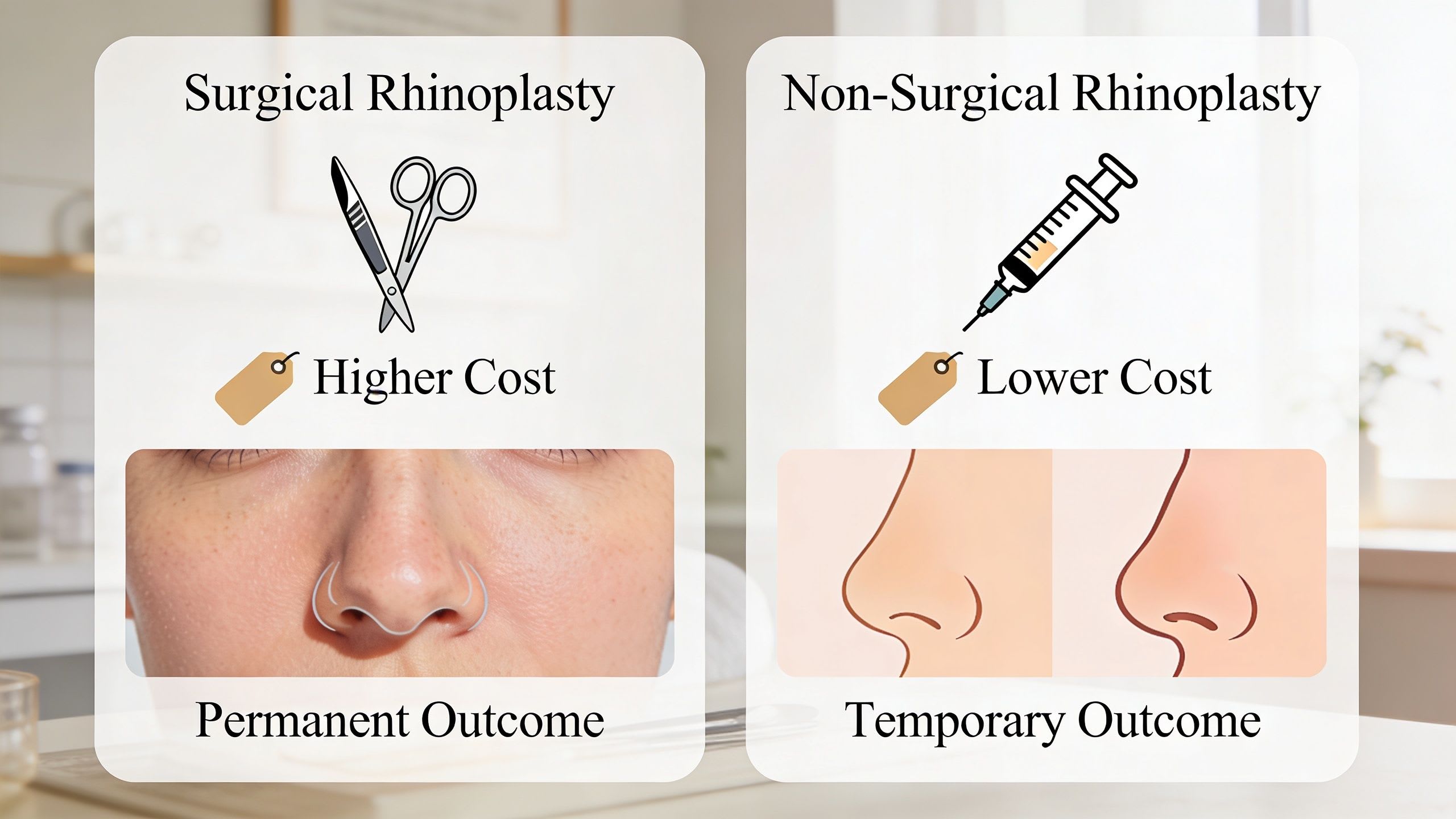
The complexity-based source cited earlier also notes that non-surgical rhinoplasty options such as dermal fillers or thread lifts typically cost CHF 700 to CHF 2,200 and offer temporary results of 6 to 12 months, while surgical options sit in higher cost tiers but aim for lasting structural change.
Side-by-side comparison
| Decision point | Surgical rhinoplasty | Non-surgical rhinoplasty |
|---|---|---|
| Upfront cost | Higher | Lower |
| Longevity | Intended as a permanent structural result | Temporary, usually needs maintenance |
| What it can change | Shape, projection, width, structure, airflow in relevant cases | Camouflage and subtle contour adjustment only |
| Recovery | More involved | Usually lighter and faster |
| Best for | Patients who want durable anatomical change | Patients who want limited, reversible refinement |
When non-surgical treatment works well
A filler-based approach can make sense if the goal is modest and highly specific. For example, some patients want to soften the appearance of a dorsal irregularity or create a straighter visual profile without surgery.
It does not reduce nose size. It also doesn’t correct internal structural problems or produce the same degree of tip reshaping as surgery.
When surgery is the better financial decision
The lower upfront cost of fillers is appealing, but patients should think in terms of outcome, not only entry price. If your goal is permanent reshaping, repeated temporary treatments may become less satisfying over time because they don’t solve the underlying anatomy.
Some patients are ideal filler candidates. Others are using fillers to postpone the operation they already know they want.
That’s the key trade-off. Non-surgical rhinoplasty can be a useful temporary tool. It isn’t a substitute for surgical change when the anatomy itself needs to be altered.
Financing and Health Insurance for Your Nasenkorrektur
Swiss patients often ask two separate questions that should be kept apart. First, will health insurance pay anything? Second, if it won’t, can the clinic help spread the cost?
For purely aesthetic rhinoplasty, the answer on insurance is usually straightforward. Mandatory basic Swiss insurance does not cover cosmetic procedures done only for appearance. If the surgery is medically necessary, such as a documented functional problem affecting breathing, reimbursement may be possible. The verified data provided for this topic notes that basic insurance can reimburse up to 80 to 90 percent in medically necessary cases when properly documented.
When insurance may apply
Coverage is generally considered only when the operation addresses function rather than beauty alone. That usually means the clinic or surgeon must document a genuine medical indication, and the insurer must accept it.
Common practical points include:
- Functional symptoms matter: Breathing impairment is handled differently from aesthetic dissatisfaction.
- Documentation matters: Medical records and formal assessment are central.
- Combined procedures need clarity: If surgery includes both functional and aesthetic elements, the funding split may not be simple.
Patients shouldn’t assume that because part of the operation is functional, the entire bill will be covered. The insurer may distinguish between medically necessary components and cosmetic refinements.
Financing outside insurance
Where insurance doesn’t apply, some Swiss clinics offer staged payment arrangements or work with external financing providers. The available source material for this topic also points out a market gap here. Transparent Swiss-wide data on financing models is limited, which means the only reliable way to judge options is to ask each clinic directly.
A sensible approach is to discuss:
- Whether instalment payments are available
- When payment is due in relation to surgery
- Whether consultation fees are separate
- How additional costs would be handled if the treatment plan changes
A practical mindset
Financing can help with cash flow. It shouldn’t be used to make a borderline decision feel affordable. A permanent facial procedure still needs to stand on its own merits, both medically and financially.
The best financial plan is one that leaves room for recovery needs and follow-up, not only the operation date itself.
Choosing a Qualified Surgeon Why Expertise Is Worth the Cost
If patients remember only one thing about the kosten einer nasenkorrektur, it should be this. The surgeon is not the place to treat rhinoplasty like a commodity. The nose is central to the face, structurally complex, and unforgiving of poor judgement.
In Switzerland, higher fees often reflect stricter credentialing, more specialist training, and a more controlled treatment environment. That doesn’t mean an expensive quote is automatically the right one. It does mean that expertise has to be checked, not assumed.

What FMH and MedReg mean in practice
Two of the most useful checks for Swiss patients are:
- FMH specialist recognition, particularly in Plastic, Reconstructive and Aesthetic Surgery
- MedReg registration, which allows you to confirm that a physician is properly listed in the Swiss medical register
These checks don’t replace a consultation. They do help filter out uncertainty before you get that far.
How to verify a surgeon properly
A practical screening process looks like this:
- Confirm identity and registration
- Check specialist title
- Ask how much of their work is rhinoplasty
- Review case style, not only beauty level
- Test the consultation quality
The right consultation often sounds more cautious than the wrong one.
Red flags worth taking seriously
Patients should pause if they encounter:
- Unclear credentials
- No written cost breakdown
- Overly optimistic promises
- Dismissive answers about breathing, healing, or revision risk
- Heavy emphasis on booking quickly rather than understanding the plan
For readers comparing clinics, directories can help with the first layer of screening. For example, plastic surgery group listings on BeautyGuide can support early comparison of providers and profiles, but credential checks and consultation quality still matter more than presentation.
Why expertise justifies the premium
A skilled rhinoplasty surgeon produces more than a prettier nose. They balance shape, airflow, tissue behaviour, and long-term stability. That judgement is part of what Swiss patients are paying for.
When the operation is done well, the higher fee often reflects planning discipline, operative precision, and a lower chance of needing to solve avoidable problems later. In nose surgery, that’s not a luxury. It’s the core of the value.
Your Consultation Checklist Questions to Ask About Cost
A consultation should leave you with enough clarity to make a decision without guessing. If cost still feels vague afterwards, the conversation wasn’t specific enough.
Bring written questions. That keeps the discussion practical and makes it easier to compare clinics fairly.
Questions that matter most
- What exactly is included in the quoted price?
- Which items could be billed separately?
- Is the consultation fee separate from the surgery fee?
- If the operation changes after examination, how does the quote change?
- What is your policy on revision or corrective treatment?
Questions about logistics and planning
- Will I need an overnight stay, and is that included?
- Who handles my follow-up appointments?
- What costs should I expect after surgery, such as medication or additional checks?
- Do you offer payment plans or staged payment options?
- If insurance may cover the functional part, who prepares the documentation?
Ask for the final quotation in writing. Verbal reassurance is not the same as cost clarity.
One more useful preparation step is reviewing what a structured first visit should look like. This guide on what to expect during a first aesthetic consultation can help you spot whether the clinic is approaching the discussion with the level of detail a surgical decision deserves.
If you’re comparing the kosten einer nasenkorrektur in Switzerland, BeautyGuide helps you continue that research with a Swiss clinic directory focused on verified medical credentials, treatment categories, and city-based comparison across locations such as Zürich, Geneva, Basel, Lausanne, Bern, Lucerne, Lugano, and Zug.
This article is for informational purposes only and does not replace professional medical advice.