
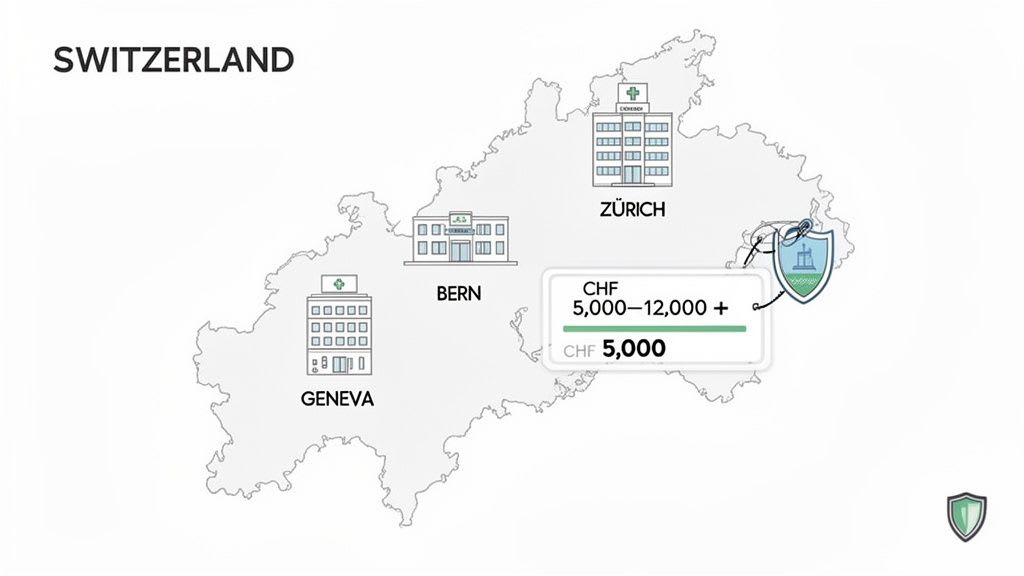
When you begin researching hair transplantation, the cost is often the primary concern. In Switzerland, the investment for a high-quality procedure typically ranges from CHF 5,000 to over CHF 12,000. This price is not arbitrary; it is a direct reflection of the exceptionally high medical standards, advanced technology, and quality of care inherent to the Swiss healthcare system.
Understanding Hair Transplant Costs in Switzerland
This guide serves as a financial map for your hair restoration journey in Switzerland. We will break down every element contributing to the final cost, as it is never a single flat number. The price is a composite of several key factors, from the specific surgical technique used to the surgeon's expertise and the clinic's location.
Why Swiss Quality Is Reflected in the Cost
Switzerland's reputation for medical excellence is world-renowned and naturally influences its pricing structure. The country operates under strict regulations from authorities like Swissmedic, which sets a very high bar for safety, hygiene, and the qualifications of medical professionals. This ensures that whether you choose a clinic in Zürich, Geneva, or Bern, you are investing in a procedure performed in a top-tier, controlled environment by a skilled medical team.
So, what does the cost cover? It primarily includes:
The Surgeon's Expertise: You are not just paying for a procedure; you are investing in the surgeon's experience. A doctor with an FMH (Swiss Medical Association) specialisation in plastic, reconstructive and aesthetic surgery or dermatology has dedicated years to mastering their craft, and this expertise is a significant component of the cost.
Advanced Technology: Leading clinics invest heavily in the latest tools, such as high-precision DHI implanters or robotic FUE systems. This technology can lead to more refined results but also increases clinic overheads, which influences the price.
Comprehensive Care: The final figure usually covers more than the surgery itself. It typically includes initial consultations, professional anaesthesia administration, and crucial post-operative check-ups that ensure your recovery is monitored and supported.
Setting Realistic Financial Expectations
It is important to approach this with a clear understanding of the potential investment. Data analysis across numerous clinics indicates an average price for a hair transplant in Switzerland of approximately CHF 10,000. This highlights the consistent pricing at the premium end of the market, which is aligned with the high standards of care.
To provide a quick sense of what to expect for different needs, here is a general breakdown.
Estimated Hair Transplant Costs in Switzerland at a Glance
This table offers a summary of typical cost ranges for common hair transplant scenarios in Switzerland, helping you to better gauge the potential investment.
| Treatment Scenario | Average Graft Count | Estimated Cost Range (CHF) |
|---|---|---|
| Small Session (e.g., hairline refinement) | 800 - 1,200 Grafts | CHF 5,000 - CHF 7,500 |
| Medium Session (e.g., crown coverage) | 1,500 - 2,500 Grafts | CHF 7,500 - CHF 10,000 |
| Large Session (e.g., extensive coverage) | 2,500 - 4,000+ Grafts | CHF 10,000 - CHF 12,000+ |
This should provide a solid starting point for your financial planning.
Our goal is to give you the clarity needed to navigate the financial aspects of your decision. By understanding how the transplant method, graft count, and clinic choice affect the final price, you can have more productive discussions with prospective clinics. For more information on finding the right provider, see our guide on selecting the best hair transplant clinics in Switzerland.
Platforms like BeautyGuide.ch can simplify this search by connecting you directly with verified, reputable clinics across the country, helping to ensure your journey is built on a foundation of trust and transparency from the start.
What Factors Determine the Final Cost of a Hair Transplant?
When you receive a quote for a hair transplant, the final number is a careful calculation based on several key variables that directly impact the quality and outcome of your result. Understanding these components is the first step in making an informed decision about the kosten haartransplantation schweiz.
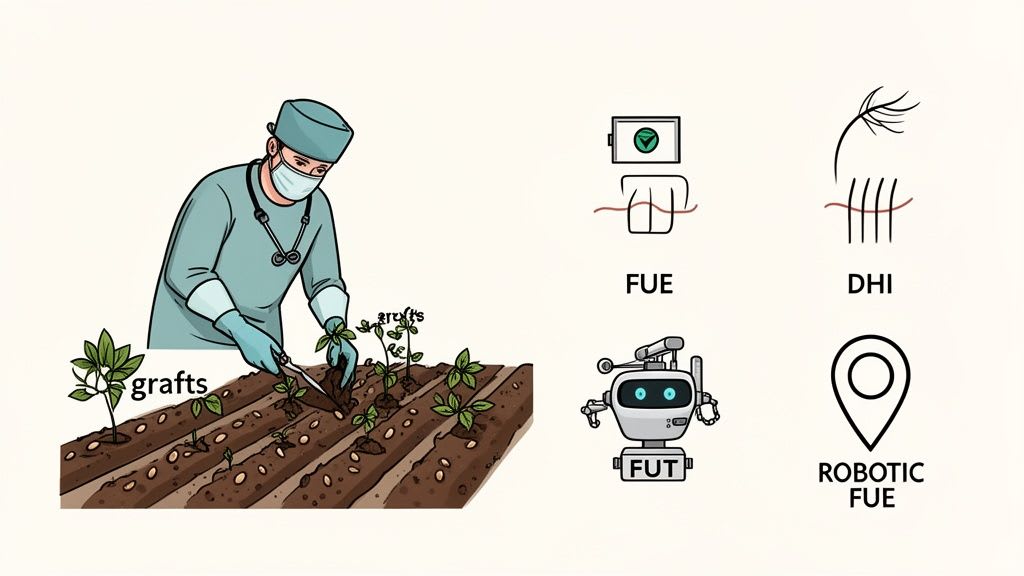
The single most significant factor driving the price is the number of grafts required. A "graft" is a small anatomical unit of skin containing one to four hair follicles.
For context, refining a small area of a thinning hairline is like planting a few seeds in a small pot. Restoring hair across the entire crown, however, is more like planting a meadow. The first scenario requires far fewer grafts and will naturally cost less than the second.
During your consultation, the surgeon will evaluate your level of hair loss—often using a classification system like the Norwood scale—to determine how many grafts are needed to achieve the desired density and coverage. This number becomes the core of your cost calculation.
How Surgical Method and Technology Affect the Price
The specific technique the surgeon employs for your procedure also has a major impact on the final bill. In Switzerland, leading clinics offer several methods, each with a different price point based on the required skill, time, and technology.
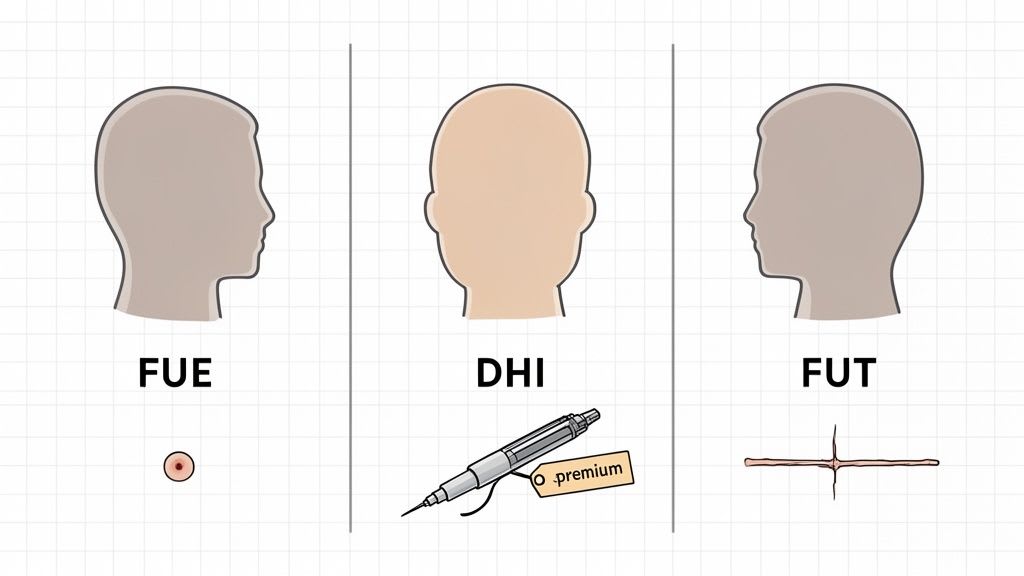
Follicular Unit Extraction (FUE): This is the predominant method. The surgeon extracts each follicular unit individually, a process that is incredibly detailed and meticulous. Its primary advantage is that it leaves virtually no noticeable linear scarring.
Direct Hair Implantation (DHI): DHI can be considered a more precise variant of FUE. It uses a specialised instrument, the Choi implanter pen, which allows the surgeon to place each graft with complete control over its angle and depth. This level of artistry takes more time and skill, so it often comes at a higher price but can deliver very natural-looking results.
Follicular Unit Transplantation (FUT): Sometimes called the "strip method," FUT involves removing a thin strip of scalp from the donor area. It can be a highly effective and more cost-efficient option per graft, especially for cases requiring a large number of grafts, but it does leave a fine linear scar.
Some clinics have also invested in advanced tools like robotic FUE systems. These machines use AI-powered imaging to assist the surgeon in extracting grafts with high precision. While this can enhance the procedure, the technology itself is a significant investment, and that cost is naturally reflected in the price.
The Value of Surgeon Expertise and Clinic Reputation
A large part of the cost is associated with peace of mind. The skill and experience of your surgeon are, without question, the most important factors for your safety and for achieving an aesthetically pleasing and natural-looking result.
In Switzerland, look for surgeons with an FMH (Foederatio Medicorum Helveticorum) specialisation. This title signifies that a doctor has completed years of rigorous, standardised training in fields such as plastic, reconstructive and aesthetic surgery or dermatology. It is a true hallmark of Swiss quality and expertise.
A surgeon who has built a reputation for excellent results over many years will justifiably command a higher fee for their services. You are not just paying for the procedure; you are investing in their proven skill, artistic eye, and ability to manage risks.
Finally, the clinic's own standing and location play a role. A state-of-the-art facility in the centre of Zürich or Geneva will have higher operational costs—rent, highly trained staff, and general overheads—than a smaller practice in a different town. These costs are part of the price of treatment. In return, however, you often gain access to premium facilities, a high-calibre patient experience, and an entire team dedicated to your care.
Cost Breakdown by Hair Transplant Technique
When you begin reviewing quotes for a hair transplant in Switzerland, you will quickly notice that the technique your surgeon recommends plays a significant role in the final price. This is not just a financial consideration. The most suitable method depends on your unique hair loss pattern, your aesthetic goals, and even your lifestyle. Understanding the differences is the first step toward making an informed decision about the kosten haartransplantation schweiz.
Hair loss is a significant concern for many, and the search for effective solutions is ongoing. It may be surprising to learn that Switzerland has one of Europe's highest reported rates of male pattern hair loss, at 38.53%. This figure underscores why hair transplantation has become such a widely accepted and trusted procedure here. You can explore these trends further by reviewing the full 2026 hair transplant statistics from Market Media.
Follicular Unit Extraction (FUE): The Popular Choice
If you have done any research, you have likely encountered Follicular Unit Extraction, or FUE. It is by far the most well-known and widely practised technique in Swiss clinics today. The process is highly meticulous: a surgeon uses a specialised micro-punch tool to carefully extract individual hair follicles—the grafts—directly from the donor area, typically the back of the head. These grafts are then delicately implanted into the areas where hair is thinning.
Because every graft is removed one by one, FUE is labour-intensive and demands incredible precision from the medical team. Its popularity stems from its main advantage: it avoids the long, linear scar associated with older methods. Instead, it leaves tiny, dot-like scars that are practically invisible once the hair grows, making it an ideal choice if you prefer to wear your hair short.
Best For: Those who want minimal scarring, prefer shorter hairstyles, or require a moderate number of grafts.
Cost: Tends to fall in the mid-to-high price range. The detailed, manual work involved explains its price point.
Direct Hair Implantation (DHI): The Precision Method
Direct Hair Implantation (DHI) can be viewed as a highly advanced variant of FUE. The key difference is a unique tool called a Choi Implanter Pen. This device allows the surgeon to implant each graft directly into the scalp without needing to create the recipient sites beforehand.
This "one-step" process gives the surgeon exceptional control over the depth, angle, and direction of every single hair. This level of artistry is what helps create dense and natural-looking hairlines. The skill required for DHI is top-tier, and that is reflected in the cost.
DHI is often the preferred method for highly visible areas like the frontal hairline or for adding density between existing hairs, as the Choi pen minimises disruption to surrounding follicles.
Follicular Unit Transplantation (FUT): The Strip Method
Follicular Unit Transplantation, also known as the "strip method," is the most traditional of the three main techniques. With FUT, the surgeon removes a thin strip of skin containing healthy hair from the donor area. This strip is then passed to a skilled team who, under high-magnification microscopes, dissect it into individual follicular units for implantation.
Although FUE has become more common, FUT remains an excellent and highly effective option, particularly for individuals needing a large number of grafts to address extensive baldness. Because many grafts can be harvested at once, the cost-per-graft for FUT is often lower than for FUE or DHI. The trade-off is a fine, linear scar in the donor area, which is easily concealed as long as you do not wear your hair shaved or extremely short.
Best For: Individuals with advanced hair loss who require a high graft count and do not plan on a very short hairstyle.
Cost: Often the most economical option on a cost-per-graft basis, making it a viable choice for large-scale restorations.
To help you see how these techniques compare, we have put together a simple table.
Comparison of Hair Transplant Techniques in Switzerland
This table breaks down the key differences between FUE, DHI, and FUT. Reviewing everything from cost and procedure to recovery can help you and your surgeon decide which path is best for your specific needs and goals.
| Technique | Average Cost per Graft (CHF) | Best For | Key Feature |
|---|---|---|---|
| FUE | CHF 4.50 – CHF 7.00 | Minimal scarring, shorter hairstyles, moderate hair loss. | Individual graft extraction leaves tiny, virtually invisible dot scars. |
| DHI | CHF 5.50 – CHF 8.50 | High-density in visible areas (e.g., hairline), working around existing hair. | Choi Implanter Pen allows for direct implantation, giving maximum control. |
| FUT | CHF 3.00 – CHF 5.50 | Extensive hair loss requiring a high number of grafts (3,000+). | A strip of tissue is removed, allowing for a high yield of grafts at once. |
Ultimately, the best technique is the one that aligns with your level of hair loss, budget, and desired final appearance. Discussing these pros and cons openly with a qualified surgeon is the most important step you can take.
How Location Affects Hair Transplant Prices in Switzerland
When researching hair transplant costs, one of the first things you will notice is that the price can vary depending on where you are in Switzerland. The clinic’s location plays a significant part in the final bill, with a clear difference between major cities and smaller towns. Understanding why can help you find the right balance between cost, quality, and convenience.
The kosten haartransplantation schweiz are almost always highest in major hubs like Zürich and Geneva. This is not a coincidence; it is a matter of economics. Clinics in these prime locations face much higher operational costs, from expensive commercial rent for their modern facilities to the competitive salaries needed to retain top-tier medical teams.
This premium also reflects the fact that the most renowned, highly specialised clinics tend to be concentrated in these cities, attracting a national and international patient base. So, while you may pay more, that higher price often means access to some of the most esteemed surgeons and the very latest technology.
Pricing Differences Between Major and Minor Cities
While Zürich and Geneva sit at the top of the price scale, you can often find slightly more moderate pricing in other key Swiss cities.
Basel, Bern, and Lausanne: These cities are home to excellent medical facilities and skilled surgeons. The clinic's operational costs might be somewhat lower than in Zürich or Geneva, and sometimes this saving is passed on to the patient.
Lugano and Smaller Cantonal Capitals: You may find more competitive prices in clinics located in less populated areas, simply because their overheads are lower. However, there are typically fewer specialised hair transplant clinics to choose from, so thorough research is essential.
It is crucial to remember that while the price might fluctuate, the standard of medical care should not. Swiss medical regulations, overseen by bodies like Swissmedic and the FMH, apply nationwide. This ensures a consistent level of safety and quality, whether you're in a bustling city centre or a quiet town.
A lower price in a smaller city does not automatically signal lower quality, but it does mean you need to be extra diligent. The surgeon’s qualifications, hands-on experience, and the clinic's verifiable results should always be your top priorities. Location is a secondary factor.
Balancing Cost, Convenience, and Expertise
So, should you travel from Lugano to Zürich for your procedure? It comes down to what you value most. For many, having the treatment close to home is a significant advantage. It simplifies logistics, especially for the initial consultation and any follow-up visits.
On the other hand, if the most suitable surgeon for the specific technique you require—such as a complex DHI procedure to rebuild your hairline—is based in a major city, the extra travel and cost could be a wise investment in achieving your desired result. If you are considering options in Switzerland's largest city, our guide to the top-rated hair transplant clinics in Zürich is a great place to start comparing specialists.
Ultimately, the best decision strikes a balance between cost, convenience, and—most importantly—the confidence that you are in the hands of an expert. Using a platform like BeautyGuide.ch to research verified clinics across Switzerland helps ensure your choice is based on trust and quality, not just geography.
What Is Included in Your Price Quote and What Is Not
When you begin exploring the kosten haartransplantation schweiz, receiving your first price quote is a significant step. But the number on the page is only part of the story. The key is to know precisely what that figure covers—and, more importantly, what it does not. A professional Swiss clinic will provide an itemised breakdown, leaving no room for ambiguity or unexpected costs later on.
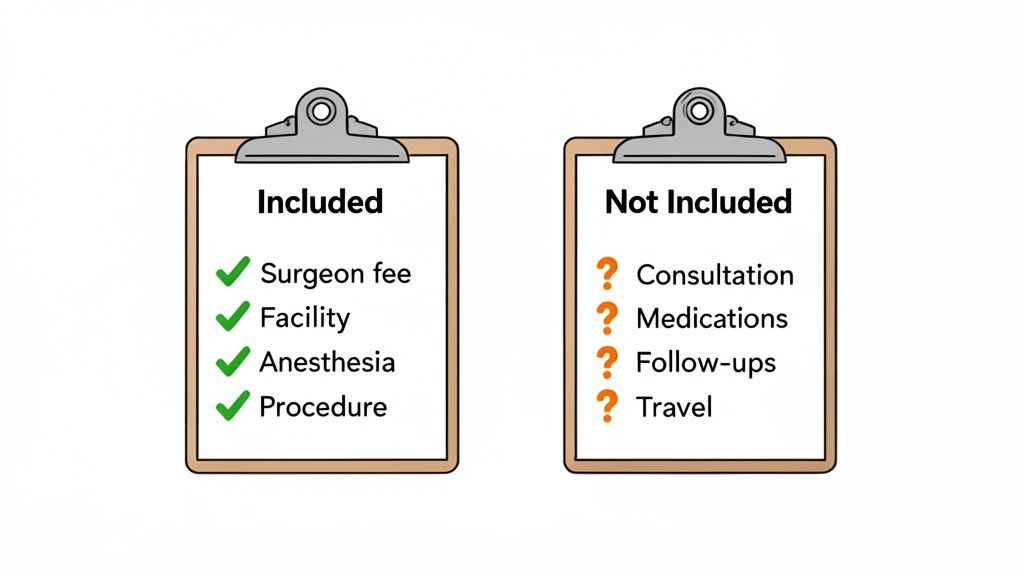
Think of the estimate as the financial road map for your entire procedure. To ensure you do not take a wrong turn, let's break down what should be included in the main price and what often appears as an additional expense.
What Should Be in the Main Price
A comprehensive quote from a reputable Swiss clinic bundles all the core surgical costs into one clear price. This figure should represent the complete service you receive on the day of your procedure.
Here’s what you can expect to be covered:
The Surgeon's Fee: This is the largest part of the bill, and for good reason. It covers the surgeon's expertise, their years of specialised training (e.g., FMH credentials), and the delicate skill required to perform the transplant.
Surgical Facility Costs: This includes the use of the sterile operating theatre, all sophisticated equipment (like FUE or DHI tools), and the medical supplies used during your surgery.
Anaesthesia and Anaesthetist's Fee: Your comfort and safety are paramount. This fee covers the local anaesthesia and the professional who administers it, ensuring the entire process is pain-free.
The Procedure Itself: This is the cost for the hours of meticulous work performed by the surgeon and their technical team as they carefully extract and implant each graft.
These four items are the absolute essentials. They form the foundation of a safe, high-quality hair transplant that meets Switzerland’s rigorous medical standards.
Potential Costs That May Not Be Included
Beyond the surgery itself, there are other services and products you will need. Some clinics roll these into an all-inclusive package, but many list them separately. It is your responsibility to ask for clarification.
When you review a quote, your primary goal should be to get a full picture of the total investment. Never assume something is included unless you see it in writing. This simple step can prevent stress and unexpected bills.
Here’s a checklist of potential extra costs to discuss during your consultation:
Initial Consultation Fee: Some clinics offer this for free, while others charge a fee. It’s worth asking if this fee is credited toward the procedure cost if you decide to proceed.
Pre-Operative Tests: Depending on your medical history, you might need blood work or other tests to confirm you are a suitable candidate for surgery.
Post-Operative Medications: You will need prescriptions for items like painkillers, anti-inflammatories, and antibiotics to ensure comfort and prevent infection.
Specialised Aftercare Products: Clinics almost always recommend special shampoos, foams, or lotions to protect your scalp and new grafts.
Follow-Up Appointments: Clarify how many post-operative check-ups are included. Are appointments a year later still covered, or do they incur a separate charge?
Future Touch-Up Sessions: Sometimes, a small follow-up procedure is needed a year or two later for added density. Ask if the clinic offers a preferential rate for existing patients.
Getting clear answers to these questions is the best way to budget accurately. It allows you to move forward with your decision, feeling confident that you know exactly where you stand financially.
Navigating Insurance and Financing Options in Switzerland
A hair transplant is a significant decision, both personally and financially. Once you start seriously considering the procedure, one of the first questions that arises is about the kosten haartransplantation schweiz and how to pay for it.
Let's address the topic of insurance directly and then explore the financing options available to help you plan your budget with confidence.
The Role of Swiss Health Insurance
Many people hope their health insurance might cover at least part of the cost. Unfortunately, in Switzerland, this is almost never the case.
The Swiss healthcare system categorises hair transplants as a purely cosmetic procedure, not a medical necessity. This distinction is what dictates insurance coverage.
Basic Health Insurance (Grundversicherung): Your mandatory insurance is designed to cover essential medical care. Since common hair loss (androgenetic alopecia) is not a threat to your physical health, a hair transplant is not included in the list of covered benefits.
Supplemental Insurance (Zusatzversicherung): Even with a top-tier supplemental plan that covers extras like private rooms or alternative therapies, purely cosmetic surgeries are almost always excluded. The only rare exception might be reconstructive surgery required after an accident or illness, which does not apply to typical pattern baldness.
Therefore, it is best to approach this process with the expectation of covering the full cost yourself.
It is essential to approach your budget with the clear expectation that the full cost of the hair transplant will be your responsibility. This allows for realistic financial planning from the very beginning.
Exploring Financing and Payment Plans
Recognising that this is a major investment, many leading clinics in Switzerland offer ways to make the cost more manageable. These are designed to help you spread out the payments, but it is important to understand how they work.
Third-Party Medical Loans
Many clinics have partnerships with specialised medical financing companies. This functions like a personal loan tailored for medical procedures. You apply, and if approved, the finance company pays the clinic on your behalf. You then repay the loan to the company in monthly instalments over a set period. Be sure to carefully review the interest rates and terms, as they can vary.
In-House Payment Plans
Some clinics may offer their own payment plans directly. This could involve splitting the total cost into a few instalments. These can sometimes be interest-free but often require the balance to be fully paid before your procedure date or shortly after. Always request the terms in writing to avoid any misunderstandings.
When considering any financing option, take your time. Read the fine print, get a clear picture of the interest rates, and ensure the monthly payments are manageable for your budget. Careful planning ensures your focus can remain where it belongs: on achieving a successful outcome.
Frequently Asked Questions About Hair Transplant Costs
Even after researching the kosten haartransplantation schweiz, a few practical questions often remain. Let's address some of the most common queries to help you feel confident about your next steps.
Why Are Hair Transplants in Switzerland More Expensive Than in Other Countries?
The cost difference primarily comes down to Switzerland's exceptionally high standards across the board. The price is not arbitrary; it reflects the entire medical ecosystem. This includes the country's high cost of living and, more importantly, the rigorous oversight from regulatory bodies like Swissmedic.
Furthermore, you are paying for the expertise of surgeons with demanding qualifications, such as an FMH specialisation. This ensures you are treated in a world-class medical setting with state-of-the-art equipment. It also means you have a local, accountable Swiss provider for all your follow-up care, which is critical for a successful long-term outcome.
Can I Find a Quality Hair Transplant for Under CHF 5,000 in Switzerland?
For a standard procedure, finding a quality transplant under CHF 5,000 is highly unlikely. However, this price point might be possible for very small-scale work, such as refining a tiny section of the hairline or concealing a scar that requires only a few hundred grafts.
Be very cautious of any offer that seems unusually low. A "bargain" price can be a red flag for an inexperienced team, outdated technology, or a quote with hidden fees. When it comes to a medical procedure on your body, investing in quality and safety is always the wiser long-term decision.
A price that seems too good to be true often is. In Switzerland's regulated market, cost is a direct reflection of the quality, safety, and expertise involved in the procedure.
Is the Payment Per Graft or a Flat Fee?
Most clinics in Switzerland use a cost-per-graft model. This is generally the most transparent way to price a procedure because the final bill is directly tied to the amount of work required for your specific degree of hair loss.
Some clinics may offer a package deal or a capped flat fee, especially for very large sessions involving thousands of grafts. To avoid any surprises, always insist on a detailed quote breaking down the estimated graft count and the price for that number. Keep in mind that the final count can sometimes vary slightly on the day of the procedure, which your surgeon will discuss with you.
If you want to see what different graft counts can achieve, our gallery of hair transplant before and after photos is a helpful resource.
How Can I Get an Accurate Price Estimate for My Situation?
There is only one way to get a reliable, personalised cost: a professional consultation. No online calculator can replace a surgeon’s expert assessment.
During the consultation (which can be in-person or virtual), the surgeon will evaluate:
The current state of your hair loss (often using the Norwood scale).
The health and density of your donor area.
* Your personal goals for the final look and hairline.
This assessment allows them to create a customised treatment plan and provide you with an accurate cost. The best first step is to use a platform like BeautyGuide.ch to connect with verified and reputable Swiss clinics for a consultation. It is the only way to get the concrete answers you need to move forward.
Explore More
This article is for informational purposes only and does not replace professional medical advice.