
You may be at the point where waxing no longer feels simple. The appointment itself is brief, but the cycle never ends. Hair returns, the skin becomes reactive again, and you book the next session because there isn't a real stopping point.
That's where the question laser haarentfernung oder waxing becomes more than a grooming preference. In Swiss practice, it's usually a decision about long-term results, skin tolerance, scheduling, and whether you want to keep paying for temporary clearance or move towards sustained reduction.
The Choice Between Temporary and Permanent Hair Removal
Most patients compare these two methods at a practical moment. They're tired of arranging appointments every few weeks, dealing with regrowth, or managing irritation in areas such as the underarms, bikini line, legs, or upper lip. Waxing still has a place, especially when someone wants immediate hair removal without committing to a treatment course. But it remains a repeat service by design.
Laser hair removal sits in a different category. It's a clinic-based treatment aimed at reducing future hair growth rather than only removing what is visible today. That difference matters if your real goal is less maintenance over time.
A quick side-by-side view makes the decision clearer:
| Factor | Laser Hair Removal | Waxing |
|---|---|---|
| Main goal | Long-term hair reduction | Temporary hair removal |
| Mechanism | Uses light energy to disable the follicle | Pulls hair out from the root |
| Best fit | Patients seeking sustained reduction | Patients wanting immediate, short-term smoothness |
| Appointment pattern | Course of sessions, then occasional maintenance | Ongoing repeat appointments |
| Hair colour limitations | More effective when melanin is present in the hair | Works regardless of pigment |
| Skin considerations | Requires assessment of skin and hair contrast | Can be irritating in sensitive areas |
In Switzerland, patients also tend to weigh convenience differently. Someone commuting in Zürich, working in Geneva, or balancing family life in Basel often values fewer future appointments as much as the cosmetic result itself. That's one reason laser consultations have become a common comparison point alongside traditional waxing services such as waxing appointments in Zürich.
Clinical perspective: If you want smooth skin for an event or holiday, waxing can still be appropriate. If you want to reduce how often hair comes back, waxing can't do that by itself.
The useful way to compare them isn't “which is better”. It's “which result are you buying”.
Understanding the Mechanisms Laser vs Waxing
The most important distinction is simple. Laser targets the follicle. Waxing targets the hair. That's why the long-term outcome differs so much.
How laser works
Professional laser treatment uses concentrated light energy. In Swiss clinic practice, professional diode laser hair removal requires a wavelength of up to 1060 nm to thermally destroy the hair follicle's holding apparatus, and the technology depends on melanin as the target. That's why it works best on darker hair and has limitations with very light, grey, blonde, or red hair, as outlined in this Swiss comparison of laser and waxing.
The practical consequence is straightforward. The darker the hair, the easier it is for the device to identify the target. The laser energy travels through the pigment in the hair structure and converts to heat where it needs to act.
This is also why laser isn't judged after one visit. Clinics usually treat hairs that are present and biologically available at that moment. Other follicles are in different phases and need later sessions.
How waxing works
Waxing uses mechanical traction. The strip or wax mass grips the hair and removes it from the root area, but it doesn't disable the follicle's ability to produce another hair. The hair is gone for a while, but the structure that makes it regrow remains active.
For many patients, that creates a familiar pattern:
- Smoothness now: The area feels clear immediately after treatment.
- Regrowth soon after: Hair gradually returns over the following weeks.
- Repeat dependence: The method only works if you keep booking again.
Waxing does have one advantage in this mechanism comparison. It doesn't depend on pigment. If the goal is to remove visible hair regardless of colour, waxing can do that.
Why the mechanism matters in practice
A treatment's mechanism tells you what it can realistically deliver. Laser can reduce future growth because it acts on the follicular system. Waxing can't offer that same endpoint because it doesn't alter the follicle in a lasting way.
That's also why a proper laser hair removal treatment overview should always discuss hair colour, skin type, and treatment timing rather than promising uniform results for everyone.
The right question isn't whether both methods remove hair. They do. The relevant question is whether they change what happens next.
Effectiveness and Results A Head-to-Head Comparison
A patient in Zürich can walk out of a waxing appointment with completely smooth legs the same day. Six weeks later, the hair is back and the cycle starts again. Laser works differently. It asks for patience at the start in exchange for less regrowth over time.
That difference matters because patients often judge both methods too early. The fair comparison is not day one. It is the result after a full treatment course, then again after one year.
What results look like with laser
Laser treatment is designed to reduce hair growth progressively. Improvement is usually uneven at first. Some patches respond early, others take longer, and fine residual hairs may remain even after a good course of treatment. In practice, this is normal.
Clinical research supports that pattern of gradual, cumulative reduction. In this PubMed review on laser hair removal outcomes, long-pulsed ruby lasers reduced hair counts after treatment, alexandrite lasers showed substantial long-term reduction, and diode lasers also produced meaningful decreases across repeated sessions. The review also describes partial clearance at six months and much stronger reduction after multiple treatments.
That is why responsible Swiss clinics speak about permanent hair reduction, not absolute permanent hair removal. The goal is fewer hairs, slower regrowth, and a lower need for ongoing maintenance. For suitable candidates, that is a meaningful clinical endpoint.
Results are usually best on dark, coarse hair with clear contrast against the skin. Hormonal areas such as the face can respond less predictably than underarms or lower legs. This is one of the practical trade-offs I discuss with patients before we start.
What results look like with waxing
Waxing gives an immediate visible result. For a wedding, holiday, or short-term preference, that can be perfectly reasonable.
The limitation is simple. Each appointment resets the appearance of the area, but it does not reduce the follicle's capacity to produce the next hair. Density, growth pattern, and long-term dependence on repeat treatments usually stay the same.
Some patients report that regrowth feels softer at times, but waxing should still be viewed as temporary removal, not a method for lasting reduction.
Laser Hair Removal vs. Waxing at a Glance
| Factor | Laser Hair Removal | Waxing |
|---|---|---|
| Core outcome | Long-term reduction in regrowth | Temporary removal only |
| Typical treatment rhythm | Treatment course, then occasional maintenance | Repeat visits indefinitely |
| Time horizon | Improvement builds over months | Result ends when hair regrows |
| Effect on follicle | Targets the follicular structure during active growth | Removes the hair shaft and root area without stopping future production |
| Suitability by hair colour | Best on pigmented hair | Works across hair colours |
| Ideal use case | Patients who want less future upkeep | Patients who want short-term smoothness |
Where the real comparison becomes clear
Waxing often wins the first-week comparison. Laser usually wins the one-year comparison.
That is the point many patients miss. If the aim is to be smooth for an event next weekend, waxing is efficient. If the aim is to spend less time managing hair over the next several years, laser offers a different category of result.
This distinction also affects treatment planning. Patients who move from waxing to laser need to stop waxing in advance so the follicle can produce a visible, treatable hair again during the right growth phase. Without that target, the laser has much less to act on. Clinically, this is one of the main reasons laser courses are delayed or made less efficient.
Practical decision rule: Choose waxing for short-term clearance. Choose laser for a long-term reduction strategy with realistic expectations about maintenance and residual hair.
Cost Analysis in Switzerland Laser vs Waxing Over Time
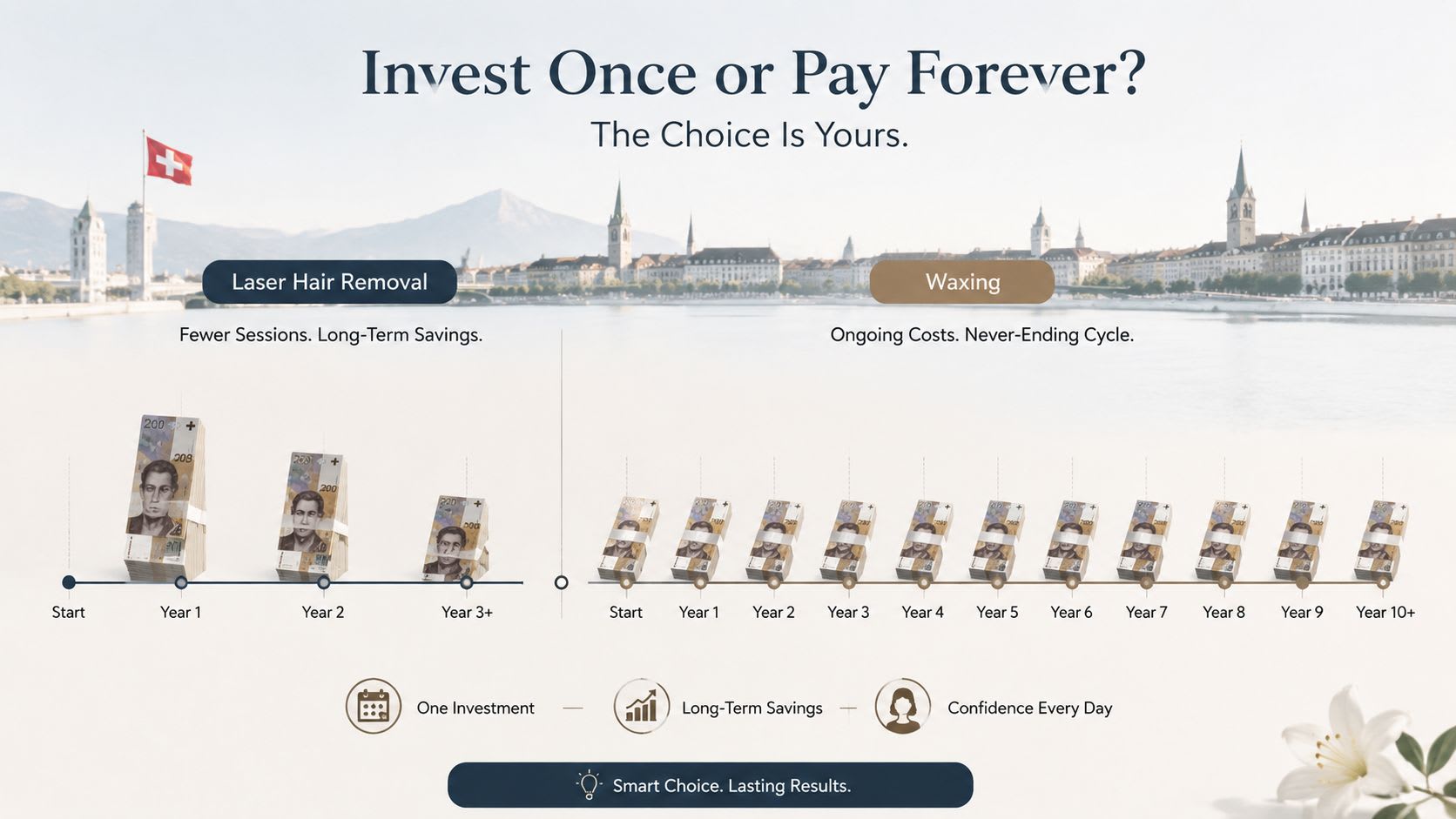
A common Swiss patient scenario is simple. Waxing looks cheaper when you book the first appointment. The picture changes once the same area is treated again and again over several years.
What Swiss patients usually pay
Swiss pricing varies by canton, clinic model, device, and treatment area. City-centre clinics in Zürich or Geneva often charge more than regional providers, and physician-led settings may price differently from beauty studios. Even so, the cost structure stays predictable. Waxing spreads the expense across frequent repeat visits. Laser concentrates more of the cost into an initial treatment course.
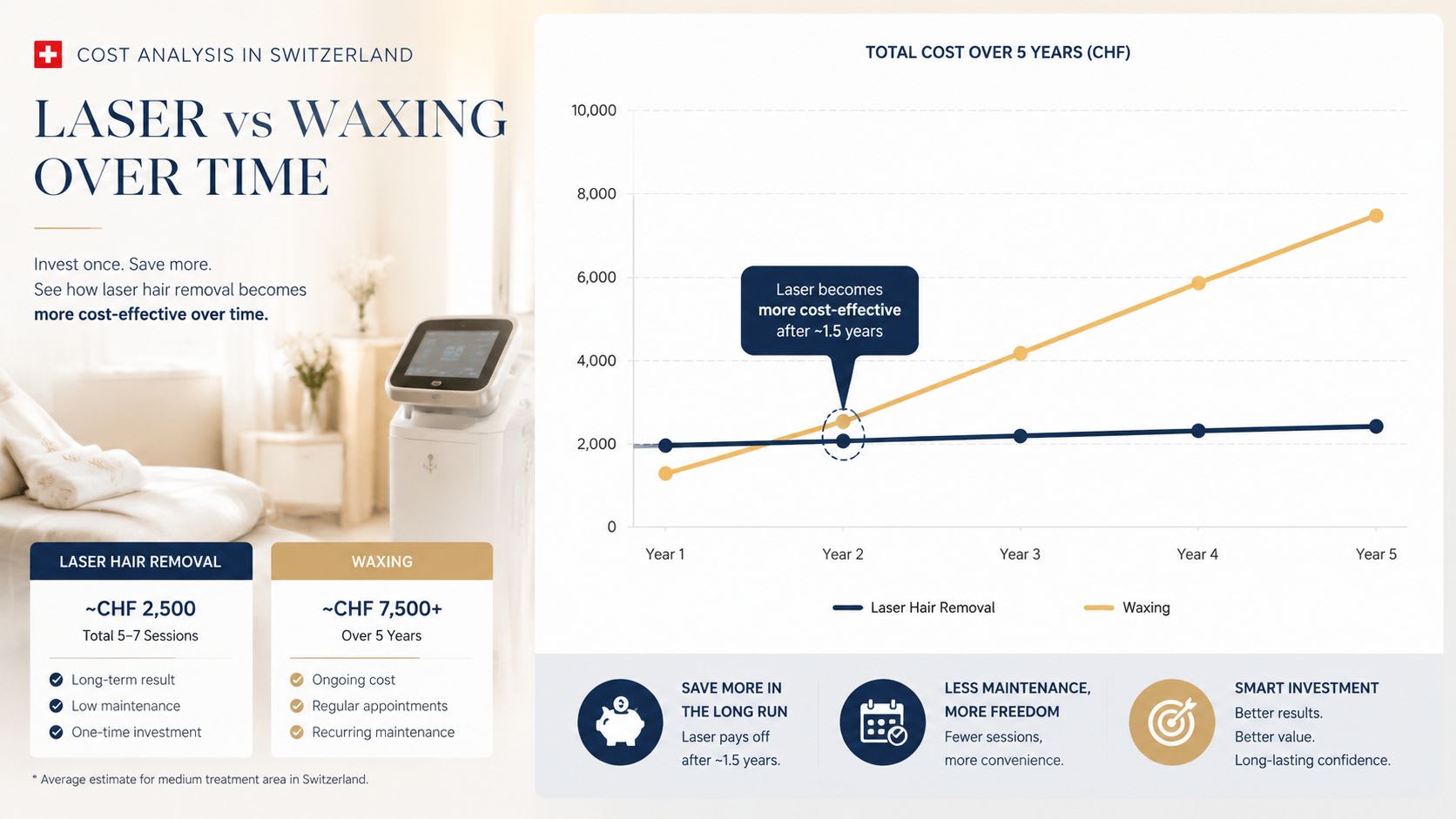
One Swiss comparison of waxing and laser notes annual waxing spend in the range of CHF 1,200 to CHF 1,800, with examples such as CHF 700 for a full-leg laser session in Zürich and CHF 180 to CHF 300 for bikini areas, as described in this Swiss cost comparison for waxing and laser.
For patients deciding between the two, that distinction matters more than the price of a single appointment.
The five-year view is the honest one
Hair removal should be costed like orthodontics or skincare treatment. The relevant question is not what one visit costs. The relevant question is what the method is likely to cost over five years in Switzerland.
Using the annual waxing range above, regular waxing comes to:
- CHF 6,000 over five years at the lower end
- CHF 9,000 over five years at the upper end
Laser usually involves a defined series first, then occasional maintenance depending on the area, hormones, and hair pattern. In practice, that is why laser often becomes financially favourable by around the second year for patients who would otherwise keep waxing consistently.
That does not mean laser is cheaper for every person. A patient treating only a very small area infrequently may still spend less with waxing. A patient treating underarms, bikini, lower legs, or multiple areas for years usually sees the opposite pattern.
Why quotes differ so much between clinics
Area size is the first reason. Full legs take longer than underarms. A small facial zone is quick, but it may require more careful parameter adjustment. Intimate areas are not large, yet they need precision and experienced handling.
The second reason is treatment planning. Some clinics advertise a low per-session price but discuss neither the likely number of sessions nor the cost of maintenance. That is not wrong, but it makes comparison harder. Patients should ask for the expected total plan, not only the entry price.
The third reason is Swiss clinical standard. Better cooling systems, medical oversight, patch testing when indicated, and realistic scheduling add value even if the first invoice is higher.
Cost mistakes I see patients make
The most common mistake is comparing one waxing appointment with one laser session. That is not an equal comparison. Waxing has no built-in endpoint. Laser usually does.
The second mistake is starting laser too soon after waxing. Patients who have waxed recently often need to wait 4 to 6 weeks before the first laser session so the follicle can produce a visible hair again. That waiting period frustrates people, but it has a clear clinical reason. If the hair has been pulled out from the root, the laser has less of a target to act on. Starting too early can reduce efficiency and increase the cost per useful session over the full course.
That is one of the overlooked economic arguments for planning properly from the start.
Questions worth asking before you compare prices
Ask each clinic the same practical questions:
- How is the treatment area defined? Bikini, Brazilian, lower legs, and full legs are not standardised terms everywhere.
- Is the quote per session or for a realistic treatment course?
- How many sessions are usually expected for my area and hair pattern?
- What maintenance is commonly needed after the initial series?
- Who performs the treatment, and under what medical supervision?
A low sticker price can still become the more expensive path. In Switzerland, long-term hair removal decisions are usually won or lost in the cumulative cost, not in the first invoice.
Suitability Pain Levels and Potential Side Effects
The best method depends on your hair colour, skin behaviour, tolerance for repeated treatments, and what you expect from the result.
Who tends to suit laser better
Laser usually suits patients who want long-term reduction and have enough pigment in the hair for the device to target effectively. Darker hair generally responds more predictably than blonde, grey, white, or red hair because the mechanism depends on melanin.
It also suits people who are willing to follow a treatment schedule carefully. Laser isn't a one-off convenience procedure. It works best when appointments are timed properly and pre-treatment instructions are followed exactly.
Who may still prefer waxing
Waxing can remain useful for patients whose hair colour makes laser less efficient, or for those who only want occasional hair removal without committing to a medical course. It also removes visible hair immediately, which some patients prioritise over long-term reduction.
That said, waxing isn't always gentle. In sensitive areas, repeated pulling can aggravate the skin, and Swiss benchmarks note a higher risk of micro-wounds and inflammation in intimate areas with waxing than with properly managed laser treatment, as noted earlier in the Swiss laser-versus-waxing comparison.
What pain usually feels like
Pain perception varies, and patients describe both methods differently.
- Laser: Often described as a brief heat sensation or a snapping feeling on the skin.
- Waxing: Usually felt as a sharp pull during removal, followed by short-term tenderness.
The practical difference is that laser discomfort is typically linked to a treatment course with a longer-term goal, while waxing discomfort returns every time you repeat the service.
Patient guidance: Don't compare pain in isolation. Compare pain against the result horizon. Temporary discomfort can feel very different when the benefit lasts months or years rather than weeks.
Side effects to discuss honestly
No hair removal method is entirely consequence-free.
For laser, clinics commonly discuss temporary redness, mild perifollicular swelling, warmth, and sensitivity after treatment. These effects are usually short-lived when the patient is appropriately selected and the settings are chosen correctly.
For waxing, common issues include irritation, ingrown hairs, skin sensitivity, and occasional superficial trauma, especially if the skin barrier is already compromised.
A proper consultation should also cover what each method can't do well. If your hair has very little pigment, laser may have clear limitations. If your skin reacts badly to repeated traction or if ingrown hairs are a chronic problem, waxing may become less attractive over time.
Preparing for Treatment and Choosing a Clinic in Switzerland
One of the most misunderstood points in laser hair removal is also one of the most important. You must stop waxing before starting laser.

Why the no-waxing rule matters
Swiss dermatologists in Zürich and Geneva strictly enforce a 4-week waxing-free window before laser hair removal because waxing removes the follicle target the laser needs in order to transmit energy and destroy the root. The same Swiss dermatology source states that up to 30% of laser treatment failures in Switzerland stem from follicle disruption caused by waxing before treatment, according to Swiss dermatology guidance on hair removal preparation.
This isn't a minor technicality. It's one of the main reasons patients pay for sessions that underperform.
If you remove the target, the laser has far less to act on. The session may still happen, but the biology is no longer working in your favour.
For patients switching from waxing to laser, that often means a waiting period before the first appointment. It can feel inconvenient, but it protects the effectiveness of the treatment plan.
How to prepare sensibly
A consultation should give you a clear pre-treatment checklist. In practice, the essentials usually include:
- Stop waxing, plucking, and epilating: These methods interfere with the follicular target.
- Discuss hair and skin characteristics openly: Especially if your hair is light, mixed in colour, or sparse.
- Report sensitivity or prior reactions: Sensitive skin can still be treated, but settings and aftercare need planning.
What to check when choosing a Swiss clinic
In Switzerland, clinic selection should be methodical rather than aesthetic. A modern reception area doesn't tell you whether treatment planning is competent.
Look for:
- Credential verification: Use MedReg to check whether a physician is properly licensed.
- Specialist background: FMH-listed dermatology or closely relevant aesthetic medical expertise matters for assessment quality.
- Device transparency: The clinic should explain what platform it uses and who operates it.
- Consultation depth: You should leave understanding candidacy, limitations, timing, and aftercare.
If you're comparing providers across cantons or major cities, a neutral clinic directory can make the screening process easier. BeautyGuide maintains Swiss aesthetic clinic listings with credential-focused comparison, which is useful when you want to review providers by location and treatment type.
A practical sign of a well-run clinic is how clearly it communicates before you ever attend. Many aesthetic businesses now use structured digital systems for triage and booking, and tools such as Hyperleap AI for med spa solutions show how clinics can organise treatment enquiries, appointment flow, and patient communication more consistently. That doesn't replace medical judgement, but it can improve the patient pathway.
Your Decision Checklist and Frequently Asked Questions
If you're still deciding between laser haarentfernung oder waxing, reduce the question to what matters in daily life rather than what sounds more advanced.
A practical decision checklist
Use this shortlist before booking:
- Your goal over the next few years: If you want repeated short-term smoothness, waxing may be enough. If you want less future regrowth and fewer appointments, laser is usually the stronger fit.
- Your hair colour: Darker hair tends to align better with laser technology. Very light, grey, blonde, or red hair may require a different discussion.
- Your budget structure: Some patients prefer lower recurring payments. Others prefer a higher initial spend if it reduces long-term cost and maintenance.
- Your skin behaviour: If waxing repeatedly causes irritation or ingrown hairs, that should weigh heavily in the decision.
- Your willingness to follow protocol: Laser works best when you respect timing rules and preparation steps.
Bottom line: The better method is the one that matches your biology, budget horizon, and patience for maintenance.
Frequently asked questions
Can I switch from waxing to laser midway through my routine
Yes, but not immediately in the sense many patients hope. You usually need a waxing-free interval before laser starts so the follicular target is present again. If you've been waxing regularly, your clinic should tell you how long to pause before the first session.
Are at-home laser devices the same as professional treatment
No. Home-use devices and professional clinic systems don't sit in the same category of power, supervision, or treatment planning. For patients in Switzerland seeking predictable reduction, clinic treatment remains the more medically controlled route.
What if I have blonde, grey, white, or red hair
This is one of the main limitations of melanin-dependent laser treatment. In those cases, waxing may still remove hair effectively in the short term, but it won't create the same long-term reduction pathway. Some clinics may discuss alternative approaches depending on the hair type and treatment area.
Is waxing ever the better option
Yes. It can be the better option when the goal is immediate temporary smoothness, when the patient doesn't want a treatment course, or when hair characteristics reduce laser efficiency. It's also a reasonable bridge option for some patients before they commit to a longer-term plan.
Should I choose based only on price per session
No. With hair removal, single-session pricing is often misleading. The more useful comparison is total spend, total time commitment, and whether the treatment changes future maintenance.
If you're comparing hair removal options in Switzerland, BeautyGuide can help you review treatments and assess qualified clinics by city, credentials, and specialty before you book a consultation.
Explore More
This article is for informational purposes only and does not replace professional medical advice.