
At its heart, the difference between medical and non-medical aesthetic treatments comes down to one simple thing: what part of the body is being treated and by whom.
Medical procedures work on living tissue beneath the skin's surface. Think injectables, deep laser resurfacing, or thread lifts. These require a doctor's hand. On the other hand, non-medical services focus only on the skin’s superficial, non-living outer layer—what you’d experience during a classic facial. Getting this distinction right is the most important first step for anyone in Switzerland considering an aesthetic treatment.
Quick Summary
The core difference lies in the depth of treatment. 'Medical' aesthetics (performed by doctors/nurses) affects living tissue and uses prescription-strength devices. 'Non-medical' beauty (performed by estheticians) treats only the dead outer skin layer (epidermis) and uses lower-energy devices.
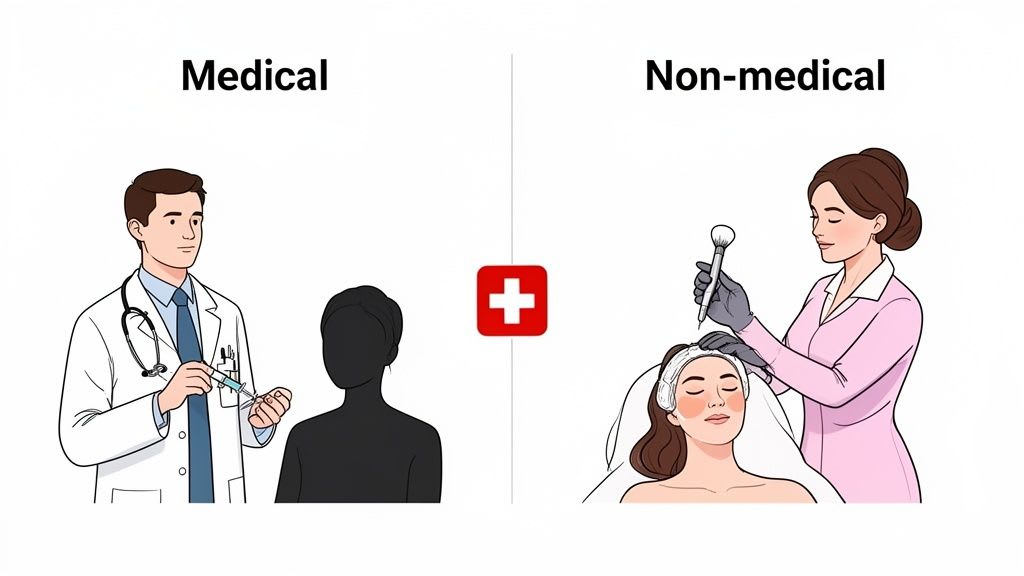
Understanding The Core Difference in Aesthetic Care
Here in Switzerland, patient safety is built on a clear legal and professional line. Any procedure that penetrates the skin, uses high-energy devices, or involves prescription-only products is legally classified as a medical act.
This means these treatments must be performed by, or under the direct supervision of, a licensed medical doctor. Ideally, this would be an FMH-certified specialist registered in the official MedReg database. You can explore the full range of recognised medical aesthetic treatments available in Switzerland to see what falls into this category.
This isn't just about credentials; it’s a legal framework designed to protect you. It ensures the person performing the treatment has the years of medical training needed to handle potential risks and complications. In contrast, non-medical cosmetic services you find in beauty salons are limited to surface-level care. While great for maintaining skin health, they simply do not create the same biological changes as a medical procedure.
The Hardware Reality: Same Name, Different Machine
Don't be fooled by the name on the menu. A "microneedling" facial at a local beauty salon and a medical microneedling session in a doctor's clinic might sound the same, but they use fundamentally different technology. In strictly regulated markets like Switzerland and the EU, certain powerful devices like Class 4 lasers cannot legally be operated without medical certification.
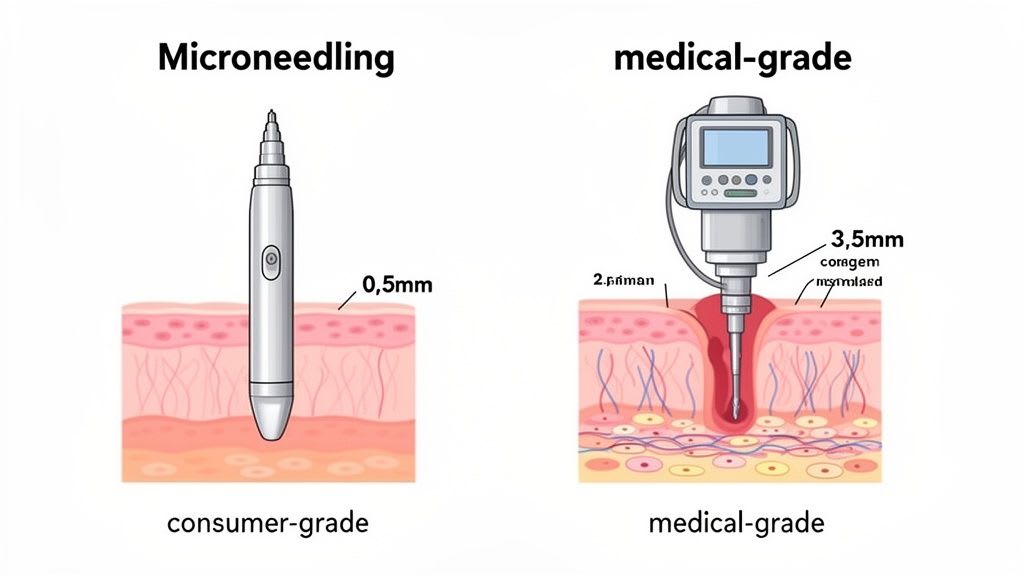
Consumer Grade vs. Medical Grade Devices
Non-medical spas and salons rely on consumer or "aesthetician grade" devices. These are intentionally built with lower energy outputs and shallower treatment depths to ensure safety when operated by staff without medical training. They affect the epidermis—the skin's outermost, non-living layer.
Medical clinics, on the other hand, are equipped with medical grade equipment. These are powerful, highly regulated machines designed to safely affect living tissue in the dermis and deeper, which is where new collagen is formed and real cellular change happens.
A 'Microneedling' pen in a salon might go 0.5mm deep, while a medical RF Microneedling device goes up to 3.5mm to remodel collagen. This depth difference is everything. A superficial treatment provides a temporary glow; a deep medical procedure creates lasting structural improvement.
Ultimately, it’s the machine's classification and the operator's medical license, not the treatment's name, that dictates whether you're getting a surface-level cosmetic touch-up or a true medical procedure capable of producing significant, long-term biological results.
At a Glance: Medical Clinic vs. Beauty Salon
When you're looking to enhance your appearance, understanding the provider's qualifications and environment is crucial. A medical clinic is a healthcare facility, bound by strict regulations. A beauty salon, on the other hand, focuses on surface-level cosmetic services without medical oversight. Understanding this core difference is the first step toward making a safe, informed decision.
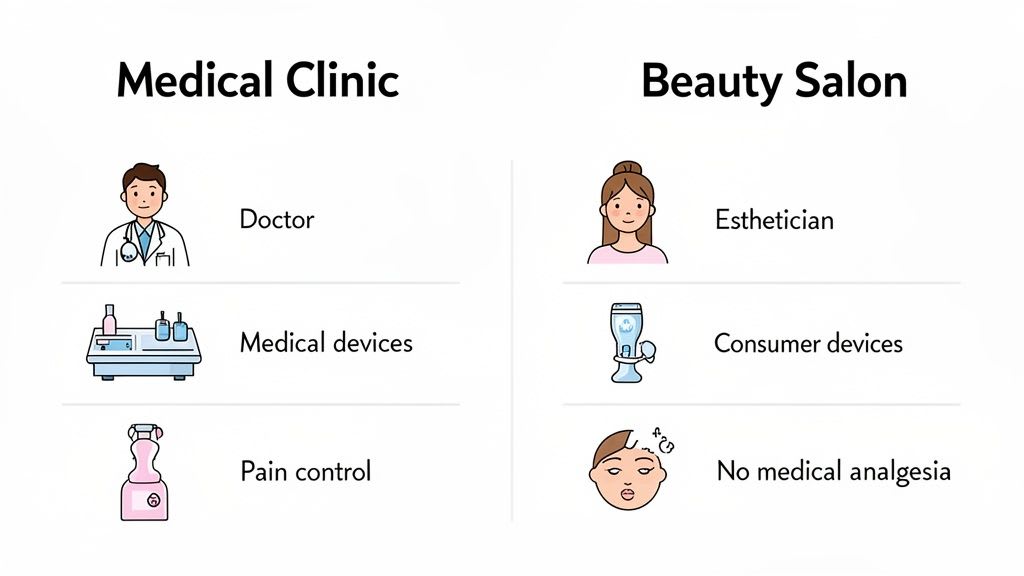
To lay it out clearly, this table breaks down the key differences between a medically supervised clinic and a non-medical beauty salon in Switzerland.
| Feature | Medical Aesthetic Clinic | Non-Medical Beauty Salon |
|---|---|---|
| Who performs it? | A certified medical doctor (FMH) or a registered nurse under a doctor's direct supervision. | A licensed esthetician or beautician with non-medical training. |
| Pain Management | Medical-grade options like lidocaine injections for comfort during intensive procedures. | Limited to non-prescription topical numbing creams only. |
| Device Power | Unrestricted access to powerful, medical-grade (e.g., Class 4) lasers and prescription devices. | Legally capped and restricted to lower-energy, consumer-grade devices. |
| Risk Level | Moderate to High, professionally managed by medically trained staff with a deep understanding of anatomy and complications. | Low, because treatments are superficial and non-invasive. |
| Results Duration | Long-lasting, often measured in years (e.g., fillers, laser resurfacing, medical-grade body contouring). | Temporary, typically lasting from a few days to a few weeks (e.g., standard facial, light exfoliation). |
Choosing the right setting is about more than just the treatment; it's about your safety. For anything that works beneath the skin's surface, a medical clinic is the only appropriate choice. You can browse a curated list of medically supervised aesthetic clinics in Switzerland on our platform.
Run Away If You See These Signs
When you're exploring aesthetic treatments, knowing what to avoid is just as important as knowing what you want. A bit of vigilance goes a long way in spotting providers who might be cutting corners or operating outside of Swiss regulations.
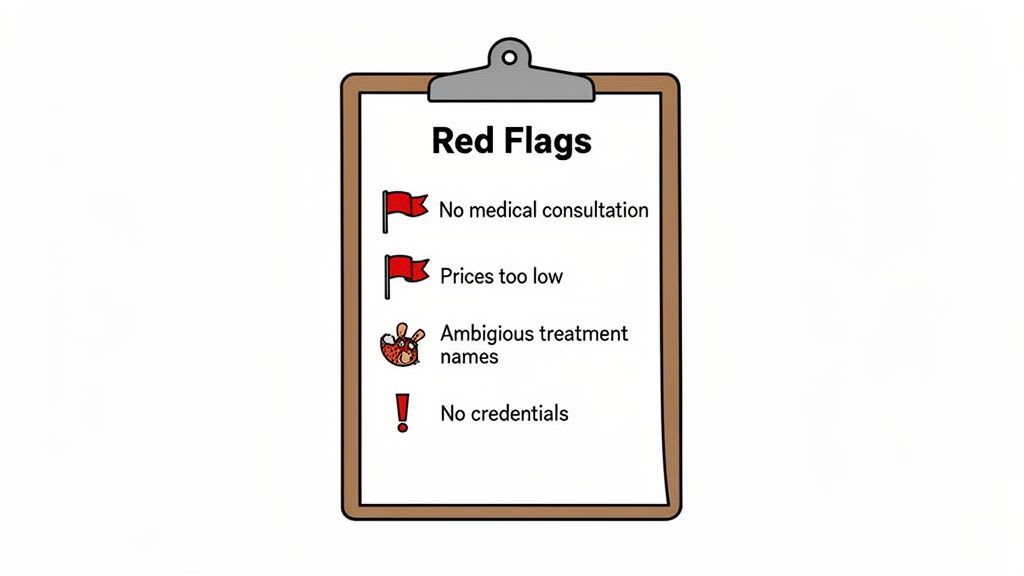
Trust your gut. If something feels off, it probably is. Be wary of these specific red flags:
They offer 'Botox' but call it a 'wrinkle serum infusion'. Using vague language for regulated medical products like Botulinum Toxin or hyaluronic acid fillers is a common tactic to mislead patients and skirt advertising laws.
The price is 70% below market average. An unusually low price is not a bargain; it’s a warning. It can signal counterfeit products, unapproved devices, or dangerously inexperienced practitioners.
No consultation with a doctor is offered. In Switzerland, any medical-grade treatment (injectables, deep peels, powerful lasers) legally requires a proper consultation with a licensed doctor before the procedure. Skipping this step is a violation of patient safety protocols.
High-pressure sales tactics. A true medical professional's role is to educate you and determine if a treatment is appropriate for you. They will never pressure you into booking on the spot.
Before you book anything, it's worth reading our guide on how to select the right beauty clinic for a more detailed checklist.
FAQ: Your Questions Answered
When you're exploring aesthetic treatments, it's natural to have questions. Let's clear up some of the most common queries with a focus on Swiss standards.
Can a beautician legally inject lip fillers?
Absolutely not. In Switzerland, injecting dermal fillers is strictly a medical procedure. It involves placing a substance like hyaluronic acid deep within facial tissues, which requires an expert understanding of anatomy to avoid serious complications like vascular occlusion (blocking a blood vessel). Only a licensed medical doctor, or a specially trained nurse under a doctor's direct orders, is legally allowed to perform filler injections.
Is medical grade laser hair removal permanent?
Medical-grade lasers offer permanent hair reduction, a subtle but important distinction from "removal." A powerful, medical-grade laser (e.g., Class 4) targets and destroys hair follicles in their active growth phase. Because hair grows in cycles, several sessions are needed to treat all follicles effectively. After a full course of treatment, most patients see a dramatic, long-lasting reduction in hair. Any hair that does regrow is typically much finer and lighter. In Switzerland, the use of these powerful lasers is legally restricted to medical professionals to ensure safety.
Why is medical microneedling more expensive?
The higher price reflects the significant difference in treatment intensity, technology, and practitioner expertise. You are investing in a clinical procedure, not just a facial. The cost covers the skill of a medical doctor or supervised nurse, the use of advanced, more powerful medical-grade devices (like RF microneedling), and the safety and sterility of a clinical environment, including proper pain management. You are paying for a genuine medical treatment that delivers significant, long-term changes to your skin's structure.
Explore More
This article is for informational purposes only and does not replace professional medical advice.