Understanding Rhinoplasty Costs in Switzerland (Nasen-OP Kosten Schweiz) 2026

When considering rhinoplasty, one of the first and most practical questions is, "How much will this cost?" In Switzerland, the cost of a nose surgery, or Nasen-OP, generally falls between CHF 8,000 and CHF 15,000. This price range reflects Switzerland's exceptionally high medical standards, the expertise of its surgeons, and the personalised nature of each procedure.
Your Rhinoplasty Investment in Switzerland
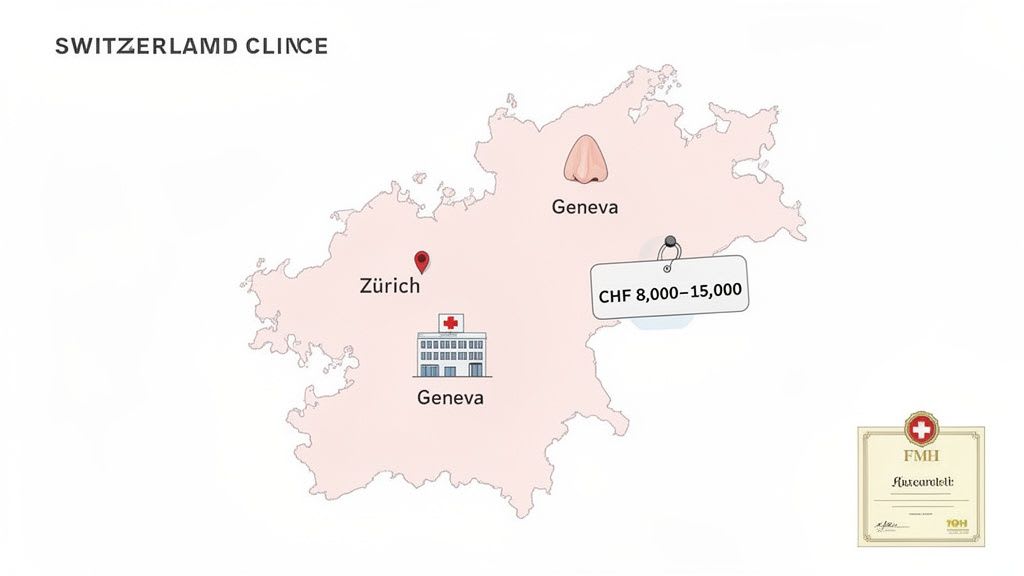
Choosing to undergo rhinoplasty is a significant personal and financial decision. The price is not a simple, one-size-fits-all figure but a comprehensive investment in your well-being, guided by the safety and quality that define the Swiss medical system.
The wide cost range is due to several key factors that influence the complexity and quality of care. Let’s break down what determines the final price.
Key Cost Determinants
Surgeon's Expertise: A surgeon’s experience and credentials are paramount. A specialist with an FMH (Swiss Medical Association) title in plastic, reconstructive, and aesthetic surgery commands higher fees, reflecting years of dedicated training and a proven track record of successful outcomes.
Procedure Complexity: Not all nose surgeries are the same. A minor adjustment to the nasal tip is less complex and therefore less costly than a comprehensive procedure involving bone reshaping, cartilage grafting, and correcting functional breathing issues.
Geographic Location: Clinic operating costs vary across Switzerland. A leading clinic in central Zürich or Geneva will likely have a different price point than a practice in a smaller canton due to higher overheads.
Type of Surgery: A first-time nose surgery is known as a primary rhinoplasty. If you are correcting a previous surgery, it's a revision rhinoplasty. Revisions are almost always more complex and expensive because the surgeon must work with scar tissue and altered anatomy.
For example, a complex open rhinoplasty performed by an FMH-certified specialist in Zürich using advanced 3D imaging technology could cost upwards of CHF 12,000. In contrast, a more straightforward case in Lausanne might start closer to CHF 9,500. These figures provide a realistic benchmark based on individual needs and location.
It is helpful to view this not just as a cost, but as an investment. The price reflects Switzerland's world-class medical infrastructure, access to highly qualified specialists, and the meticulous pre- and post-operative care that ensures patient safety and a refined result.
This information provides a solid financial starting point. To understand what is aesthetically achievable, we recommend reviewing real-life examples. You can get a better sense of potential results by viewing our gallery of rhinoplasty before and after photos.
Next, we will detail what a typical quote includes, so you can feel prepared and informed for your consultation.
Decoding What Your Rhinoplasty Quote Truly Includes
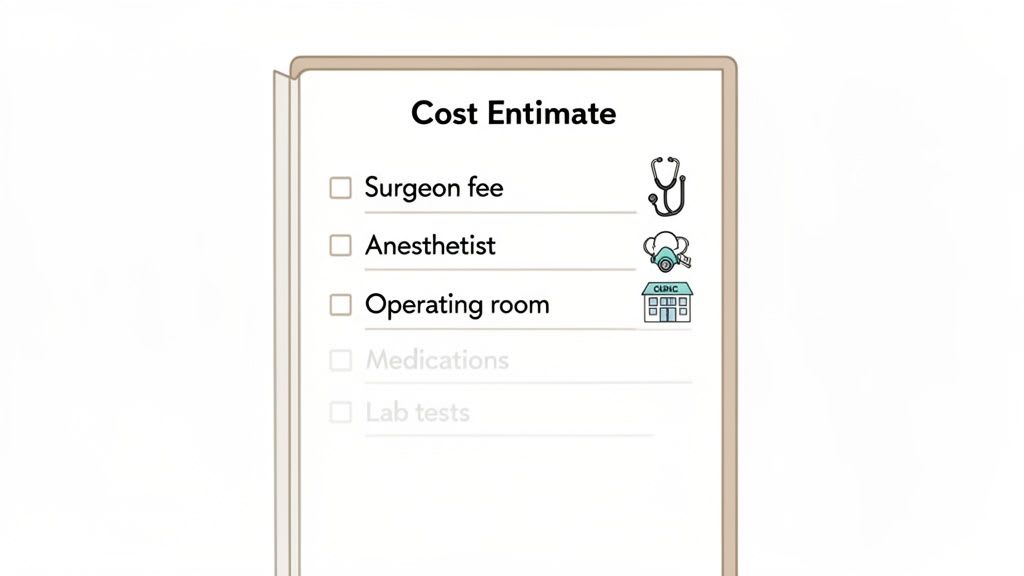
When a clinic provides a cost estimate for your rhinoplasty, understanding what is covered is crucial to avoid unforeseen expenses. A transparent quote from a reputable Swiss clinic is a sign of professionalism and respect for the patient.
The total price should be seen as a bundle of essential services, each playing a vital role in ensuring a safe and successful procedure. A standard, all-inclusive quote for a Nasen-OP in Switzerland typically combines several core components into one figure.
Standard Inclusions in a Swiss Rhinoplasty Quote
Most comprehensive quotes will cover all primary expenses directly related to the surgery itself. This provides a clear, upfront picture of the investment required.
Here is what you should almost always find included:
Surgeon's Fee: This is typically the largest portion of the total cost. It covers the skill, detailed planning, and surgical execution by your FMH-certified plastic surgeon, reflecting their specialised training and the time dedicated to your procedure.
Anaesthetist's Fee: Patient safety is the absolute priority. This fee covers the specialist anaesthetist who administers the anaesthesia and carefully monitors your vital signs throughout the operation.
Operating Facility Costs: This part covers the use of the sterile, state-of-the-art operating theatre, including all sophisticated surgical equipment, sterile instruments, and support from the professional nursing and technical staff.
Initial Post-Operative Care: The quote almost always includes the standard follow-up appointments required to monitor your healing process. This usually means a few visits for removing splints or stitches and ensuring your recovery is progressing as expected.
A detailed quote is more than just a set of figures; it is a roadmap of the care you will receive. A transparent breakdown demonstrates a clinic's commitment to patient education and ensures there are no ambiguities about the services provided for the stated Nasen-OP Kosten.
Potential Exclusions to Clarify
Even with a commitment to transparency, some costs can be variable or specific to your situation and may not be in the initial estimate. It is important to inquire about these potential extras during your consultation to obtain a complete financial overview.
To ensure you are fully prepared, ask your clinic to clarify if these items are part of your quote:
Pre-Operative Tests: Depending on your health status, you might require specific blood tests or other medical evaluations before being cleared for surgery. These are sometimes billed separately.
Prescription Medications: The cost of post-operative medications, such as pain relievers or antibiotics, is typically not included in the surgical package. This will be a separate expense at the pharmacy.
Overnight Stays: While some highly complex procedures might include an overnight stay, it is often an additional cost. If a stay in the clinic or hospital is a possibility, be sure to confirm the associated fees.
Specialised Materials: In more complex revision surgeries, your surgeon might need special materials like cartilage grafts. The cost of sourcing and preparing these could be listed as a separate line item.
Unforeseen Complications: While rare in Switzerland’s high-standard medical environment, the costs to manage unexpected complications are not usually covered in the initial surgical fee.
Clarifying these details is a vital part of your first consultation. For more on how to approach this important meeting, you can read our article about what to expect during a first aesthetic consultation. Arriving with the right questions will help you move forward with complete confidence.
What Drives the Cost of Rhinoplasty?
When you begin researching the cost of rhinoplasty, or Nasen-OP Kosten, you will notice that prices can vary significantly. This is not arbitrary. The final figure is a careful calculation based on several crucial factors, each directly linked to the safety, quality, and ultimate success of your surgery.
Let's examine the components behind the price tag.
Surgeon Expertise and Specialisation
The single most significant factor is the surgeon's skill. In Switzerland, you should seek a surgeon with an FMH (Foederatio Medicorum Helveticorum) specialisation in plastic, reconstructive, and aesthetic surgery. This title represents years of intensive, standardised training and is a hallmark of quality and safety.
An experienced surgeon who has performed hundreds of nose surgeries brings an invaluable depth of expertise. They understand how to manage complex anatomy, anticipate potential challenges, and apply refined techniques to create natural-looking results. That level of artistry and experience comes at a premium, but it is an investment in achieving your desired outcome while minimising risks.
Primary Versus Revision Rhinoplasty
Whether your nose has been operated on before significantly impacts the complexity and cost. A primary rhinoplasty is performed on a nose for the first time. A revision rhinoplasty, in contrast, is a subsequent surgery intended to correct or improve upon a previous one.
Revision procedures are almost always more difficult and, consequently, more expensive. Here’s why:
Scar Tissue: The surgeon must navigate internal scar tissue from the first operation, which makes the process more delicate and unpredictable.
Altered Anatomy: The nose's original structure has been modified. The surgeon often needs to rebuild the framework using more advanced techniques.
Need for Grafts: Cartilage may be needed to add support or shape, but the ideal sources might have been used in the first surgery. This could require the surgeon to harvest cartilage from the ear or a rib, adding significant time and complexity.
A primary rhinoplasty is like building from a new blueprint. A revision is like renovating a historic structure—it requires more specialised skill, careful deconstruction, and creative solutions to unexpected challenges. The price reflects this increased complexity.
Clinic Location and Facility Type
The location of the surgery also matters. The costs of operating a premier medical facility vary considerably across Switzerland.
The European cosmetic surgery market is substantial, and Switzerland is a key centre for high-quality procedures. Within the country, a large percentage of surgeries occur in major cities like Zürich, Geneva, and Basel. The higher cost of living and concentration of elite medical talent in these urban centres can increase Nasen-OP Kosten by 10-15% compared to clinics in smaller cantons. You can explore more Swiss market trends at Statista.
You may also find a price difference between a private clinic and a large hospital. Private clinics often offer a more bespoke, discreet experience, which can be reflected in their pricing. Hospitals are equally safe, but their overhead and billing structures differ.
Surgical Complexity and Technology
Finally, your surgical goals are a major cost driver. A simple procedure to refine the nasal tip will naturally cost less than a comprehensive operation that involves reshaping the bridge, narrowing the nostrils, and straightening a deviated septum simultaneously.
Leading Swiss clinics often invest in advanced technology to improve results. For instance, 3D imaging and simulation software allows you to see a preview of your potential new nose before the operation. This technology adds to the initial cost but is an invaluable tool for ensuring you and your surgeon share the same vision, leading to higher patient satisfaction and more predictable outcomes. The use of specialised instruments, like piezoelectric tools that sculpt bone with high precision, can also affect the final price, directly linking cost to the quality of care.
Navigating Insurance and Financing for Your Surgery
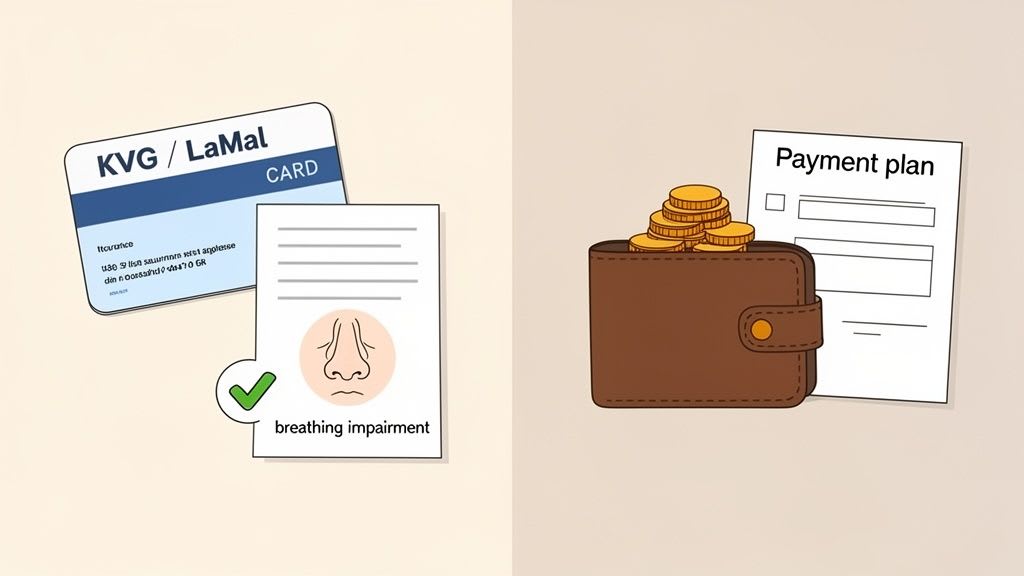
Managing the finances for your rhinoplasty is a key part of the planning process. A common question is, "Will my health insurance contribute to the Nasen-OP Kosten Schweiz?" The answer depends on the reason for the surgery.
In Switzerland, the healthcare system draws a clear distinction between procedures performed for aesthetic reasons and those that are medically necessary. This distinction is the single biggest factor in determining coverage under the basic health insurance (KVG/LaMal).
Distinguishing Between Aesthetic and Functional Rhinoplasty
If your goal is purely aesthetic—to change the appearance of your nose—the surgery is considered elective. As such, it will not be covered by your mandatory basic health insurance. You will be responsible for the full cost of a cosmetic rhinoplasty.
However, if there is a medical reason for the surgery, your insurance may cover some or all of the costs. This is known as a functional rhinoplasty.
When Does Swiss Health Insurance Cover Nose Surgery?
For the Swiss health insurance system to consider covering the cost, a clear, documented medical need must be established. The most common reason is a significant breathing problem caused by the nasal structure.
A few key conditions that may qualify for coverage include:
Deviated Septum: A severely bent nasal septum that obstructs airflow is the leading reason for insurance coverage.
Post-Traumatic Deformity: If a past injury resulted in both a visible deformity and breathing difficulties, the functional component of the repair may be covered.
Congenital Defects: Certain birth defects that impair nasal function may also qualify for a covered surgical correction.
The first step is to obtain a formal diagnosis from an ENT (Ear, Nose, and Throat) specialist or your plastic surgeon. They will conduct tests to document the issue and submit a detailed report to your insurance provider for pre-approval. It is essential to receive this approval in writing before scheduling your surgery.
What if your surgery is a combination of functional and aesthetic goals, such as fixing a deviated septum while also refining the tip? In this scenario, your insurance will typically only cover the medically necessary portion. The clinic will provide a separate quote for the aesthetic component, which you would pay for yourself.
Exploring Financing Options For Aesthetic Procedures
When rhinoplasty is purely cosmetic and insurance is not an option, you will need to fund it privately. Most clinics expect payment upfront, but many in Switzerland understand that this is a significant investment.
To make the cost more manageable, some clinics in Zürich, Geneva, and Bern offer flexible payment solutions. These may include in-house payment plans or partnerships with medical financing companies, allowing you to break down the total cost into smaller monthly payments.
If you consider this route, always inquire about interest rates and the total repayment amount to have a complete understanding of the final cost.
Surgical Vs. Non-Surgical Options: A Cost and Results Comparison
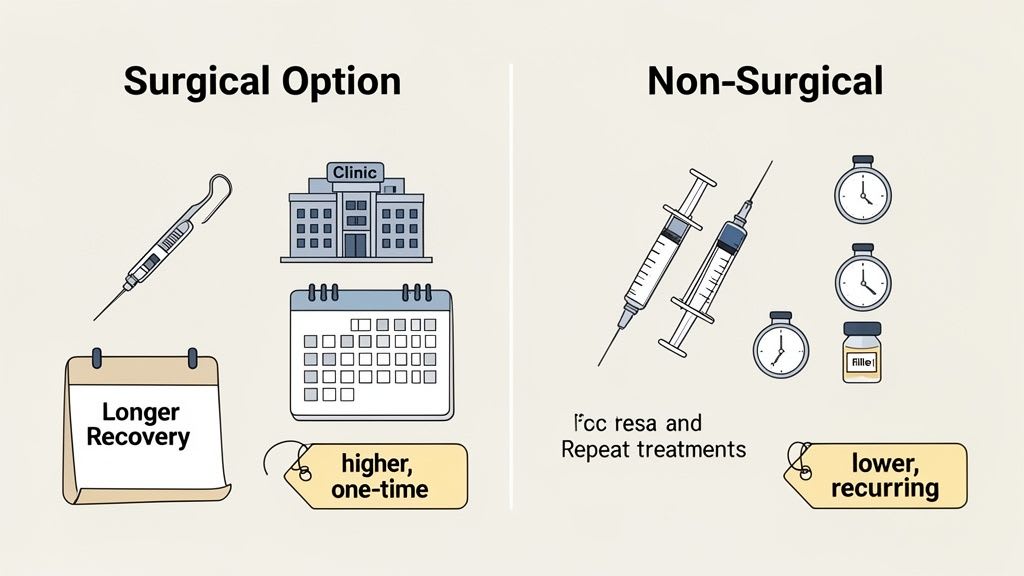
When considering changes to your nose, the traditional surgical Nasen-OP is often the first thing that comes to mind. However, it is no longer the only option. In recent years, a non-surgical alternative—often called a "liquid nose job"—has become a popular choice in Swiss aesthetic clinics. This technique uses injectable dermal fillers to subtly reshape the nose without incisions.
Understanding the differences between these two approaches is essential for making a choice that aligns with your goals, budget, and tolerance for downtime. Each has its own set of advantages, limitations, and a very different price structure.
The Initial Cost Vs. The Long-Term Investment
Cost is a major deciding factor. A non-surgical nose treatment is more affordable upfront. A single session with dermal fillers in Switzerland typically costs between CHF 800 and CHF 1,500. This makes it an accessible option for minor adjustments.
However, the results are not permanent. The hyaluronic acid fillers used are gradually absorbed by the body, typically lasting 12 to 18 months. To maintain the look, you must return for repeat treatments, which becomes an ongoing expense over time.
In contrast, a surgical rhinoplasty is a significant initial financial commitment. As discussed, the Nasen-OP Kosten Schweiz can range from CHF 8,000 to CHF 15,000. While the upfront cost is much higher, the results are designed to be permanent. It is a one-time investment for a lasting change, not a recurring subscription.
What Each Procedure Can—And Can't—Do
Beyond cost, it is critical to understand what each approach can realistically achieve. Their capabilities are vastly different, and the right choice depends on the specific changes you desire.
A non-surgical approach is excellent for making additive changes.
Non-surgical rhinoplasty can effectively:
Smooth out a small bump or hump on the nasal bridge.
Lift or subtly refine the tip.
Correct minor asymmetries or small indentations.
It works by adding a small amount of volume in precise locations to create the illusion of a straighter, more defined shape. It cannot make the nose smaller, narrow the nostrils, or correct significant structural issues like a severely deviated septum.
A liquid nose job is like using clever contouring makeup; it adds volume to create shadows and highlights that enhance natural features. Surgery alters the underlying bone and cartilage for a new, permanent structure.
For any kind of reduction or major structural work, surgery is the only viable option. If you want to decrease the overall size of your nose, remove a prominent dorsal hump, reshape the cartilage in the tip, or improve your breathing, a surgical rhinoplasty is required.
The table below breaks down the key differences side-by-side.
Surgical Vs. Non-Surgical Rhinoplasty In Switzerland
| Feature | Surgical Rhinoplasty ('Nasen-OP') | Non-Surgical Rhinoplasty ('Liquid Nose Job') |
|---|---|---|
| Cost | CHF 8,000 - CHF 15,000+ (one-time) | CHF 800 - CHF 1,500 (per session) |
| Permanence | Permanent | Temporary (lasts 12-18 months) |
| Downtime | Significant (2-3 weeks initial, up to a year for final result) | Minimal to none (minor swelling or bruising) |
| Procedure | Invasive (involves incisions, anaesthesia, reshaping bone/cartilage) | Minimally invasive (series of small injections) |
| Best For | Reducing size, removing large humps, major reshaping, fixing breathing | Smoothing small bumps, lifting the tip, correcting minor asymmetry |
| Limitations | Higher cost, longer recovery, surgical risks | Cannot make the nose smaller or fix structural/breathing issues |
This comparison provides a solid foundation for your research and can help you feel more prepared for a consultation. Ultimately, only a qualified specialist can provide a personalised recommendation based on your unique anatomy and aesthetic goals.
How We Verify Clinics For Your Peace Of Mind
When researching the Nasen-OP Kosten Schweiz, it is easy to focus on the numbers. However, the true value lies in the surgeon's skill and the clinic's adherence to Switzerland's world-class medical standards. Your safety is paramount, which is why our verification process is so thorough.
Choosing the right surgeon is the most important decision you will make. In Switzerland, the gold standard is the FMH (Foederatio Medicorum Helveticorum) specialisation in plastic, reconstructive, and aesthetic surgery. This title signifies years of demanding, specialised training and a deep commitment to patient safety and surgical excellence. It is your best guarantee of quality.
Our Commitment To Your Safety
At BeautyGuide.ch, we believe trust begins with transparency. Our purpose is to connect you with professionals you can rely on, whether you are in Zürich, Geneva, or Bern. To achieve this, we follow a simple but non-negotiable verification process for every clinic we feature.
Our checks are designed to confirm the most important credentials. By cross-referencing with official Swiss federal registers, we ensure every practitioner meets the strict national standards required to practise medicine in Switzerland.
Every patient deserves the confidence of knowing their surgeon is properly qualified. We see our verification as a crucial first step—confirming that the professionals listed are licensed to practise in the Swiss healthcare system. This gives you a trusted foundation to begin your search.
The BeautyGuide Verification Steps
We ensure every clinic on our platform is run by qualified professionals. This is not just a promise; it is a process.
MedReg Licence Check: First, we confirm that the lead doctors are registered with MedReg. This is the official Register of Medical Professions managed by the Swiss Federal Office of Public Health (FOPH/BAG), and it proves they hold a valid federal licence to practise medicine anywhere in Switzerland.
Highlighting FMH Specialists: We also make it a point to clearly indicate when a surgeon holds the respected FMH specialisation. This helps you quickly identify surgeons who have achieved the highest level of postgraduate training in their field.
Following these steps ensures that when you browse clinics on BeautyGuide.ch, you are viewing a curated directory of vetted professionals. We provide the information and tools you need to take the next step with confidence. To better understand the system that protects you, you can learn more about how Swiss medical standards protect aesthetic patients in our detailed article.
Your Top Questions About Rhinoplasty Costs in Switzerland
Let's address some of the most frequent questions people ask when researching Nasen-OP Kosten Schweiz. We have compiled the essentials here to provide you with straightforward answers and help you feel more confident in your decision-making process.
Are Rhinoplasty Prices in Zürich or Geneva Higher Than in Other Cities?
Yes, you can generally expect to pay more in major cities like Zürich and Geneva—typically around 10-15% more. This is primarily due to the higher cost of operating a practice in these prime locations, including rent and competitive staff salaries. Additionally, these cities have a higher concentration of highly experienced, in-demand surgeons, whose fees reflect their level of expertise. It is important to remember, however, that Switzerland's high standards for medical care and quality are upheld nationwide.
Why Does a Revision Rhinoplasty Cost More Than a Primary One?
A revision rhinoplasty is a more complex and delicate operation than a first-time surgery, which is why it comes with a higher price tag. The surgeon must work around scar tissue from the previous procedure, making the nasal tissues less predictable and more challenging to sculpt. The nose's original structure has been altered, so the work is less about initial shaping and more about careful reconstruction. Often, the surgeon needs to harvest cartilage from the ear or a rib to build new support, which adds significant time and complexity to the surgery. This intricacy demands exceptional skill and more time in the operating theatre.
Do Swiss Clinics Offer All-Inclusive Price Packages?
Many clinics in Switzerland offer packages that bundle the main costs, including the surgeon's fee, anaesthetist, operating facility use, and standard follow-up visits. However, it is essential to request a detailed, written quote. Review it carefully to understand exactly what is included and, more importantly, what is not. Common exclusions are prescription medications, any pre-operative lab tests, and the costs of managing any rare complications. Gaining this clarity upfront is the best way to avoid financial surprises.
Is Rhinoplasty Cheaper in a Neighbouring Country?
While a price quote from a clinic abroad may seem lower at first glance, it is vital to consider the total value and not just the initial cost. Switzerland is renowned for its incredibly high medical standards, strict safety protocols, and seamless continuity of care. These factors are built into the price and are crucial for a safe and successful outcome. When you factor in the costs of travel, accommodation, additional time off work, and the difficulty of managing follow-up appointments or complications from abroad, any initial savings often diminish. Choosing a local, FMH-certified specialist in Switzerland provides peace of mind and easy access to post-operative care—support that is invaluable.
Explore More
This article is for informational purposes only and does not replace professional medical advice.