
You're standing in front of the mirror, turning slightly to the side, and the same question keeps coming back. Is a bump, a drooping tip, or a mild asymmetry something that can be improved without surgery, or would a filler-based change just be a temporary illusion? For many people in Switzerland, non surgical nose reshaping starts exactly there, with curiosity mixed with hesitation, and the right answer depends on what you want the nose to do, not just how you want it to look.
This treatment is usually best understood as precision volumisation. A clinician uses hyaluronic acid filler to add tiny amounts of support in selected areas of the nose, so the profile looks straighter, more balanced, or slightly lifted. It's not a reduction procedure, and it doesn't remove bone or cartilage. If you want a broader overview of where this fits among injectable options, a useful related reference is facial balancing with injectables, especially for readers comparing nose refinement with other contouring goals.
For patients who are already comparing treatment categories, the basic filler framework is similar to what's covered in BeautyGuide's guide to dermal fillers in Switzerland. The difference is that the nose demands much tighter technique, because the margin for error is smaller and the visual result depends on millimetre-level placement. That's why this topic sits at the intersection of aesthetics, anatomy, and clinic selection.
What Non Surgical Nose Reshaping Actually Means
A lot of people hear “liquid nose job” and assume it's a lighter version of surgery. That's not quite right. Non surgical nose reshaping is best thought of as a way to camouflage the nose, not rebuild it.
What it can change
In practical terms, filler can smooth a small dorsal bump, lift a tip that points downwards, and soften minor asymmetry. By adding support to selected points, the injector changes how light falls across the bridge and tip, which can make the profile look straighter even though the nose itself hasn't been made smaller. That optical effect is the whole logic of the procedure.
What it can't do
It can't remove a hump, narrow a wide nasal base, or correct breathing problems. Those goals belong to surgical rhinoplasty, not injectables. Patients sometimes come in hoping for a “smaller” nose, then realise the filler result is a better version of the existing shape, not a true reduction.
Practical rule: if your main question is “Can I preview a contour change?”, filler may fit. If your question is “Can I structurally change the nose?”, surgery is usually the more realistic path.
This is why the consultation matters so much. A good clinician will explain that the treatment is temporary, reversible in principle if hyaluronic acid is used, and best suited to contour correction rather than major shape alteration. Swiss patients who value a cautious, medically grounded approach often prefer that honesty over marketing language.
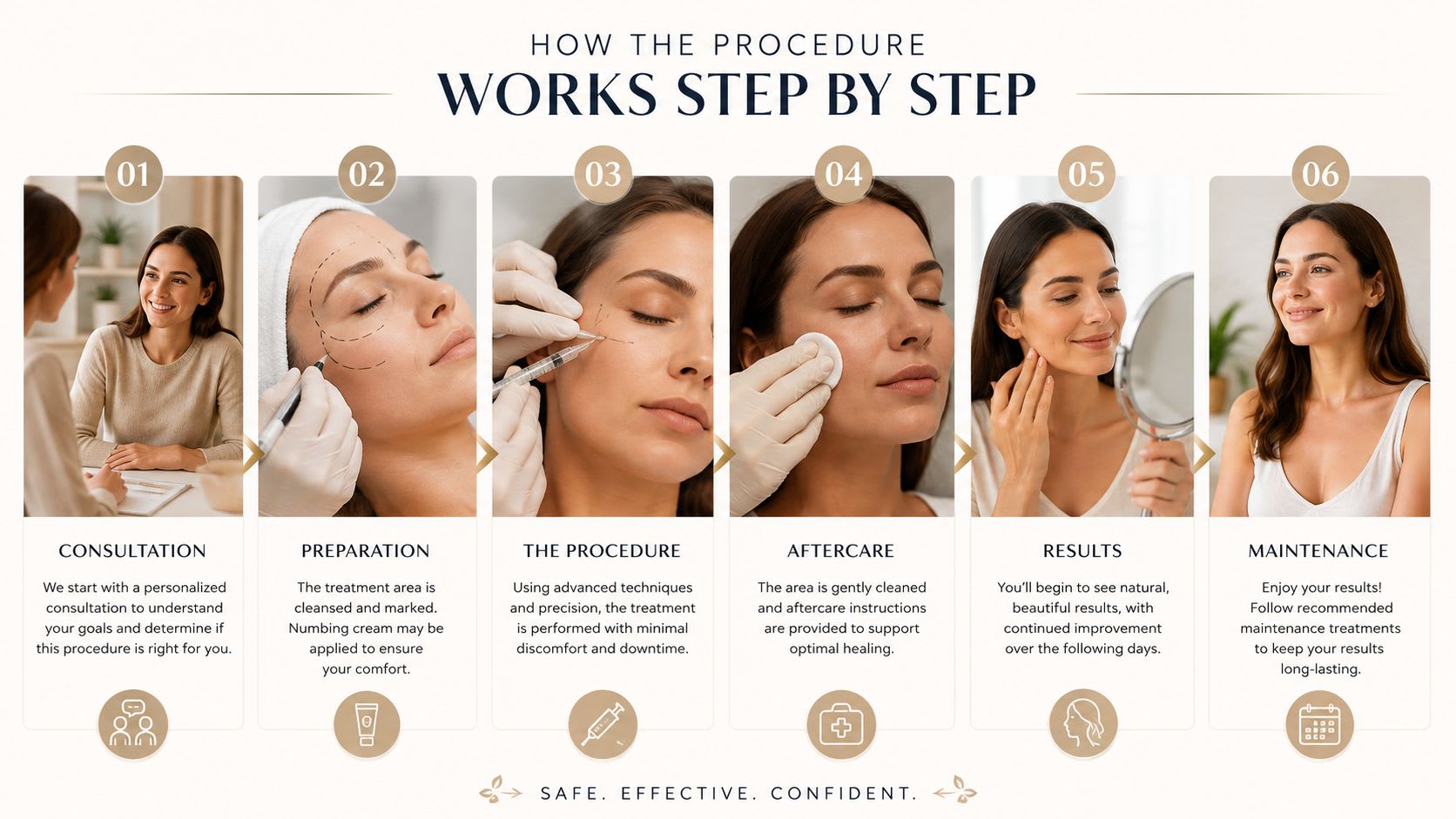
How the Procedure Works Step by Step
A filler treatment on the nose starts with anatomy, not with volume. The injector first identifies the support zones, because the nose behaves more like a small bridge with load-bearing points than like one smooth surface. In modern protocols, the filler is placed in the deep supraperichondrial or supraperiosteal plane, a midline, deep level that is generally preferred over more superficial or lateral injection sites where important vessels are more likely to lie. The aim is controlled shaping, with only the amount needed for contour, not blanket filling.
The anatomy of a good result
The main structural areas are the tip projection, columella support, radix filling, dorsum straightening, and supratip refinement. In a volumetric approach such as NOSER, these zones are treated in a defined sequence so the injector can improve the overall profile rather than adding more material to one point. Clinical protocols rely on very small amounts, with reported maxima of 0.2 mL at the tip, 0.3 mL at the columella, and 0.3 mL at the radix or dorsum source.
Seen another way, the nose is being balanced, not inflated. A small addition at the radix can change how the bridge reads from the front, while a careful touch at the tip can make the profile look more aligned without changing the nose's underlying structure.
The tools and safety habits
A 30-gauge needle or a 22-/23-gauge cannula is typical, and the injector works with slow, low-pressure delivery and reflux checks before each injection source. Those details matter because the nose has a dense vascular network, and the wrong plane or the wrong pressure can increase risk. Small boluses, usually under 0.1 mL, are used as a technical safeguard, not as a style preference.
The choice of instrument is part of operator judgement. A needle can allow very precise placement, while a cannula may be preferred in selected areas to reduce sharp tissue passes, but neither tool is “safe” on its own if the anatomy is misread. That is why the same product can behave differently in different hands.
In experienced hands, the procedure becomes a geometry exercise. Every tiny amount changes the balance of shadow and light, which is why injector judgement matters as much as the product itself.
That operator dependency is central in Switzerland too. Two clinics can use the same filler brand and still produce very different outcomes, because the result depends on anatomy reading, injection depth, and restraint. A clinic such as BeautyGuide's Center for Plastic Surgery may be relevant for readers who want a medically grounded consultation standard and a careful assessment of whether a repeat session plan makes sense from the start.
Liquid Rhinoplasty Versus Surgical Rhinoplasty
A patient who wants a straighter-looking nose often starts with one question, can filler do enough, or is surgery the more honest answer. The two options solve different problems. Liquid rhinoplasty can soften a bump, refine a contour, or create the impression of better alignment. Surgical rhinoplasty changes the framework itself, so it is the route for larger structural change and functional correction.
| Criterion | Liquid rhinoplasty | Surgical rhinoplasty |
|---|---|---|
| Main effect | Camouflage, contour refinement, optical straightening | Structural reshaping |
| Best for | Mild hump correction, tip support, small asymmetries | Major shape change, size reduction, airway issues |
| Reversibility | Hyaluronic acid filler can be dissolved | Not easily reversible |
| Downtime | Usually short | Longer recovery |
| Duration | 9 to 12 months is typical, with broader summaries placing benefit around 9 to 18 months depending on product and technique source | Permanent |
| Repeat planning | Often needed | Usually not a maintenance pathway |
The practical difference is easy to miss if you only look at before-and-after photos. Filler changes how light falls across the nose, which can be enough for a mild dorsal hump or a small irregularity. Surgery changes the bones and cartilage, so it can reduce size, alter projection, or address breathing concerns in the same operation. Those are different tools, and they should be matched to different goals.
The limit many patient articles gloss over is structural. Liquid rhinoplasty cannot remove tissue, narrow the nose, or rebuild support that is already missing. It can make a nose look better by adding carefully placed volume, but it does so by camouflage, not by reconstruction. If the nose needs a lasting change in shape or function, surgery remains the more realistic pathway.
Repeat planning also matters more with filler than many people expect. A first session may be enough for a modest refinement, yet the result is temporary and should be treated as part of a longer plan, especially if the aim is to keep the same profile over time. That is why operator skill matters so much in a filler-based nose treatment. The injector has to judge anatomy, restraint, and future touch-up strategy at the same time.
Swiss clinic selection should follow the same standard. A careful consultation is more important than a glossy gallery, because the result depends heavily on who is doing the injections and how they assess risk, not just on the product used. Readers who want a medically grounded starting point can review Center for Plastic Surgery, especially if they want to compare a repeat-session plan with a surgical consultation before deciding.
For a patient, the question is simple enough. If the aim is a temporary contour improvement with limited downtime, filler may fit. If the aim is a permanent structural change, surgery is the better fit.
What a Real Consultation and Treatment Look Like
A proper Swiss consultation starts with a medical discussion, not a syringe. The clinician should ask about your health history, your motivations, prior treatments, and whether your concern is cosmetic, functional, or both. Photographs are usually taken for planning, and the nose is assessed from the front, oblique view, and profile.
What happens on the day
The skin is cleaned, the injector marks key points, and consent should include discussion of vascular risk, bruising, and the possibility of a touch-up. Treatment time is often short, but that doesn't mean it's casual. The actual injection sequence is measured and deliberate, and the patient is usually awake and able to give feedback while the clinician checks symmetry.
The idea that every patient gets a finished result in one sitting is too simple. In one published technique study, 56% of patients were treated in a single session, while 44% needed a touch-up source. That staged reality is normal, not a sign that something went wrong.
What good follow-up looks like
A careful clinic will usually offer review before calling the result complete. That matters because swelling, early filler settling, and optical adjustments can make the first look slightly different from the final look. For readers exploring the wider treatment journey, BeautyGuide's page on facial aesthetic treatments helps place nose reshaping in a broader Swiss aesthetic context.
The most important thing to understand is that a good consultation doesn't promise perfection. It sets a realistic plan, including whether a second visit might be needed to refine the shape.
Risks and Complications in Honest Proportion
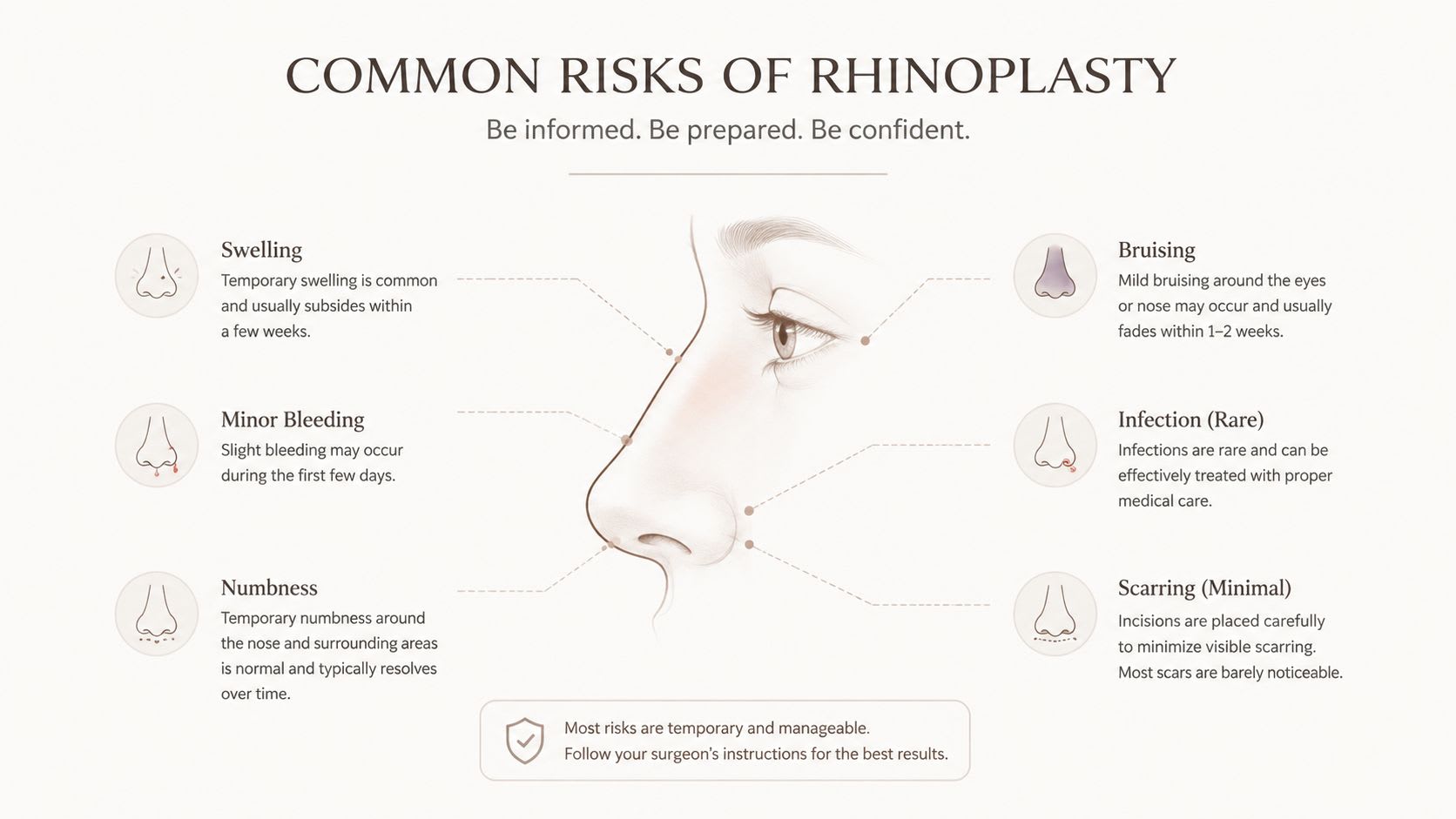
A cautious consultation starts with the part many patient guides smooth over. Liquid rhinoplasty can be useful, but the nose sits in a tightly supplied vascular area, so the conversation must include bruising, swelling, redness, tenderness, and the small but serious possibility of a vascular event. In a 2024 systematic review of 30 studies covering 9,657 patients, overall complication incidence was 39.11%, with erythema and swelling the most common at 27.95%, and the same evidence base reported arterial occlusion in 0.27% of patients source. These numbers are easiest to interpret if you separate common, short-lived reactions from the rare events that demand immediate action.
Common versus rare
A separate systematic review found that patient satisfaction was over 90% across included studies, while temporary issues such as edema, erythema, post-injection pain, and bruising were the most frequent reported effects source. In the large case series of 5,000 nonsurgical rhinoplasties, reported complication rates were low, with 0.04% infection and 0.06% skin necrosis source. The practical point is simple. A reaction that looks dramatic in the mirror can still be minor, while a rare vascular problem can look subtle at first and still need urgent treatment.
Important distinction: low event rates do not make the nose a low-stakes area. Technique, anatomy, and emergency readiness matter more here than in many other filler sites.
Why credentials matter
Injector expertise is the main safety variable. A clinic should know how to recognise vascular compromise, use hyaluronidase, and respond quickly if something goes wrong. For readers who want a plain-language checklist on filler safety, are dermal fillers safe Manchester is a useful external reference, because the same risk logic applies here. Qualifications, protocols, and clear consent matter more than branding.
For Swiss patients, that means checking medical registration, asking whether reversal products are available on site, and choosing a clinic that discusses risks directly instead of minimising them. In MedReg and FMH terms, operator oversight is not a box-ticking exercise. It is the framework that helps distinguish a carefully planned treatment from a casual injection.
Aftercare, Downtime, and How Long Results Last
A smooth result still depends on aftercare. The first day or two usually calls for caution, especially if you bruise or swell easily. The treated nose should be handled gently, and anything that puts firm pressure on the bridge, including heavy glasses, is usually paused for a short period.
What to expect in the first days
Early swelling can make the nose look slightly different from the final result, especially at the bridge and tip. A short break from exercise is common, and heat or pressure are often avoided while the filler settles. That waiting period matters because the mirror on day one does not show the finished shape.
The time question matters just as much. Published experience shows that results commonly last about 9 to 12 months, with broader summaries placing benefit in the 9 to 18 month range depending on the filler used source. In that same large case series, about 32% of patients returned at 12 months for retreatment.
What that means in real life
The words “non surgical” can sound more permanent than they are. In practice, this treatment is temporary, and for many people it becomes a maintenance plan if they like the result and want to keep it. That can suit Swiss patients who prefer a subtle profile change without moving straight to surgery.
The trade-off is straightforward. Hyaluronic acid can be adjusted or reversed, which gives flexibility, but the result may need repeat sessions, and each return visit should be planned with the same care as the first. That is where operator dependency matters most, because a well-judged result depends on anatomy, technique, and whether the clinic plans ahead for follow-up rather than treating the nose as a one-time filler site.
Cost Expectations and What Drives Price in Switzerland
Swiss patients often want a price before they want a philosophy, but this treatment is one of those cases where the number alone can mislead. Prices vary because the quote reflects more than a syringe of filler. It reflects the product used, the injector's experience, the clinic setting, and whether the visit includes planning and follow-up.
What usually shapes the quote
A structural nose treatment often uses a high G-prime hyaluronic acid, because the filler needs lifting capacity and shape retention. That type of product generally sits in a different category from softer fillers used in less demanding areas. Volume also matters, since some noses need only tiny amounts while others need more layered support.
Location matters in Switzerland too. Clinics in Zurich and Geneva often face higher operating costs than practices in smaller cities, and that tends to show up in pricing. The inclusion of a review appointment or touch-up can also change the quote, and advertised “from” prices may not include consultation or aftercare.
How to judge a quote properly
A very low price should make you ask more questions, not fewer. It can indicate limited volume, a less experienced injector, or a clinic that doesn't build in proper follow-up. The safest way to compare is to ask what's included and who performs the injections.
For a consultation in Zürich, Geneva, Basel, Lausanne, Bern, Lucerne, Zug, Lugano, or St. Gallen, bring a short checklist:
- Medical registration: confirm the injector is listed in MedReg.
- Specialist background: check for FMH-listed expertise where applicable, especially in plastic surgery or dermatology.
- Procedure volume: ask how many non surgical nose reshaping treatments they do in a year.
- Emergency readiness: ask whether hyaluronidase is stocked on site.
- Portfolio quality: review before-and-after images of noses with similar anatomy to yours.
- Consent process: ask how complications and retreatment are discussed.
A clinic that answers these questions calmly is usually giving you more useful information than one that focuses on “best price” language.
In practice, the right quote is the one that makes the medical setup transparent, not the one that looks cheapest on first glance. That's especially true for a procedure where operator dependency is the main variable patients can control.
FAQ and the Honest Takeaway
Most patients want to know four things before they book. First, does it hurt? Usually only mildly, because modern fillers often include lidocaine and clinicians may use numbing cream. Second, can the filler be removed if the result isn't right? With hyaluronic acid, yes, hyaluronidase can dissolve it.
Common concerns
People also ask whether the procedure is suitable for all skin types and ethnicities. The answer is yes in expert hands, but the technique needs to respect different nasal anatomies and skin thicknesses. Pregnancy and breastfeeding are different, because elective injectables are usually deferred.
The most useful takeaway is not that the treatment is universally right or wrong. It's that non surgical nose reshaping can work very well for selected patients who want contour refinement, accept a temporary result, and choose a clinician who understands nasal anatomy and complication management. The evidence shows high satisfaction in appropriately selected cases, but it also shows why skill matters more here than in many other injectable treatments source.
What to ask in a Swiss consultation
- Who injects me, and what is their MedReg or FMH background?
- Do you use hyaluronic acid and keep reversal enzyme available?
- How do you handle vascular complications if they occur?
- Will I likely need a touch-up or staged refinement?
- What outcome is realistic for my own nasal anatomy?
That's the standard a patient in Switzerland should expect. The safest first move isn't choosing the lowest quote, it's choosing the most credentialed consultation.
If you're comparing clinics for non surgical nose reshaping in Switzerland, BeautyGuide helps you do it with less guesswork. Visit BeautyGuide to explore verified Swiss clinics, check medical credentials, and continue your search with a neutral, medically serious lens.
Explore More
This article is for informational purposes only and does not replace professional medical advice.