
You're probably comparing these treatments after noticing one of two things in the mirror. Either the part line is widening and the hair calibre looks finer, or shedding has become persistent enough that “wait and see” no longer feels sensible. In Swiss clinics, the two injectable options most often discussed for non-surgical hair restoration are PRP and mesotherapy.
That sounds simple until you start researching. One clinic presents PRP as the more regenerative option. Another emphasises mesotherapy as a gentler way to nourish the scalp and reduce shedding. Some offer both, but explain them as separate tracks rather than part of a broader treatment plan. For patients searching PRP vs Mesotherapy Haare in Zürich, Geneva, Basel, Bern or Lausanne, the confusion is understandable.
The question isn't which treatment sounds more modern. It's which one fits your diagnosis, your timeline, your tolerance for repeat visits, and your budget in Switzerland. In practice, the wrong comparison leads to disappointment. A patient with genetic miniaturisation may expect mesotherapy to do what PRP does better. Another patient with diffuse shedding may choose PRP first when a nutritive approach would have been more logical.
PRP and Mesotherapy An Introduction for Swiss Patients
Both treatments are established in Swiss aesthetic and dermatology settings, but they work differently and they ask different things from the patient. That matters more than marketing language.
PRP, or Platelet-Rich Plasma, is an autologous treatment. Blood is taken from the patient, processed, and the platelet-rich fraction is injected into the scalp. Mesotherapy places externally prepared active ingredients into the scalp, typically vitamins, proteins, peptides or similar supportive substances, depending on the clinic's protocol.
Why Swiss patients often hesitate between them
In consultation, I see the same decision pattern repeatedly. Patients usually want to know four things first:
- Which one is stronger
- Which one works faster
- Which one costs less over time
- Whether combining them is medically sensible
Those are the right questions. PRP and mesotherapy aren't interchangeable, even if both are presented as injectable scalp treatments.
The decision is usually about trade-offs
Swiss patients tend to make careful, practical treatment decisions. They want clear protocols, transparent pricing, and realistic timelines. That approach is useful here, because neither option is a universal answer.
Clinical reality: Neither treatment should be framed as a guaranteed fix for every form of alopecia. Suitability depends on the pattern of loss, the condition of the follicle, and the treatment goal.
A good comparison has to cover mechanism, protocol, likely response pattern, maintenance needs, and cost in Switzerland. It also has to address the question many clinic pages skip: whether combination therapy can outperform monotherapy in the right patient.
How Each Treatment Works on the Scalp
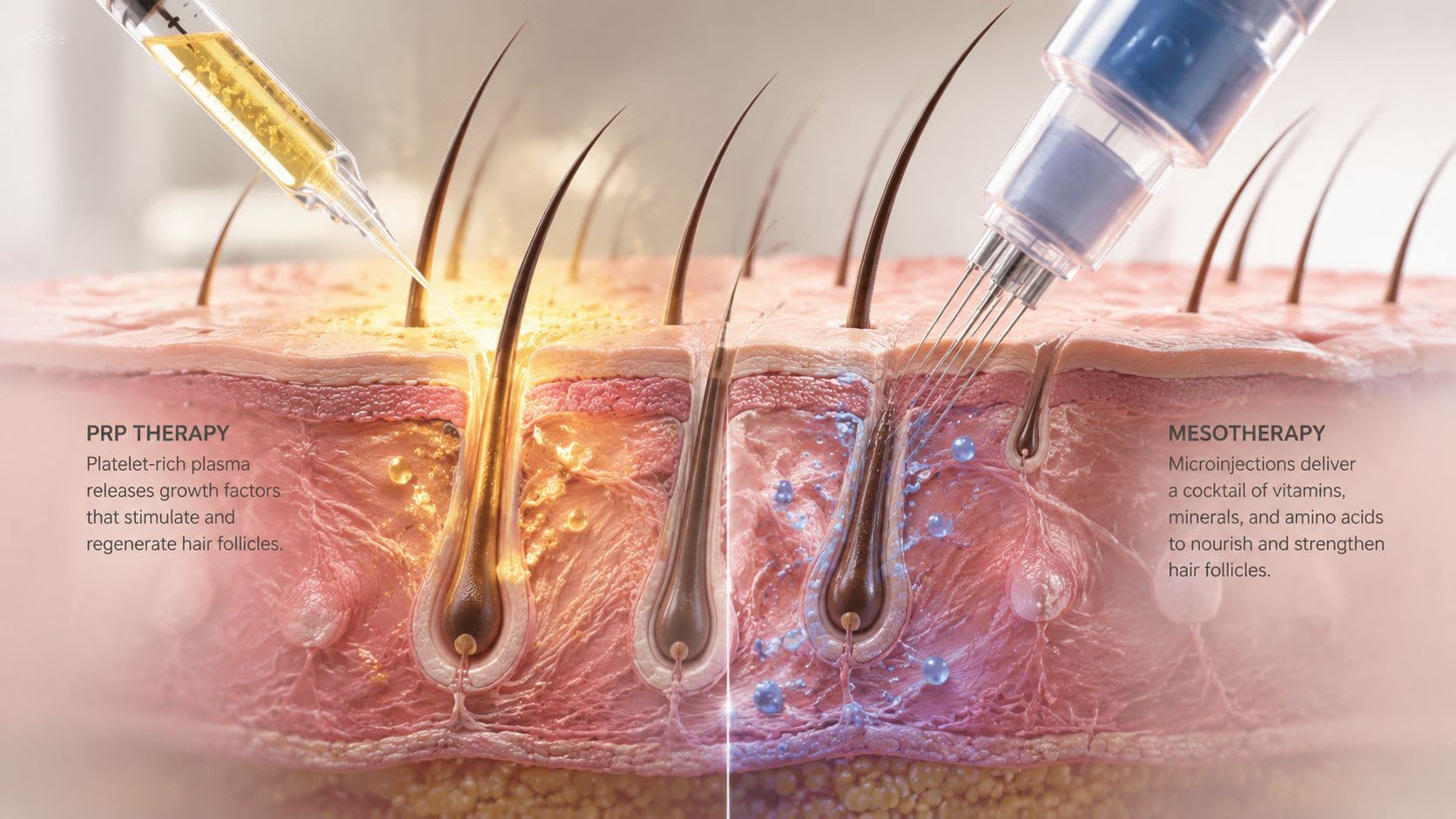
The most useful way to understand the difference is this. PRP tries to stimulate repair from within. Mesotherapy tries to support the scalp from without.
How PRP works
PRP relies on the patient's own concentrated platelets and growth factors. Blood is drawn, centrifuged, and the prepared plasma is injected into areas of thinning. The biological idea is straightforward: platelets carry signalling molecules that can support follicular activity and tissue repair.
This is why PRP is often positioned as the more regenerative of the two approaches. It isn't adding an external cocktail. It uses the patient's own biological material to create a targeted stimulus in the scalp.
In practical terms, PRP is usually considered when the goal is to improve the quality of existing follicles, not just to support the scalp environment.
How mesotherapy works
Mesotherapy takes the opposite route. Instead of using blood-derived material, it injects external vitamins and proteins into the scalp, delivering a nutritive blend directly where support is needed. That can make it appealing in patients with diffuse thinning, stressed scalp conditions, or a treatment plan focused on support rather than regenerative signalling.
A Swiss practice summary describes this distinction clearly and notes that in an internal patient survey, over 90% reported reduced hair loss after mesotherapy, and over 80% observed new hair growth in previously lost areas (Praxis Wagener on PRP and mesotherapy for hair loss).
For patients unfamiliar with mesotherapy for aesthetic treatment use, the simplest analogy is targeted scalp nourishment. The ingredients vary by provider, but the intent is to improve the local environment around the follicle.
Why the mechanism matters clinically
If the follicle still has recoverable activity, PRP may offer a stronger biological push. If the scalp needs supportive input and the main concern is active shedding or poor scalp condition, mesotherapy may fit the logic better.
The treatment choice should follow the diagnosis, not the popularity of the procedure.
That's where many online comparisons fall short. They describe both as “hair injections” and stop there. The mechanism is exactly why the outcomes, timelines and maintenance patterns differ.
Treatment Protocols and Patient Experience Compared
A common Swiss consultation starts like this. The patient is open to both treatments, but one question decides the plan: “Can I realistically follow the schedule?”
That question matters more than many online comparisons admit. PRP and mesotherapy differ not only in mechanism, but in visit frequency, treatment intensity, recovery pattern, and how quickly patients feel they are “doing enough.” In practice, adherence often shapes the outcome as much as the product injected.
PRP vs. Mesotherapy At a Glance
| Factor | PRP Therapy | Mesotherapy |
|---|---|---|
| Core approach | Uses the patient's own platelet-rich plasma | Uses externally prepared nutritive ingredients |
| Initial treatment rhythm | Usually spaced further apart, often monthly in the initial phase | Usually given in a denser series, often weekly or every two weeks at the start |
| Maintenance | Commonly repeated at wider intervals once the initial course is complete | Often requires more regular upkeep to maintain the effect |
| Time to visible change | Improvement tends to build gradually over several months | Early changes in shedding or scalp quality may be noticed sooner |
| Cost per session in Switzerland | Higher per session because the treatment includes blood draw, preparation, and sterile processing | Lower per session in many Swiss clinics, but total spend depends heavily on session count |
| Main commitment | Higher upfront cost, fewer visits, slower visible payoff | Lower entry cost, more appointments, and a greater risk that patients stop early |
A patient who travels regularly for work often does better with PRP because the schedule is easier to protect. A patient who wants a lower per-visit price and is comfortable with frequent short appointments may prefer mesotherapy.
What the treatment journey feels like
PRP usually feels more clinical. The appointment includes venous blood collection, centrifugation, scalp preparation, and then injections. Patients who dislike blood tests notice that immediately. Patients who want an autologous treatment often see that same step as a benefit.
Mesotherapy is procedurally simpler. There is no blood draw, and the treatment itself is often quicker. The trade-off is rhythm. If the first phase requires repeated visits over several weeks, convenience can become the limiting factor, especially for patients commuting into Zürich, Zug, or Geneva.
Comfort is also different. Both involve scalp injections, so neither is a spa treatment. PRP can feel more pressurised in sensitive areas because the injected volume and scalp tension matter. Mesotherapy often involves many superficial microinjections, which some patients tolerate better and others find more irritating because of the repeated pricks.
In Swiss practice, I discuss protocol burden before discussing package price. That is usually the more honest starting point.
For patients already exploring broader regenerative options, some clinics also consider PRP combined with microneedling for scalp stimulation when the indication is appropriate.
Practical differences that affect real-world adherence
Published guidance from the International Society of Hair Restoration Surgery describes PRP as a treatment that is usually delivered as a series and then maintained over time, with protocol details varying by indication and clinic process (ISHRS overview of platelet-rich plasma in hair restoration). That variation is clinically normal. Swiss clinics do not all use the same centrifuge system, platelet concentration target, injection depth, or maintenance interval.
Mesotherapy has even greater protocol variation because the injected formulations differ between clinics. A consensus review in the Journal of Cutaneous and Aesthetic Surgery notes that mesotherapy techniques, depth, and products are not standardised, which is exactly why patient experience and durability can differ so much from one provider to another (mesotherapy review on PubMed Central).
This matters for combination therapy as well. Some patients assume combining PRP with mesotherapy automatically gives a stronger result. Sometimes it does. Sometimes it only adds cost, more appointments, and more scalp irritation without a clear clinical reason. In Swiss practice, combination treatment makes more sense when the diagnosis supports two goals at once, for example regenerative stimulation plus scalp support, and when the patient can realistically follow the full schedule.
Where patients often misjudge the protocol
The lower session price does not automatically mean the lower treatment cost. Mesotherapy can look easier to start, then become more expensive over time if maintenance is frequent.
PRP asks for more patience at the beginning. Mesotherapy asks for more consistency.
That is the trade-off patients should understand before they commit.
Effectiveness and Ideal Candidates for Each Treatment
The more useful clinical question isn't “Which treatment is best?” It's “Best for what pattern of hair loss?”
When PRP is usually the stronger fit
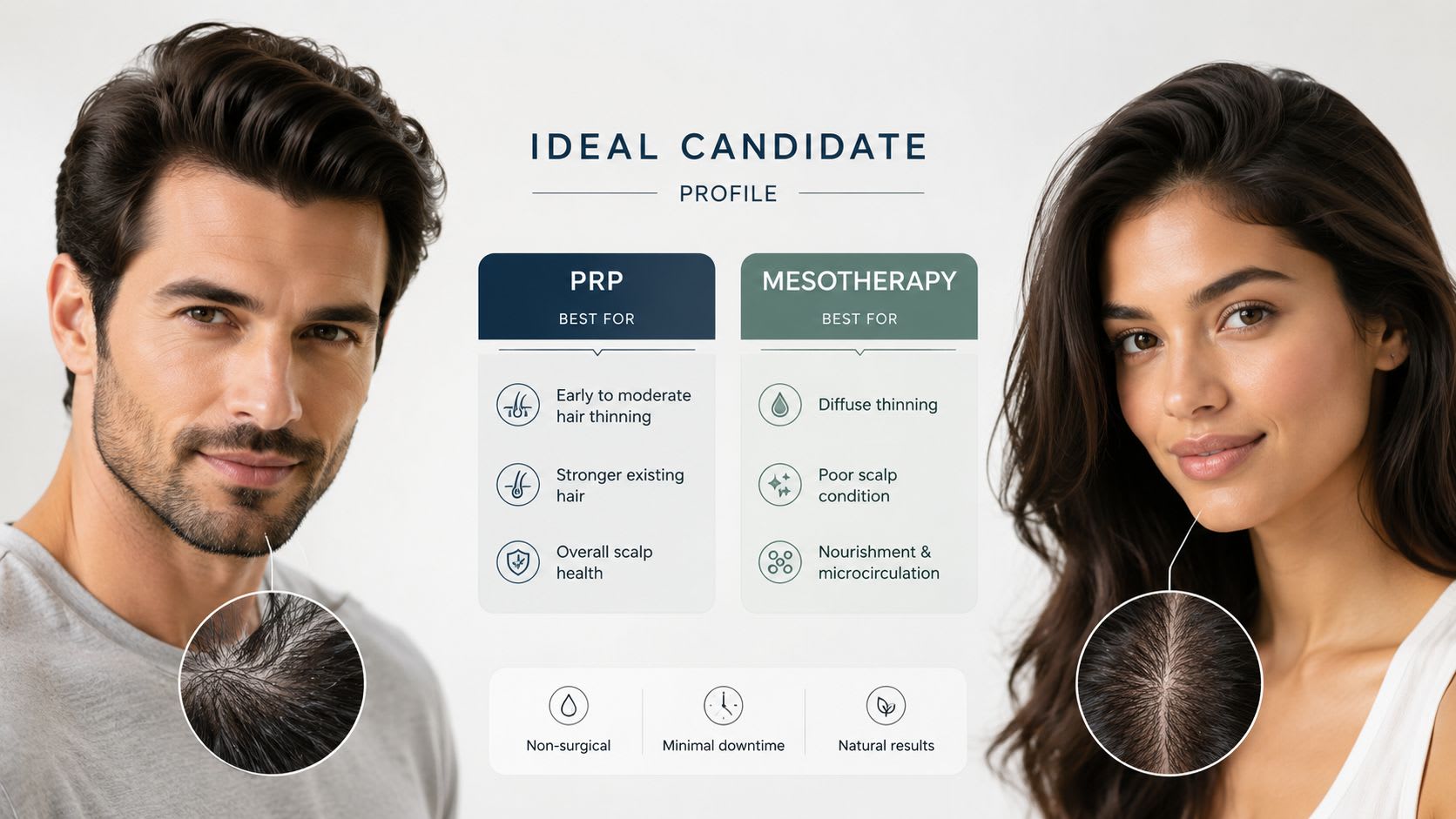
A 6-month clinical benchmark found that PRP demonstrated statistically significant superiority in hair thickness changes, while mesotherapy formulations showed significant density increases mainly at the vertex region. The authors concluded that this points to PRP's superior mechanism for follicular repair compared with mesotherapy's nutrient-based approach (PubMed summary of the 6-month benchmark study).
Clinically, that makes PRP particularly relevant when the objective is to improve the calibre and quality of miniaturising hair. In educated patients with suspected androgenetic alopecia, that distinction matters. Thickness is often the first thing they feel they've lost.
Swiss provider material also makes an important caution clear. PRP is described as advanced and highly effective, but not a standalone cure for every form of alopecia. Its efficacy as monotherapy for androgenetic alopecia in men has also been contested in some European studies, even while clinics such as MedHair in Zürich present it as one of the most effective and least invasive options currently available.
When mesotherapy may be the better first move
Mesotherapy often fits patients whose main complaint is shedding, diffuse thinning, or a scalp environment that seems depleted rather than clearly miniaturised. Swiss provider information describes visible new growth after several sessions and even notes that shedding may slow early in the course.
A Swiss observational study involving 53 patients found that mesotherapy with HCPR was superior to topical minoxidil for androgenetic alopecia, and provider material also notes that approximately 65% of patients in both mesotherapy and PRP groups reported significant symptom improvement across European clinical data (Swiss overview of mesotherapy for hair growth).
Who shouldn't expect too much from either treatment
Some patients are too late for injectables alone. If follicles are no longer active, scalp injections won't recreate dense growth where there is no viable follicular structure left. Others have underlying causes of shedding that need diagnosis before cosmetic treatment makes sense.
A careful consultation should look at:
- Pattern of loss rather than self-diagnosis from online images
- Scalp examination and, ideally, trichoscopic assessment
- Rate of progression, because stabilising active loss and thickening existing hair are different goals
- Treatment expectations, especially if the patient is hoping for transplant-level density from injections alone
A realistic plan often uses PRP or mesotherapy to improve existing hair, not to promise a full reversal of advanced baldness.
Cost of PRP vs Mesotherapy in Switzerland
A common Swiss scenario is this: a patient sees that mesotherapy costs less per visit, books on price, and only later realises the yearly budget may end up closer to PRP than expected. For hair restoration, the right comparison is the cost of a treatment plan, not the invoice from the first appointment.
What Swiss patients usually pay
Swiss pricing is fairly consistent across major cities, although the exact fee still depends on the clinic, the injector, and what is included in the session. A published Swiss price overview from Hair and Skin Medical AG lists PRP at CHF 400 to 800 per session and mesotherapy at CHF 150 to 400 per session for hair treatment (Swiss hair treatment price overview). In practice, PRP usually sits higher because it includes blood collection, centrifugation, and reinjection of the processed plasma.
Mesotherapy often looks easier on the budget at the start. That is true per session. It is not always true over 12 months.
What actually drives the final cost
The total spend depends on four decisions made during consultation:
- How intensive the initial course is
- How often maintenance is needed
- Whether the clinic uses doctor-led PRP or delegated injection protocols
- Whether treatment is done as monotherapy or as part of a combined plan
This last point matters in Switzerland. Patients are often shown PRP and mesotherapy as competing options, but the primary financial question is whether a combined strategy is justified for the pattern of loss, scalp condition, and treatment goal. Combination therapy can improve the biological logic in selected cases, but it also raises the annual budget quickly.
A simple example helps. A patient may spend less to start mesotherapy, yet come back more often for upkeep. Another patient may pay more upfront for PRP, but with fewer maintenance sessions. The cheaper first step is not automatically the cheaper protocol.
PRP usually costs more per visit for clear practical reasons
PRP is more resource-intensive. The appointment requires venepuncture, sterile handling of the sample, centrifugation, preparation of the platelet-rich fraction, and then scalp injections. In Swiss clinics, that process is usually doctor-led, and the fee reflects both the materials and the medical time.
Mesotherapy is operationally simpler. The product is prepared in advance, the session is shorter, and the consumable cost is lower. That difference explains the lower session price better than marketing language does.
Insurance and reimbursement in Switzerland
For androgenetic hair loss and other aesthetic indications, patients should usually budget both treatments as self-paid. Swiss clinics and hospital guidance generally treat these procedures as private medicine rather than mandatory insurance benefits.
There are exceptions in broader medical care, but they should be discussed case by case with the treating physician and the insurer. In routine aesthetic practice, reimbursement is the exception, not the rule.
My practical advice on budgeting
Ask for the price of the full first-year plan before starting. That should include the initial series, likely maintenance, review visits, and any add-on costs if the clinic later recommends combining PRP with mesotherapy.
That conversation saves patients from a very common mistake in Switzerland. They compare one session of PRP with one session of mesotherapy, even though the clinical decision should be based on total strategy, expected maintenance, and whether combination treatment is medically sensible for their scalp.
Combining Treatments Is It a Superior Strategy
This is the point most comparison pages skip. They frame PRP and mesotherapy as competitors when, in selected patients, they may work better as partners.
Why combination therapy makes biological sense
PRP and mesotherapy don't duplicate each other. One aims to deliver regenerative signalling through the patient's own platelets and growth factors. The other improves the scalp environment through external nutritive support. When used together, the logic is that you aren't choosing between repair and support. You're trying to create both.
That doesn't mean every patient needs a combined plan. It means the question is valid, especially in androgenetic thinning where both follicular stimulus and scalp support may matter.
What the available data suggests
A 2024 study in JAMA Dermatology found that combining PRP with mesotherapy and microneedling increased hair density by 32% over 6 months, compared with 21% for PRP monotherapy and 19% for mesotherapy alone in patients with androgenetic alopecia (Swiss clinic page referencing the JAMA Dermatology comparison).
That is clinically meaningful. It suggests there are cases where combination therapy may justify the higher investment and complexity.
When I'd consider the combined route reasonable
Combination treatment is more defensible when the patient has early to moderate patterned thinning, viable follicles, and enough motivation to complete a structured protocol. It can also make sense for patients who have had only partial response to a single modality and want a more thorough non-surgical plan before considering more invasive options.
It is less attractive when:
- Budget is tight, because combining modalities increases the overall commitment
- The diagnosis is uncertain, because layering treatments before clarifying the problem isn't good medicine
- Expectations are unrealistic, especially if the patient wants a dramatic result from minimal intervention
Combined treatment should be proposed because it fits the biology and the diagnosis, not because it increases the invoice.
In Switzerland, one of the most useful consultation questions is simple: if both are offered, ask why the clinic recommends one protocol over the other for your specific pattern of loss.
How to Choose a Qualified Clinic in Switzerland
The quality of the assessment matters as much as the treatment itself. Two clinics can offer “PRP for hair” and deliver very different standards of diagnosis, documentation and follow-up.

What to verify before booking
In Switzerland, start with the practitioner, not the package. Look for a doctor with relevant aesthetic or dermatological experience, ideally with FMH-recognised credentials where applicable, and verify licensing through MedReg.
A reputable clinic should also be comfortable showing how it approaches hair loss assessment rather than only discussing pricing. If a provider moves straight to selling sessions without discussing diagnosis, that's a warning sign.
Questions worth asking in consultation
Use the consultation to test the quality of the clinic's thinking. Good questions include:
- What type of hair loss do you think I have
- How are you distinguishing shedding from miniaturisation
- Do you use trichoscopy or another scalp assessment method
- Why are you recommending PRP, mesotherapy, or both
- What would count as a successful response in my case
- How will you document progress
- What maintenance schedule should I realistically expect
Some patients also find it useful to compare a dedicated hair-focused provider such as Clinique du Cheveu with broader aesthetic practices, especially if they want a more specialised scalp and hair consultation.
What a strong Swiss consultation should include
A serious consultation should feel individual, not templated. It should include a scalp examination, a discussion of pattern and duration, a review of previous treatments, and a transparent explanation of the likely limits.
If the consultation makes every patient sound like an ideal candidate, the clinic is selling a protocol rather than practising careful medicine.
You should leave knowing not only the proposed treatment, but also why the alternatives were not chosen first.
Frequently Asked Questions
Are the results permanent
No. Both treatments usually require maintenance if the goal is to preserve improvement over time. Hair loss often remains an ongoing process, especially in patterned thinning.
Which one is more natural
PRP is the more natural option in the strict biological sense because it uses the patient's own blood-derived platelets and growth factors. Mesotherapy uses externally prepared ingredients, so it is less autologous, even though it may still be medically conservative and minimally invasive.
Can these treatments be combined with other hair loss therapies
Yes, often they can. In practice, injectable treatments are frequently used alongside broader medical hair plans when appropriate. The exact combination should depend on diagnosis and consultation findings.
Which treatment works faster
Mesotherapy is often chosen by patients who want a quicker early response pattern, especially when shedding is the main complaint. PRP usually asks for more patience before visible change becomes obvious.
Is one clearly better than the other
Not in every patient. PRP tends to have a stronger case where hair thickness and follicular repair are central goals. Mesotherapy may be the more intuitive first option when the emphasis is supportive scalp treatment and reducing active shedding. In selected cases, a combined strategy may offer the best non-surgical result.
If you're comparing clinics for PRP, mesotherapy, or combination hair restoration in Switzerland, BeautyGuide helps you review qualified providers, explore treatment options by city, and make a more informed shortlist before booking a consultation.
This article is for informational purposes only and does not replace professional medical advice.