
When you browse "mesotherapy before and after" images online, it’s easy to anticipate dramatic, overnight transformations. The reality, however, is more nuanced. Mesotherapy works with your body, delivering gradual improvements that build over time. The results you see will depend entirely on the area being treated, the specific formula your practitioner uses, and how your own body responds.
What Mesotherapy Results Can You Realistically Expect?
So, what is mesotherapy? At its core, it is a medical technique where a qualified practitioner uses a series of micro-injections to deliver a specialised cocktail of vitamins, amino acids, minerals, and other active ingredients directly into the middle layer of your skin (the mesoderm).
Think of it as delivering a highly concentrated nutrient solution directly to the root system of a plant. Instead of applying a cream to the surface, you are supplying your skin or hair follicles with the exact compounds they need, precisely where they can be most effective.
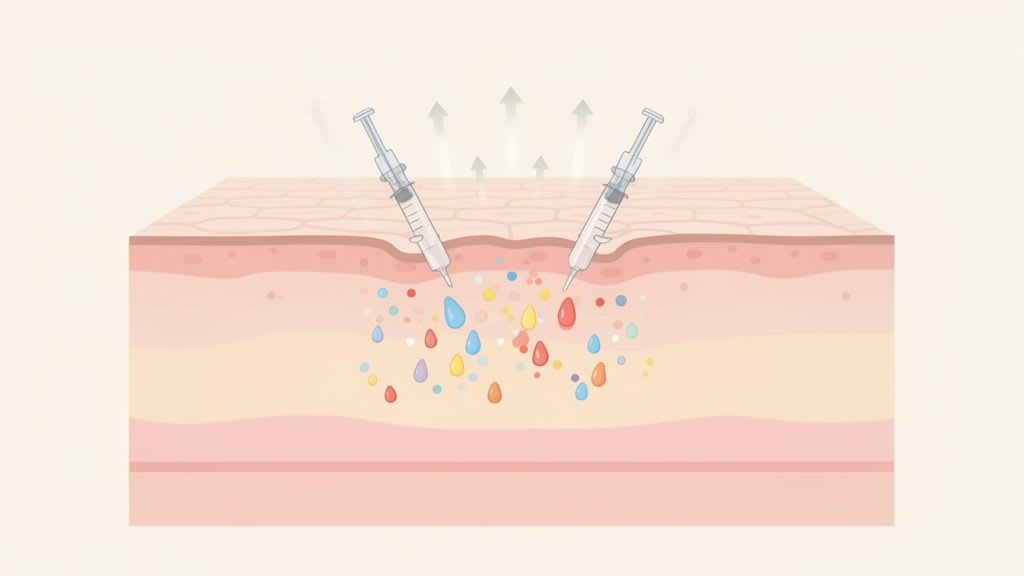
The objective is not to create an artificial effect but to stimulate your body’s own natural healing and regeneration processes. Depending on the customised blend, mesotherapy can be used to:
Stimulate new collagen and elastin production for firmer, more resilient skin.
Improve local blood circulation, which helps nourish cells and support tissue health.
Deliver potent antioxidants to help protect against environmental damage.
Assist in breaking down stubborn, localised fat deposits in small areas for body contouring.
Directly nourish and revitalise hair follicles to support hair growth and density.
Because the treatment relies on activating these natural biological functions, results appear progressively as your body responds over several weeks and multiple sessions.
Setting Realistic Expectations in Switzerland
In Switzerland, there is a strong cultural preference for natural-looking aesthetic outcomes, underpinned by high medical standards. A reputable practitioner will be clear that mesotherapy is a tool for refinement and revitalisation—it is not a replacement for surgical procedures or a solution for significant weight loss.
Patients typically seek meaningful, yet subtle, improvements. They desire better skin texture and radiance, a smoother appearance for cellulite, or a method to address thinning hair without invasive surgery.
This demand is growing. As Switzerland's population ages, so does the interest in effective, low-downtime aesthetic treatments. This trend is part of a wider movement across the continent, with the Europe mesotherapy market analysis projecting significant growth in the coming years.
The key point to remember is that mesotherapy is a medical treatment designed to stimulate a biological response. The "after" you are aiming for is achieved through a full course of treatments, typically 3-10 sessions, and maintenance visits are often required to sustain the results.
The Treatment Journey: From Consultation to Final Results
To provide a clearer picture of the process, here’s a breakdown of what a typical mesotherapy journey involves. This timeline helps manage expectations and shows how results build over a course of sessions.
| Phase | Typical Duration | Key Actions & Expectations |
|---|---|---|
| Initial Consultation | 30-60 minutes | Your practitioner assesses your concerns, determines your suitability, and designs a personalised treatment plan. This is your opportunity to ask questions. |
| The Treatment Course | 3-10 sessions (spaced 1-4 weeks apart) | You'll undergo a series of treatments. You might notice some initial plumping or glow, but the primary work is happening beneath the surface. |
| The "Building" Phase | Weeks 4-12 | Your body is actively producing collagen or repairing follicles. Visible improvements in skin texture, firmness, or hair density start to become noticeable. |
| Full Results Visible | 3-6 months | The cumulative effects of the full treatment course are now apparent. Skin appears more radiant, cellulite looks smoother, or hair seems fuller. |
| Maintenance Phase | Every 3-12 months | Follow-up sessions are scheduled as needed to maintain your results long-term. |
This table illustrates that mesotherapy is a commitment, not a one-time procedure. The outcome is a natural, refreshed appearance that comes from enhancing your body's own capabilities.
Whether you're looking to rejuvenate your face, contour your body, or restore your hair, the process must begin with a thorough consultation at a verified clinic. A medical professional will ensure the plan is appropriate for you and that every step is performed under the strict safety and hygiene protocols mandated across Switzerland.
Facial Rejuvenation: Before And After Mesotherapy
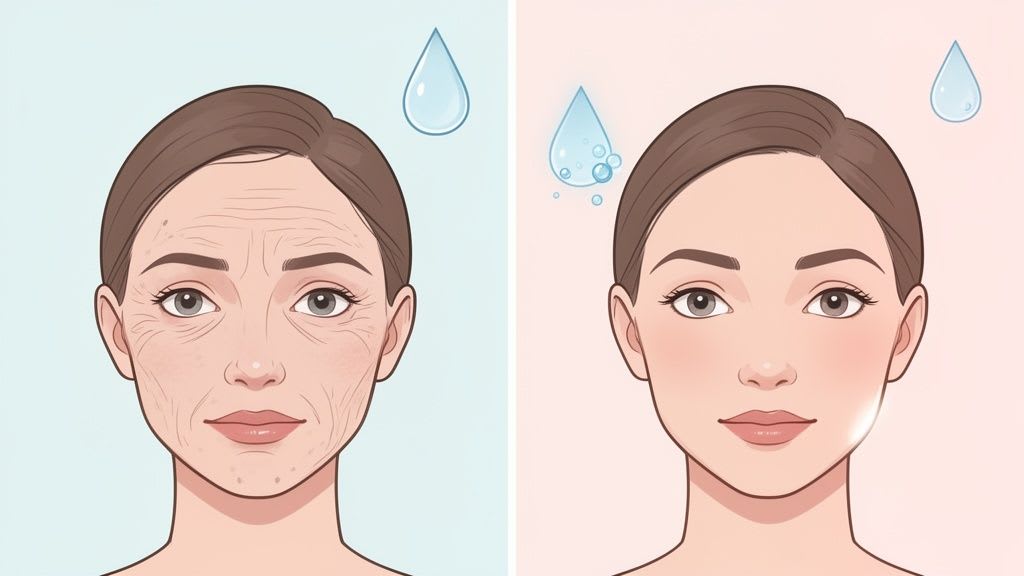
When discussing mesotherapy for the face, the focus is often on addressing the early signs of ageing. This includes skin that appears dull or tired, the emergence of fine lines, and a subtle loss of firmness. Mesotherapy targets the source of these issues, focusing on deep cellular hydration and delivering a potent cocktail of active ingredients exactly where your skin needs them most.
A qualified practitioner can create a bespoke formula to target your specific concerns, whether you seek enhanced radiance or wish to improve your skin's overall elasticity.
Before treatment, many people feel their skin looks dehydrated or stressed. Fine lines may be more noticeable, especially around the eyes and mouth. The goal of the "after" state is not to look like a different person, but to appear rested, vibrant, and healthy. You should notice your skin appears plumper, smoother, and has a natural luminosity.
The process is analogous to reviving a dehydrated plant. You can mist the leaves (similar to applying topical creams), but true revitalisation occurs when you deliver nutrient-rich water directly to the roots. That is the principle of mesotherapy; it is a deep, nourishing treatment for your skin cells.
The Timeline For Facial Results
Patience is a key component. The journey from your "before" to your "after" is a gradual one that unfolds over several weeks.
Immediately After Treatment: You may experience mild redness or tiny pinprick marks at the injection sites. This is normal and usually subsides within 24 hours. Some individuals notice an immediate (though temporary) plumping effect from the instant hydration.
Within The First Week: The "meso glow" often starts to become apparent as the skin’s microcirculation is stimulated and the vitamins and antioxidants begin their work.
After 3-4 Sessions (Approximately 4-8 Weeks): At this stage, structural changes become more visible. Your body's own collagen and elastin production has been stimulated, leading to skin that feels and looks firmer and smoother. Fine lines are softened, and skin tone appears more even.
It is this cumulative effect that builds over time to create a natural-looking and lasting improvement.
Seeing The Difference: Quantifying The Improvements
In leading Swiss clinics, progress is not just evaluated visually; it is also tracked with objective measurements. Clinical data from these practices demonstrate the treatment's effectiveness.
For instance, FMH specialists often use standardised scales to measure skin elasticity. Before a course of mesotherapy, a patient's score might be around 45%. After 3-4 sessions (spaced two weeks apart), that figure often increases to approximately 78%.
This data aligns with trends seen across the continent. You can learn more about these by reviewing reports on the European market for mesotherapy.
The goal of facial mesotherapy is not to erase every line. It is to restore a healthy, resilient quality to the skin. The best results show skin that simply looks healthier, better hydrated, and more naturally youthful.
The secret to these outcomes often lies in the custom-blended cocktails used in Swiss clinics. These formulas contain high-quality ingredients like non-crosslinked hyaluronic acid for intense hydration, powerful antioxidants such as Vitamin C to combat environmental damage, and amino acids that provide the essential building blocks for new collagen. This bespoke approach ensures your treatment directly targets your skin's unique needs.
During a consultation, a qualified practitioner will analyse your skin and recommend a suitable formula for you. If you wish to compare this with other methods, our guide on skin rejuvenation treatments offers a comprehensive overview.
Body Contouring: Before And After Mesotherapy
While many associate mesotherapy with the face, it is also an effective tool for addressing stubborn body concerns—specifically, cellulite and localised pockets of fat. It is important to be clear: this is not a weight-loss treatment. It is better described as a precision sculpting method for refining areas like the abdomen, thighs, and buttocks.
Before treatment, you might be dealing with visible skin dimpling or small areas of fat that are resistant to diet and exercise. The goal is to smooth out that skin texture and achieve a subtle, but noticeable, reduction for a more contoured appearance.
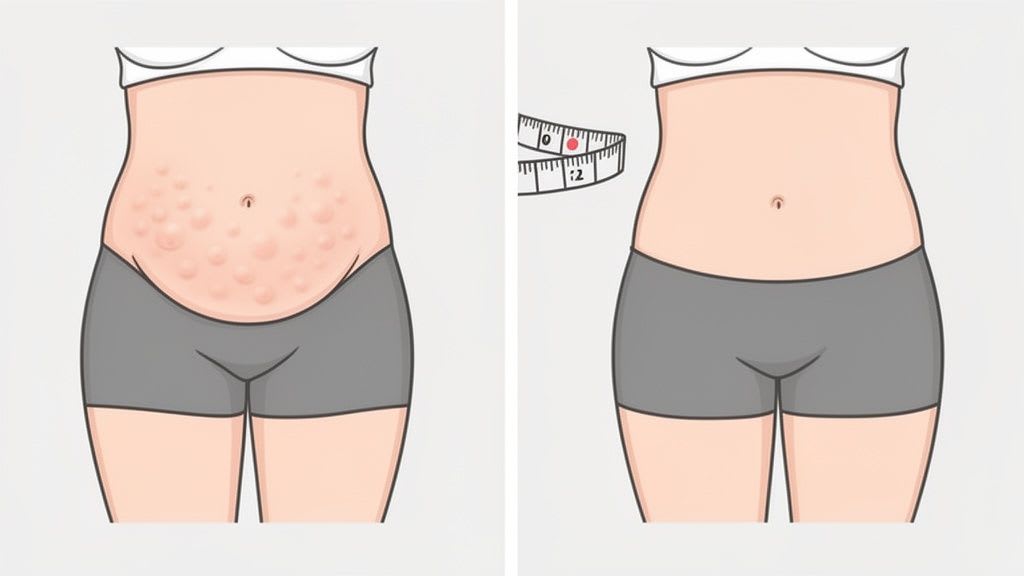
So, how does it work on fat? The efficacy lies in the customised cocktail of active ingredients. Your practitioner injects a specific blend directly into the fatty tissue, using compounds known for their lipolytic properties. This means they are effective at encouraging fat cells to break down.
Once these cells are broken down, your body’s metabolic system processes and clears the fat over the following weeks. This process allows for precise contouring of small, localised deposits.
Evaluating Cellulite Improvement
For cellulite, progress can be measured in a structured manner. The "before" state is often assessed using a clinical guide like the Nürnberger-Müller scale, which grades cellulite from Grade 0 (perfectly smooth) to Grade 3 (dimples are visible even when lying down). The objective of a treatment plan is to lower this grade.
The "after" results are not immediate. The injected formula works on multiple fronts—it helps break down fat, improves circulation, and strengthens the fibrous bands under your skin. These bands are what pull the skin down and create the "orange peel" texture, so making them more flexible helps create a smoother surface. For a better sense of all available methods, you can explore our dedicated guide to cellulite treatment in Switzerland.
In Switzerland, where aesthetic medicine adheres to high standards, mesotherapy is a trusted option. There is strong clinical consensus in Europe on its standards of practice, and data supports its efficacy. You can find more details in the research on mesotherapy's clinical standards and efficacy.
Typical Mesotherapy Results By Treatment Area
To provide a clearer picture of what you might expect, the number of sessions and the final outcome depend on the area being treated and your goals. The table below outlines some typical scenarios.
| Treatment Area | Primary Goal | Average Sessions Required | Expected 'After' State |
|---|---|---|---|
| Abdomen/Stomach | Localised fat reduction & sculpting | 6-10 sessions | A modest reduction in circumference and a smoother, more contoured appearance. |
| Thighs & Buttocks | Cellulite reduction & skin smoothing | 8-12 sessions | A noticeable decrease in skin dimpling and improved overall skin texture. |
| "Saddlebags" (Outer Thighs) | Contouring & volume reduction | 6-10 sessions | A smoother transition from the hip to the thigh, with a reduction in localised fat. |
| Arms ("Bingo Wings") | Skin tightening & slight fat reduction | 6-8 sessions | Firmer-feeling skin with a subtle improvement in the contour of the upper arm. |
It is crucial to have an honest conversation with your practitioner in a Swiss clinic to set realistic goals for your own 'mesotherapy before and after' journey.
It is essential to understand that mesotherapy for the body is about refinement. Results are measured in centimetres, not kilograms. A healthy lifestyle, including a balanced diet and regular exercise, is vital to maintaining the 'after' results long-term.
How Mesotherapy Revitalises Thinning Hair
Observing more of your scalp or a widening part can be concerning. For many, this is the first indication of hair thinning. Mesotherapy offers a direct, non-surgical approach that addresses the source of the problem: the hair follicle. The entire focus is on reviving weakened follicles and improving scalp health to encourage stronger, fuller hair growth.
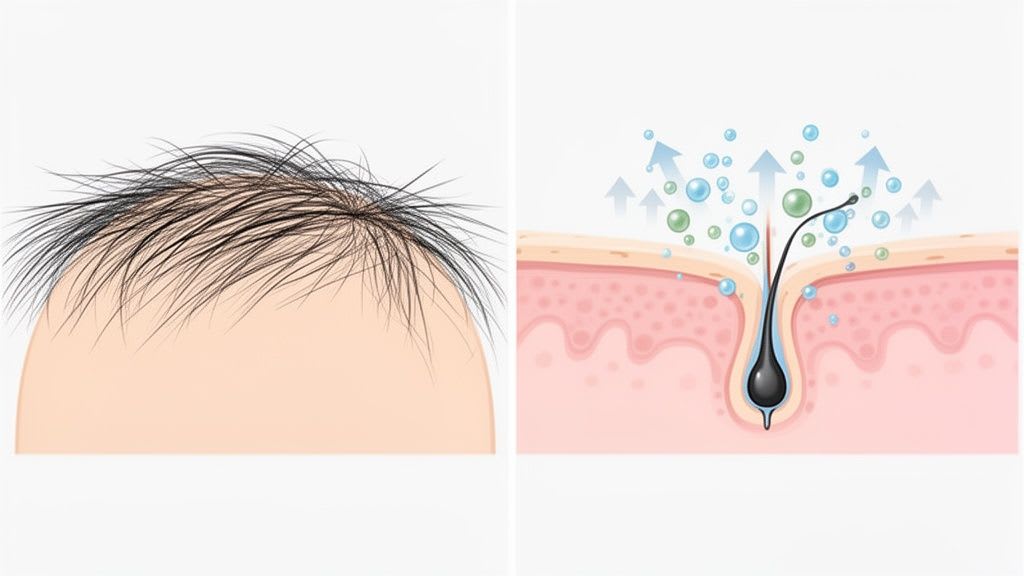
Before treatment, most people experience noticeable thinning, an increase in hair fall, and a more visible scalp. This is often a sign of underlying issues like poor circulation, a lack of essential nutrients reaching the follicles, or hormonal changes disrupting the natural hair growth cycle.
The treatment itself involves a series of micro-injections that deliver a customised cocktail of vitamins, minerals, amino acids, and other growth-promoting agents directly into the scalp's mesoderm. This technique bypasses the skin's surface, ensuring these crucial nutrients are delivered precisely where they are needed most.
The Science Behind Hair Restoration
Consider your scalp as a garden. If the soil lacks nutrients, plants will struggle to grow, appearing weak and sparse. Mesotherapy acts as a specialised nutrient solution, enriching the "soil" of your scalp to create an optimal environment for healthy hair to flourish.
This targeted approach accomplishes several things simultaneously:
Improves Blood Circulation: Better blood flow delivers more oxygen and nutrients to hair follicles.
Delivers Essential Nutrients: It directly provides the building blocks needed to produce strong, healthy hair strands.
Stimulates Follicles: The combination of the nutrient blend and the micro-injury from the needle can help revitalise dormant follicles, encouraging them back into their active growth phase.
This method is increasingly popular in Swiss clinics, which are known for delivering measurable results in hair restoration. Switzerland is a significant part of the European mesotherapy market. Clinical data supports this: some studies on alopecia patients show an increase in scalp hair density after a course of treatment. You can read about the mesotherapy market's global performance to get a broader perspective.
Managing Your Expectations for Hair Growth
It is crucial to understand that hair growth is a slow, cyclical process. The "after" images you see do not happen overnight. Real, visible improvements in hair thickness, reduced shedding, and better scalp coverage take several months to appear and depend on completing a full course of treatment.
The goal of hair mesotherapy is not to grow entirely new follicles. It is about revitalising the weak or dormant ones you already have. Consistency is what makes the difference between seeing little change and achieving a tangible improvement in hair density.
A typical treatment plan from a Swiss dermatologist will involve an initial intensive phase, followed by periodic maintenance sessions.
Initial Phase: This usually involves 4-8 sessions, scheduled roughly 2-4 weeks apart.
Visible Improvement: Many people notice less hair fall after a few treatments. New growth and a feeling of increased density typically become apparent from the third month onwards.
Maintenance Phase: To sustain follicle health and hair density, follow-up sessions are generally recommended every 3-6 months.
Your journey from a "before" state of thinning hair to an "after" of improved health and density is a gradual one. A detailed consultation with a qualified practitioner at a Swiss clinic is the best way to set realistic goals and develop a plan based on the specific cause and degree of your hair loss.
Your Safety And Finding A Qualified Swiss Clinic
Viewing impressive "mesotherapy before and after" photos can be motivating, but nothing is more important than your safety and the quality of your care. In Switzerland, aesthetic medicine operates under very high standards. Choosing the right clinic is not just about achieving your desired results; it is about ensuring your treatment is performed safely by a true professional.
It all begins with the consultation. A top-tier clinic will always conduct a thorough, unhurried conversation before proceeding with treatment. This is your opportunity to evaluate the practitioner and ensure you feel completely comfortable and confident in their abilities.
Verifying Practitioner Credentials In Switzerland
What exactly should you look for? In the Swiss medical system, a few key credentials signal a practitioner's expertise and their adherence to national standards.
MedReg Registration: This is the baseline. The Register of Medical Professions (MedReg) is a public list of every individual holding a university-level medical degree in Switzerland. If a person is not in MedReg, they are not a licensed medical doctor.
FMH Specialisation: This represents the next level of expertise. The Swiss Medical Association (FMH) awards specialist titles to physicians who have completed years of extensive, postgraduate training. An FMH title in a relevant field, like dermatology or plastic surgery, indicates a deep, proven understanding of their craft.
Finding a professional with these qualifications means your treatment is in the hands of someone who not only knows how to perform the procedure but can also safely manage any potential side effects.
What To Expect From A Quality Consultation
A proper consultation is more than a brief discussion of price. It is a full medical assessment where a good practitioner will:
Review Your Medical History: They need to be aware of any allergies or health conditions to ensure mesotherapy is a safe option for you.
Understand Your Goals: They will listen to your objectives and provide an honest opinion on whether mesotherapy is the most suitable approach.
Explain The Treatment Plan: You should leave knowing exactly what ingredients will be used, how many sessions you will likely need, and the expected timeline for results.
Discuss Risks and Aftercare: You should receive a transparent explanation of potential side effects, such as bruising or swelling, and get clear instructions for post-treatment care.
A practitioner who rushes you, avoids questions, or makes promises that sound unrealistic is a significant red flag. Your consultation should feel like a partnership—an open, educational discussion focused entirely on your health and well-being.
Finding A Verified Clinic In Switzerland
Finding the right clinic can feel overwhelming, but resources like BeautyGuide.ch are designed to simplify the process. The platform facilitates your search by verifying credentials and offering detailed clinic profiles, connecting you with trusted professionals across the country.
Switzerland has a high density of aesthetic centres, particularly in major cities like Zürich and Geneva. The results from these clinics are often well-documented. You can explore the research on mesotherapy market trends to see more data.
BeautyGuide verifies that a high percentage of practitioners on its platform comply with FMH standards, which provides peace of mind. By focusing on clinics that meet these strict criteria, you can move forward with confidence. For a deeper dive into the safeguards in place, you can learn more about how Swiss medical standards protect you.
Your Mesotherapy Questions, Answered
It is completely normal to have questions before trying a new cosmetic treatment. You want to know what to expect, from the sensation during the procedure to the results you will see in the mirror.
Here, we address the most common queries from patients considering mesotherapy in Switzerland, providing clear, straightforward answers to help you feel informed.
Is Mesotherapy Painful and What Is the Recovery Time?
Let's address the most common question: does it hurt? For most people, the procedure is well-tolerated. The needles used are incredibly fine, and to ensure comfort, practitioners almost always apply a topical numbing cream to the area beforehand. You might feel a slight prickling sensation, but generally not significant pain.
After the session, it is normal to experience some redness, slight swelling, or minor bruising at the injection sites. This is your skin's natural reaction.
These effects are temporary and usually resolve within 24 to 48 hours. A key benefit is the minimal downtime. Most people can return to their daily activities immediately, which is why it is often referred to as a "lunchtime treatment."
How Many Sessions Will I Need and How Long Do the Results Last?
This is not a one-size-fits-all treatment; the number of sessions depends on your personal goals. For facial rejuvenation—to address fine lines or improve radiance—a typical starting course is 3-6 sessions, usually spaced two to four weeks apart.
For targeting cellulite or localised fat on the body, a more intensive series of 6-10 sessions may be required to achieve the desired effect.
The results can be long-lasting, but they are not permanent. To maintain the refreshed look seen in "before and after" photos, Swiss practitioners generally recommend a maintenance session every three to six months. A healthy lifestyle, including good nutrition, exercise, and sun protection, will also help preserve your results.
Who Is an Ideal Candidate for Mesotherapy?
The best candidates are generally healthy individuals looking to target specific concerns, such as the first signs of ageing, small pockets of stubborn fat, the appearance of cellulite, or hair thinning.
It is important to have realistic expectations. Mesotherapy is excellent for targeted refinement but is not a weight-loss procedure.
There are also situations where mesotherapy is not recommended. These contraindications include pregnancy and breastfeeding, certain autoimmune disorders, active skin infections, or known allergies to any of the ingredients. A reputable practitioner in Switzerland will always conduct a thorough medical history review during your consultation to ensure the treatment is safe for you.
What Is the Average Cost of Mesotherapy in Switzerland?
The price for mesotherapy in Switzerland varies depending on several factors. The clinic's location (prices in Zürich may differ from those in a smaller town), the practitioner's experience, the size of the treatment area, and the specific cocktail of ingredients used all play a role.
As a general guide, a single session for the face may range from CHF 250 to CHF 500. Treatments for the body or for hair restoration may be priced differently.
Most clinics offer package pricing if you book a full course of treatments, which can make it more cost-effective. Any reputable clinic will provide you with a clear, itemised cost breakdown during your consultation, so there are no surprises.
Explore More
This article is for informational purposes only and does not replace professional medical advice.