
A mini face lift is a targeted surgical procedure designed to address the early signs of ageing in the lower part of the face. Unlike more extensive surgeries, its goal is not to dramatically change your appearance, but to provide a subtle 'freshening up'. It specifically addresses initial skin laxity around the cheeks and a jawline that has lost some of its sharpness, aiming for a revitalised and natural-looking result.
What Exactly Is a Mini Face Lift?
A mini face lift can be compared to a focused refurbishment rather than a full-scale renovation. It is a precise refinement intended to restore youthful definition to the lower face.
This procedure is well-suited for individuals who are beginning to see age-related changes and do not yet require the more comprehensive intervention of a full facelift.
Its primary targets are:
Mild Jowling: The slight sagging of skin that can appear below the chin and jaw.
Loss of Jawline Definition: When the clear contour of the lower face begins to soften.
Slight Laxity in the Cheeks: A minor loss of fullness in the lower cheek area.
Unlike a full facelift, which often addresses the mid-face and neck, the mini lift concentrates its efforts on this lower facial region, which is a key part of its appeal.
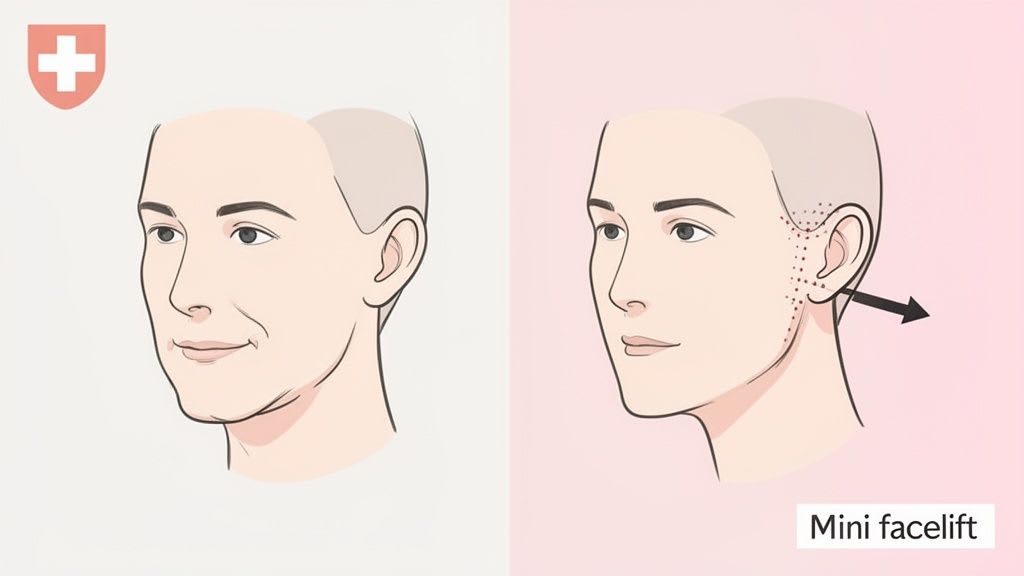
A Focused, Less Invasive Surgical Technique
The "mini" aspect of the procedure refers to the surgical technique. It involves shorter incisions, which a skilled surgeon carefully places within the natural creases in front of and sometimes behind the ears, making them very discreet once healed.
Through these small incisions, the surgeon addresses not just the skin but also the deeper supportive tissue layer (known as the SMAS layer). This tissue is gently tightened before a small amount of excess skin is removed. This dual approach—lifting the underlying foundation and then precisely trimming the excess—is what creates a smoother, more defined jawline.
This technique offers significant benefits for the patient. Shorter incisions result in less visible scarring. The recovery period is also generally faster and more comfortable. Because the surgery is less extensive, it can often be performed under local anaesthesia with sedation instead of general anaesthesia, contributing to a quicker return to daily activities.
Why It Is a Popular Choice in Switzerland
In Switzerland, the aesthetic preference often leans towards natural, understated results. The mini face lift aligns perfectly with this ethos, making it a well-regarded procedure in cities like Geneva, Zurich, and Lugano. It reflects the Swiss values of quality and discretion.
The appeal is that patients want to look rested and revitalised, not as if they have undergone obvious surgery. A mini face lift achieves this by tightening and lifting just enough to subtly rejuvenate the appearance while preserving the patient's unique facial characteristics.
For many professionals, the minimal downtime is a significant advantage. It allows for a swift return to social and professional life, making it a practical choice for maintaining an appearance that aligns with Switzerland’s high standards of personal presentation.
Is a Mini Face Lift the Right Procedure for You?
Determining if a mini facelift is the appropriate next step involves a careful assessment of your facial structure, skin health, and aesthetic goals. While a definitive answer can only be provided by a qualified surgeon, understanding the ideal candidate profile is a helpful starting point.
This procedure is designed for individuals who are just beginning to notice the first tangible signs of ageing and are seeking a targeted refresh rather than a dramatic transformation.
The best candidates are typically in their 40s and 50s and, crucially, still possess good skin elasticity. This is a vital factor. The natural resilience of the skin allows it to conform smoothly over the newly tightened underlying tissues, contributing to a natural-looking outcome. The procedure is intended for mild to moderate concerns, not the more advanced changes that would necessitate a full facelift.
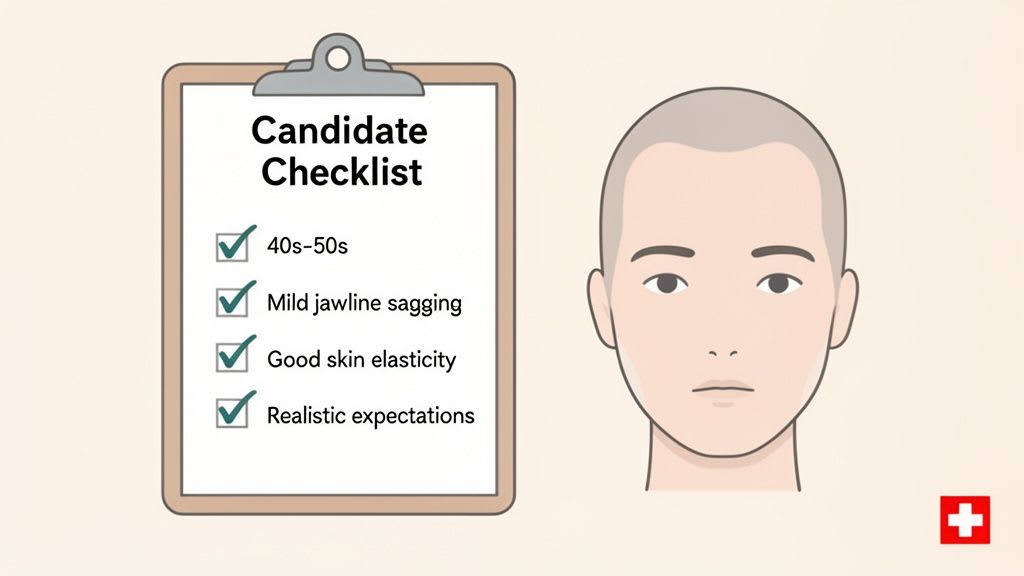
A Candidate Checklist
Consider the following points. If they align with your situation, a mini facelift may be a suitable option for you to discuss with a specialist.
Your Age: You are likely between 40 and 55 years old.
Area of Concern: Your main focus is the lower part of your face—the area around your mouth and jawline.
Your Skin's Condition: You have some sagging, but your skin retains a good degree of firmness and elasticity.
Jowl Formation: You are observing the initial formation of jowls, the slight heaviness that develops along the jaw.
Jawline Definition: The previously sharp contour along your jaw has started to soften.
Your Health: You are in good general health, are a non-smoker (or are prepared to stop), and have no medical conditions that could complicate healing.
Your Mindset: You are seeking a subtle, natural refinement—not a complete change in your appearance.
This procedure often represents a logical progression for individuals who find that non-surgical options like fillers or thread lifts are no longer providing sufficient results, but who are not yet candidates for a full facelift.
The Swiss Approach to Patient Candidacy
In Switzerland, the medical philosophy prioritises safety, subtlety, and selecting the appropriate procedure for the right patient at the right time. Leading clinics in Zurich, Lugano, and Montreux often recommend the mini facelift as an excellent initial surgical step for individuals in the 40-55 age range who are noticing early laxity in the lower face.
This reflects the Swiss preference for proactive, less invasive treatments that deliver natural-looking results with reduced downtime. You can gain further insight into this approach from reputable clinics such as dermanence.ch.
It is important to remember that this information serves as a general guide. The only way to determine your candidacy with certainty is through a thorough, in-person consultation with a qualified, FMH-certified plastic surgeon in Switzerland.
During this meeting, the surgeon will conduct a full physical examination, review your medical history, and listen carefully to your aesthetic objectives. This professional evaluation is essential to ensure that a mini facelift is the safest and most effective method to achieve your goals, in accordance with Switzerland's high standards for patient care.
Comparing Your Facial Rejuvenation Options
Choosing the most suitable method for facial rejuvenation requires careful consideration. While the mini face lift is an excellent option for specific concerns, it is one of several available treatments. To make an informed decision, it is helpful to understand the full spectrum of options, from non-invasive procedures to more comprehensive surgery.
This comparison aims to help you align a procedure with your personal goals, lifestyle, and the specific signs of ageing you wish to address. The key is to find the right solution based on your desired results, acceptable downtime, and the facial areas of concern.
Mini Face Lift vs. Full Face Lift
A common question from patients is whether a mini lift or a full lift is more appropriate. Although both are surgical procedures designed to lift and tighten facial tissues, they serve distinct purposes and are suited for different stages of the ageing process.
Mini Face Lift: This is a targeted procedure focused primarily on the lower third of the face. It is an ideal solution for addressing the initial formation of jowls or a loss of definition along the jawline. The incisions are shorter and the procedure is less extensive, resulting in a faster recovery.
Full Face Lift: This is a more comprehensive rejuvenation procedure. It addresses moderate to advanced sagging not only in the lower face and jowls but also in the mid-face (cheeks) and often includes the neck. It is a more significant operation with longer incisions, but it typically yields more extensive and longer-lasting results.
Neither procedure is inherently "better" than the other. The mini face lift is highly effective for addressing the first significant signs of ageing, while the full face lift is designed to restore a more youthful facial structure when changes have become more pronounced.
Non-Surgical Alternatives
Surgery is not the only option for facial rejuvenation. Swiss clinics offer advanced non-surgical treatments that can either postpone the need for a surgical lift or complement its results. These include treatments like thread lifts, Ultherapy, and radiofrequency procedures, all of which work by stimulating the body's natural collagen production to create a subtle, temporary lifting effect.
These options are far less invasive, require little to no downtime, and are performed without significant anaesthesia. However, the results are more modest and have a shorter duration compared to a surgical lift. They are an excellent starting point for individuals with very mild laxity or for those not yet ready to consider surgery. If you wish to explore these methods further, you can learn more about skin rejuvenation options in our detailed guide.
A simple way to conceptualise the difference is that non-surgical treatments enhance skin quality and collagen from the outside in. In contrast, a mini face lift works from the inside out by surgically repositioning the deeper tissues that support the face.
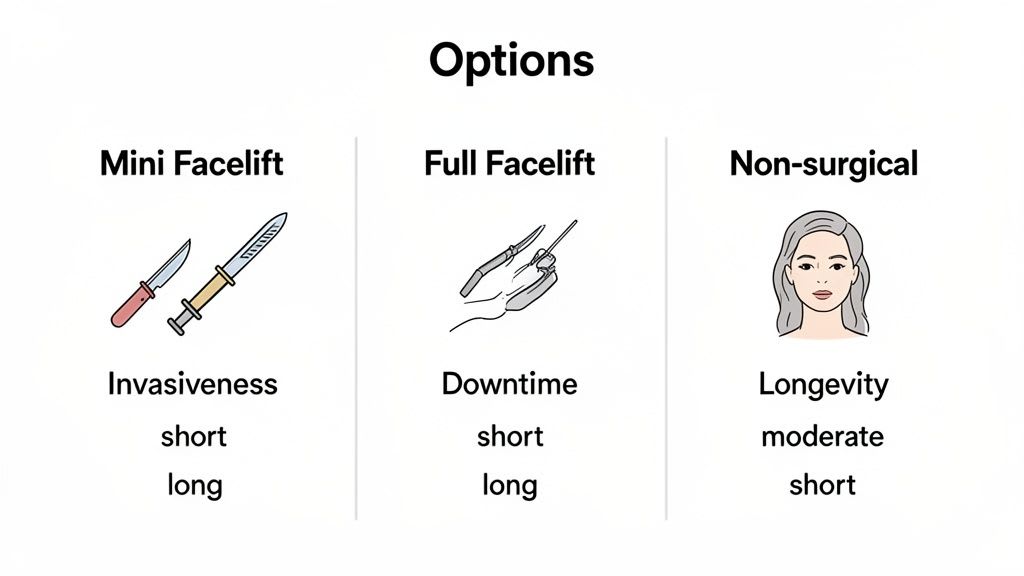
A Detailed Comparison Table
To provide a clearer overview, the following table breaks down the key differences between these approaches, offering a realistic perspective on what to expect within a Swiss medical context.
Treatment Comparison: Mini Face Lift vs. Full Face Lift vs. Non-Surgical Options
This side-by-side comparison highlights the most important factors—from recovery time to cost—to help you evaluate how each option aligns with your needs.
| Feature | Mini Face Lift | Full Face Lift | Non-Surgical Alternatives (e.g., Thread Lifts, Ultherapy) |
|---|---|---|---|
| Primary Target Area | Lower face, jawline, and mild jowls. | Mid-face, lower face, jowls, and neck. | Mild skin laxity on the face, brow, and neck. |
| Invasiveness | Minimally invasive surgery with short incisions. | Invasive surgery with longer incisions. | Non-invasive or minimally invasive (no incisions). |
| Anaesthesia Type | Typically local anaesthesia with sedation. | Usually general anaesthesia or deep sedation. | Topical numbing cream or no anaesthesia required. |
| Recovery Time | 1 to 2 weeks for most swelling and bruising to resolve. | 2 to 4 weeks before returning to social activities. | Minimal to no downtime; immediate return to daily life. |
| Longevity of Results | 5 to 10 years, depending on lifestyle and genetics. | 10 to 15 years or more, offering a long-term solution. | 6 months to 2 years, often requiring maintenance treatments. |
| Cost Range in CH | CHF 9,000 - 15,000 (approx.) | CHF 20,000 - 35,000+ (approx.) | CHF 1,000 - 5,000 per session (approx.) |
This information will better prepare you for a productive discussion with a qualified surgeon, who can then provide a personalised assessment and recommend the procedure that will safely and effectively help you achieve your desired outcome.
Your Mini Face Lift Journey: From Consultation to Recovery
Understanding the process of a mini face lift from beginning to end can help alleviate any concerns. In Switzerland, the patient journey is highly structured, with each step meticulously planned to ensure safety and comfort.
Let's walk through the entire process, from the initial consultation to the return to normal activities, so you know exactly what to expect.
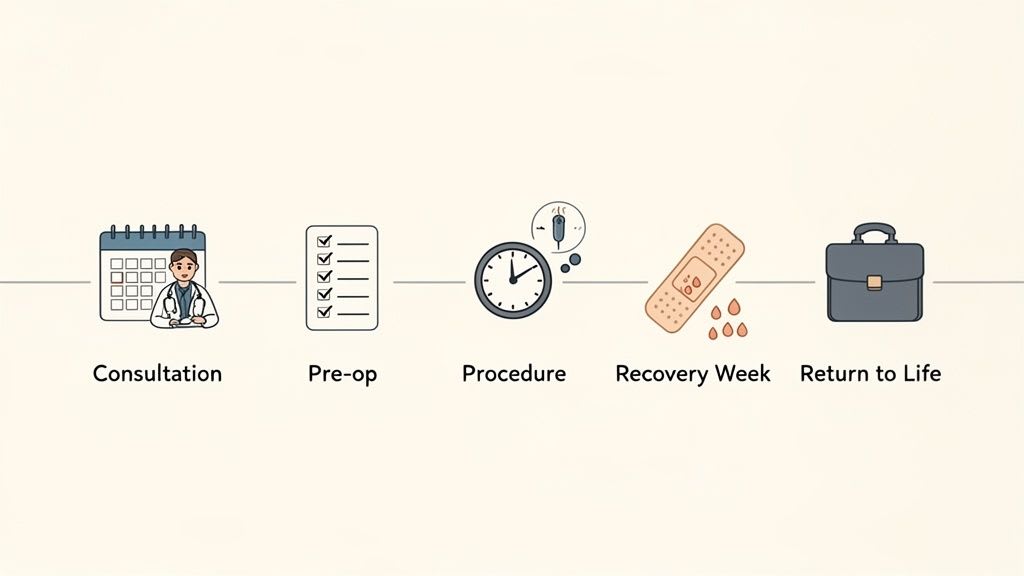
Step 1: The Initial Consultation
This first meeting is arguably the most crucial step. It involves an open and detailed conversation with an FMH-certified plastic surgeon to discuss your aesthetic goals. You are considered a partner in the decision-making process.
The surgeon will conduct a thorough examination of your facial structure and skin quality and review your medical history to confirm that this procedure is a safe and suitable option for you. This is your opportunity to ask questions. In line with Swiss medical ethics, you can expect an honest discussion about achievable outcomes, potential risks, and the recovery process. You should leave this meeting with a clear and confident understanding of the procedure.
Step 2: Pre-Operative Preparations
Once you decide to proceed, the clinic will provide a clear set of pre-operative instructions. Adhering to these guidelines is essential for a smooth procedure and an optimal recovery.
Typically, these instructions include:
Medication Adjustments: You will likely be asked to pause certain medications that can increase bleeding, such as aspirin or some anti-inflammatory drugs.
Smoking Cessation: If you smoke, it is imperative to stop for a specified period before and after surgery. Nicotine significantly impairs the healing process.
Arranging Support: You will need to arrange for someone to drive you home after the procedure and, ideally, stay with you for the first 24 hours.
Following these protocols is a vital component of the high safety standards maintained in Swiss clinics.
Step 3: The Procedure Itself
The mini face lift is almost always performed as an outpatient procedure, allowing you to return home on the same day. The surgery itself is relatively brief, typically taking about one and a half to two hours.
Most surgeons perform it under local anaesthesia combined with sedation. This ensures you are completely comfortable and pain-free without the need for general anaesthesia, which simplifies the recovery process. The surgeon makes small, discreet incisions, tightens the underlying muscle and tissue layer (the SMAS), removes a small amount of excess skin, and meticulously closes the incisions.
This focus on precision and minimally invasive techniques is a hallmark of the Swiss approach to aesthetic surgery. The goal is always a natural result with reduced downtime and scarring that is practically invisible once fully healed.
Step 4: The Recovery Phase
Patience and strict adherence to post-operative instructions are key during the recovery phase. While recovery is much quicker than that of a full facelift, it is still a process that requires careful management.
The First 24-48 Hours:
Expect some swelling and bruising, which is a normal part of the healing process. Resting with your head elevated can help minimise swelling. Any discomfort should be mild and easily managed with the pain medication prescribed by your surgeon.
Days 3-7:
Swelling and bruising will likely peak and then begin to subside noticeably. You will probably feel able to move around your home, but strenuous activities should be avoided. Around the one-week mark, you will return to the clinic for a follow-up appointment, at which time your sutures are typically removed.
Weeks 1-2:
By the end of the first week, many patients feel ready to return to office-based work. Any residual bruising can usually be concealed with makeup. By the two-week point, the most obvious signs of surgery have generally resolved, and you can begin to resume your social life.
Your surgeon will provide a detailed timeline, offering guidance on everything from incision care to when you can safely resume exercise.
Understanding Costs and Value in Switzerland
Discussing the financial aspect of a mini facelift is an important part of the decision-making process. In Switzerland, the cost of cosmetic procedures reflects the exceptionally high standards of medical care, clinic quality, and surgeon expertise. The price should be viewed as an investment in your safety and the quality of the final result.
A reputable Swiss clinic will provide a transparent, all-inclusive cost estimate. This quote typically bundles all associated fees, preventing unexpected charges later on and allowing you to plan with confidence.
Breaking Down the Cost
Understanding the components of the price for a mini facelift can provide clarity.
Surgeon’s Fee: This constitutes the largest portion of the cost and covers the surgeon’s skill, experience, and specialised training—particularly for those holding the respected FMH title.
Anaesthesia Costs: This fee covers the anaesthesiologist's services and the anaesthetic used. For a mini lift, this is often local anaesthesia with sedation rather than general anaesthesia.
Clinic or Facility Fee: This accounts for the use of the accredited operating theatre, medical equipment, nursing staff, and other operational costs required to maintain Swiss quality standards.
Post-Operative Care: The journey continues after the procedure. This part of the fee typically includes follow-up appointments, suture removal, and any necessary aftercare supplies provided by the clinic.
This all-inclusive pricing model is standard practice in Switzerland, ensuring total transparency from the outset.
Realistic Price Ranges in Switzerland
While each case is unique, a mini facelift in Switzerland generally costs between CHF 9,000 and CHF 15,000.
This makes it a more accessible procedure than a full, classic facelift. A full facelift is a more extensive operation and carries a higher price tag, often starting at CHF 30,000 or more. The lower cost of the mini lift is due to it being less invasive, requiring less time in surgery, and typically not necessitating general anaesthesia.
Why Costs Vary Between Cantons
You may notice that prices differ depending on the location within Switzerland. The operational costs of a high-end clinic in central Zurich or Geneva will vary from one in Ticino or Bern, and this is reflected in the pricing. The surgeon's reputation and the demand for their services also influence the cost.
Regardless of the canton, the fundamental value remains consistent. The price is always linked to Switzerland's strict medical regulations, the world-class training of its doctors, and the advanced technology used in its clinics. For a more detailed analysis, check out our guide on facelift costs in Switzerland.
Investing in a mini facelift in Switzerland is an investment in peace of mind. It provides the assurance that your procedure is being performed by a highly qualified surgeon in a certified facility that adheres to some of the most stringent safety protocols in the world. Prioritising this level of quality is a crucial decision for a safe and successful outcome.
How to Choose a Qualified Surgeon and Clinic
Selecting the right specialist for your mini facelift is the most critical decision you will make. In Switzerland, you have access to surgeons who meet incredibly high standards, but it is important to find the right fit for your needs.
The goal is to find a medical professional you trust—one who possesses not only the requisite technical skills but also a clear understanding of your desired aesthetic outcome. This is a partnership built on communication and shared goals.
Verify Credentials: The Swiss Gold Standard
The first step is to verify credentials. In Switzerland, the benchmark for a plastic surgeon is the FMH specialist title.
FMH stands for Foederatio Medicorum Helveticorum, the Swiss Medical Association. A surgeon holding the title "Specialist in Plastic, Reconstructive and Aesthetic Surgery (FMH)" has completed years of rigorous, specialised training that meets Switzerland's stringent national standards. This certification is a guarantee of profound expertise.
When researching surgeons, confirm that they hold this specific title. It is your primary indicator of quality and qualification.
Choosing a surgeon with the correct FMH specialisation is non-negotiable. It ensures your procedure is performed by a medical professional with comprehensive training in the precise anatomy and advanced techniques required for facial surgery.
Evaluate Experience and Aesthetic Approach
After confirming credentials, find a surgeon whose experience and artistic style align with your goals. A mini facelift requires a delicate and nuanced approach; it is as much an art as it is a science. The objective is always a result that enhances your natural appearance.
During your consultations, consider the following:
Specific Experience: Ask the surgeon how frequently they perform mini facelifts. A specialist who focuses on facial rejuvenation will have a more refined understanding of the procedure's intricacies than a generalist.
Before-and-After Photos: A reputable surgeon will readily share examples of their work. Request to see photos of past patients, particularly those with a similar facial structure and concerns to yours. This is the most effective way to assess if their aesthetic sensibility matches your own.
Their Philosophy: Discuss their approach to the procedure. Do they prioritise subtle, natural-looking results? Do they listen attentively to your objectives? You should feel that you are collaborating toward a shared goal.
The Consultation Checklist: Key Questions to Ask
The initial consultation is your opportunity to interview the surgeon. A good surgeon will welcome your questions and provide clear, honest answers. It is advisable to prepare a list of questions in advance.
Essential Questions for Your Surgeon:
- Are you an FMH-certified specialist in Plastic, Reconstructive and Aesthetic Surgery?
- Approximately how many mini facelifts do you perform each year?
- May I see before-and-after photos of your patients who have had this procedure?
- Based on my facial anatomy and skin condition, do you consider me a good candidate for a mini facelift, or would you recommend an alternative procedure?
- Where will the surgery be performed? Is the facility fully accredited?
- What type of anaesthesia will be used, and who will administer it?
- Could you describe the recovery process in detail?
- Can you explain the potential risks and complications associated with this surgery?
- What is included in the final price quote? Are there any potential additional costs?
Ultimately, you must feel completely comfortable and confident with your chosen surgeon and their team. If you are still considering your options, our guide on how to select the right beauty clinic in Switzerland offers further advice to help you make an informed choice.
Your Questions, Answered
Here are answers to some of the most frequently asked questions about the mini facelift. Having clear and accurate information is essential for making a well-considered decision.
How Long Can I Expect the Results to Last?
A mini facelift effectively resets the clock on facial ageing, but the natural ageing process continues. You can generally expect the results to last for five to ten years.
The longevity of the outcome is influenced by factors such as genetics, skin care routines, and lifestyle choices, including sun exposure and smoking. Many patients find that periodic non-surgical treatments, as recommended by their Swiss clinic, can help maintain their refreshed appearance for longer.
Will I Have Obvious Scars?
A significant advantage of the mini facelift is the discreet placement of scars. Surgeons are highly skilled at placing the short incisions within the natural creases around the ears and sometimes within the hairline.
Initially, the incision lines will be visible, but they typically fade over several months, eventually becoming very fine, pale lines that are difficult to detect. Adhering strictly to your surgeon's post-operative care instructions is the best way to ensure optimal healing and minimal scarring.
The Swiss approach to aesthetics prioritises subtlety and natural-looking outcomes. Surgeons in Switzerland are known for their meticulous incision and closure techniques, which ensure that scars blend seamlessly and do not distort the natural contours of the ear or hairline.
How Painful Is the Procedure?
The procedure itself is not painful. You will be under local anaesthesia with sedation, ensuring you are comfortable and relaxed throughout.
Post-operatively, most patients report a feeling of mild discomfort rather than significant pain. This is typically well-managed with the pain relief medication prescribed for the first few days. The most noticeable effects are swelling and bruising, which tend to peak around the second or third day and then subside significantly over the following week or two.
Can a Mini Facelift Be Combined with Other Procedures?
Yes, combining procedures is a common practice. It can often be the most effective way to achieve a harmonious and balanced result across the entire face. Your surgeon will discuss your overall aesthetic goals to develop a comprehensive treatment plan tailored to you.
Some of the most frequently combined procedures include:
Blepharoplasty: Eyelid surgery to address signs of ageing around the eyes.
Brow Lift: To elevate a heavy or drooping forehead for a more refreshed expression.
Fat Transfer: To restore youthful volume to areas such as the cheeks or temples.
Laser Resurfacing: To improve the skin's surface texture and tone concurrently.
This article is for informational purposes only and does not replace professional medical advice.