
When you're weighing up a beauty clinic abroad against one in Switzerland, the decision really boils down to two things: continuity of care and legal protection. A Swiss clinic provides a seamless care journey governed by strict local standards, whereas heading abroad can introduce serious logistical hurdles, especially if something goes wrong after you’ve flown home.
Critical Reality: The Fly-Back Gap
The biggest risk of medical tourism is not the surgery, but the 'Fly-Back Gap.' Complications (infection, necrosis) typically appear on Day 5-10, exactly when you are back in Switzerland. Your surgeon is then 2,000km away, and Swiss emergency doctors may be hesitant to intervene in complex aesthetic complications due to liability.
The "Distance" Factor: When Complications Arise 2,000km Away
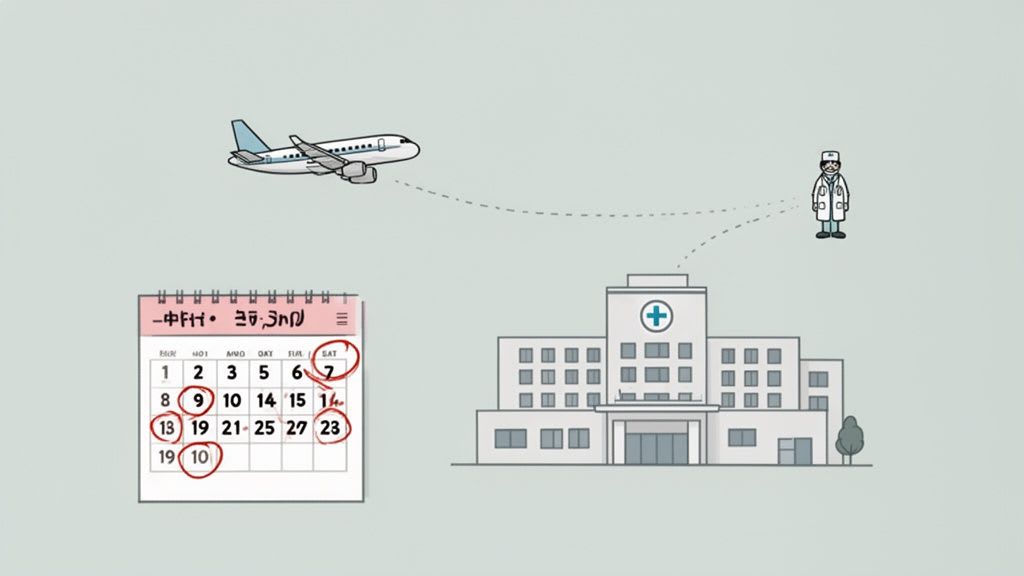
It’s easy to focus on the procedure itself when thinking about medical travel. But the most overlooked—and most dangerous—part of the journey is the period just after you land back in Switzerland. This is where the perilous "Fly-Back Gap" comes into play.
This gap leaves patients incredibly exposed. A minor issue that your original surgeon could easily manage becomes a frantic emergency in Switzerland. Local doctors do not have your full case history, may not understand the techniques used, and are often unwilling to intervene in another surgeon's recent work. This can leave you scrambling for urgent care while a manageable complication worsens.
Suddenly, any money you saved is meaningless. This logistical nightmare can turn a minor issue into a serious health crisis. Having your surgeon nearby for immediate follow-up care is a safety net that simply can't be replicated from thousands of kilometres away.
Swiss Safety Standards Versus Foreign Clinical Risks
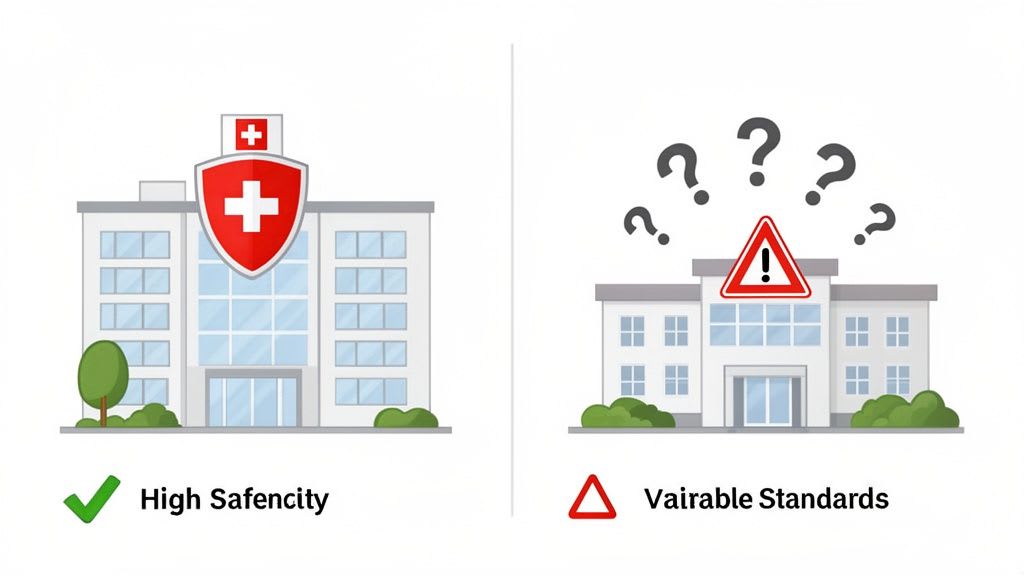
When you're considering an aesthetic treatment, your safety starts with understanding the rules and standards a clinic operates under. Switzerland’s healthcare system is known for its incredibly strict oversight, verifiable credentials, and consistent hygiene protocols. This creates a reliable, safe environment for patients.
In contrast, standards in some popular medical tourism spots can be inconsistent. While many excellent clinics exist abroad, the lack of a uniformly high regulatory bar means the burden of verification falls entirely on you—a difficult task from a distance.
Verifiable Credentials and Clinical Precision
Here in Switzerland, the system leaves no room for guesswork. Medical professionals must hold specific, verifiable qualifications, like an FMH specialisation, which can be looked up in the official MedReg database. This guarantees your practitioner has completed a demanding, standardised training process. You can learn more about why medical supervision matters in aesthetic treatments.
This rigorous approach directly impacts patient outcomes. Swiss beauty clinics consistently report post-procedure infection rates of under 1.5%. This figure stands in stark contrast to the 12-20% rates documented in some popular medical tourism destinations.
That significant difference often comes down to world-class hygiene standards and the meticulous credential checks central to the Swiss system. Choosing a clinic that operates under this strict local oversight provides a tangible safety advantage and peace of mind.
The Invisible Risk: Multiresistant Bacteria
When comparing a beauty clinic abroad versus in Switzerland, there is a danger that goes far beyond the operating theatre. High-volume medical tourism hubs, such as those in Turkey or Eastern Europe, may have vastly different antibiotic protocols and hygiene standards, creating a potential breeding ground for multiresistant bacteria.
It's a documented problem. Swiss hospital data shows that patients returning from procedures in these regions have a statistically higher rate of "Multiresistant Infections" (MRSA). These "superbugs" are not simple post-operative complications; they are a formidable health threat that can be incredibly difficult to treat.
The Burden on the Swiss Healthcare System
Once a patient brings a multiresistant bacteria into Switzerland, managing it becomes a serious challenge. Warning: These infections are difficult to treat and often require hospitalization in isolation to prevent further spread. Because standard antibiotics are ineffective, doctors must use complex and expensive alternatives that can take a heavy toll on your health. This hidden risk can instantly erase any financial savings, transforming an elective cosmetic procedure into a severe, long-term medical crisis.
Legal & Insurance Reality: A Zero-Click Comparison
Understanding your legal and insurance protections is critical, especially when choosing between a clinic in Switzerland and one abroad. In Switzerland, patient safety is legally mandated. Abroad, the protections can be minimal.
Legal and Insurance Protections: Switzerland vs. Abroad
This table breaks down the fundamental differences in patient rights, liability, and communication.
| Factor | Switzerland | Abroad |
|---|---|---|
| Legal Recourse | Mandatory Liability Insurance (You can sue/get compensated) | Often signed waivers (Zero legal standing) |
| Complication Costs | Often included in revision policy | You pay for emergency care in Switzerland (Insurance/KVG often denies coverage for elective cosmetic complications) |
| Language Barrier | Native | Translators (Risk of miscommunication during surgery) |
Ultimately, while the upfront cost might seem lower abroad, the potential financial and legal exposure you take on is exponentially higher. In Switzerland, the system is built with your protection as a priority. You can dig into these healthcare market findings on novaoneadvisor.com. For guidance on choosing a reliable local provider, see our article on how to select the right beauty clinic.
The "Total Cost" Calculator: Did You Do the Math?

A low price tag for a procedure abroad rarely tells the whole story. To understand the true financial commitment, you must look beyond the clinic’s quote and consider all the associated costs of travelling for surgery.
The Real Cost Breakdown Abroad
Before being drawn in by a seemingly great deal, consider the full financial picture:
Surgery (€3,000): The initial quoted price.
Flights (€500): For you and potentially a companion.
Hotel (€500): For pre-op consultations and initial recovery.
Companion Costs (€500): Food, transport, and lodging for your support person.
Unpaid Leave (2 weeks): Lost wages for travel, procedure, and recovery time.
Risk of Revision: The potential cost of corrective surgery back in Switzerland, which is rarely covered.
When you add these necessary expenses, the total cost abroad often approaches the price in Switzerland. The price gap frequently shrinks to a 20-30% difference, which may not be worth the significant logistical and medical risks involved, especially for major surgery. For a clearer picture, see our breakdown of what to expect for procedure costs in Switzerland.
Frequently Asked Questions (FAQ)
Considering a procedure abroad brings up serious questions. Here are answers to the most common concerns, framed from a Swiss medical and legal standpoint.
Will a Swiss doctor fix my botched foreign surgery?
Many refuse due to liability risks, or they charge a 'Reconstructive Premium' starting at CHF 20,000. Most Swiss surgeons are extremely hesitant to correct work done by another practitioner, especially from abroad. They lack the original surgical records, are unaware of the techniques or materials used, and face a high risk of encountering hidden infections or complex scar tissue. If a surgeon agrees to take the case, it is treated as a complex reconstruction, not a simple revision, with costs reflecting that complexity.
Does my travel insurance cover cosmetic surgery?
No. Standard travel insurance specifically excludes complications from medical tourism. Travel policies are designed for unforeseen accidents or illnesses, not for issues arising from elective medical procedures. Similarly, your mandatory Swiss health insurance (KVG) will not cover costs related to elective cosmetic surgery or its complications. You will be personally responsible for 100% of the costs for any emergency care or corrective procedures needed back in Switzerland.
Can I fly home immediately?
No. You face the risk of DVT (Blood Clots) or wound dehiscence if you fly too soon after tummy tucks/lipo. Flying shortly after major surgery significantly increases the risk of deep vein thrombosis (DVT), a potentially life-threatening condition where blood clots form in the legs. The changes in cabin pressure can also strain fresh incisions, leading to wound separation (dehiscence) and infection. A safe, grounded recovery period is a medical necessity, not an optional convenience.
Explore More
This article is for informational purposes only and does not replace professional medical advice.