
Let's be clinically precise about CO2 laser before and after results. This is not a gentle facial. It is a controlled, medical-grade injury to the skin designed to force a powerful healing response. The most critical thing to understand is that for a period of time, your skin will look significantly worse before it begins to look better.
Timeline Reality: The Collagen Delay
While surface skin heals in 7-10 days, the true 'After' result of a CO2 laser takes 3 to 6 months to appear. This is because the laser triggers new collagen production (neocollagenesis), which is a slow biological process. Don't judge your results in week 2.
Think of it this way: the laser vaporizes columns of skin tissue, creating a thermal wound in the dermis. This sends an urgent signal to your body's fibroblast cells to begin manufacturing new, strong collagen and elastin. This biological construction project is what creates the final result, and it cannot be rushed. Patience is not just a virtue with this procedure; it is a clinical necessity.
The precision of this technology is remarkable. CO2 lasers used in Swiss dermatology are so finely calibrated they can target specific depths of skin with micron-level accuracy. For context, this same core technology is used by scientists for highly detailed atmospheric analysis (acp.copernicus.org). That same level of precision is what allows a dermatologist to resurface skin effectively.
This deep dermal remodelling is what separates ablative lasers from less invasive treatments. For comparison, you can see how other modalities stimulate collagen in our guide on microneedling before and after results. With a CO2 laser, the goal is significant, structural improvement, not a superficial, temporary fix.
The Part No One Shows on Instagram: The "Ugly Phase" Timeline
Social media galleries almost universally omit the mandatory healing phase. For an ablative CO2 laser, this period is unavoidable and requires strict adherence to post-procedure protocols. Expecting this "ugly phase" is fundamental for any patient in Switzerland considering this treatment. Your skin will look far worse before it improves.
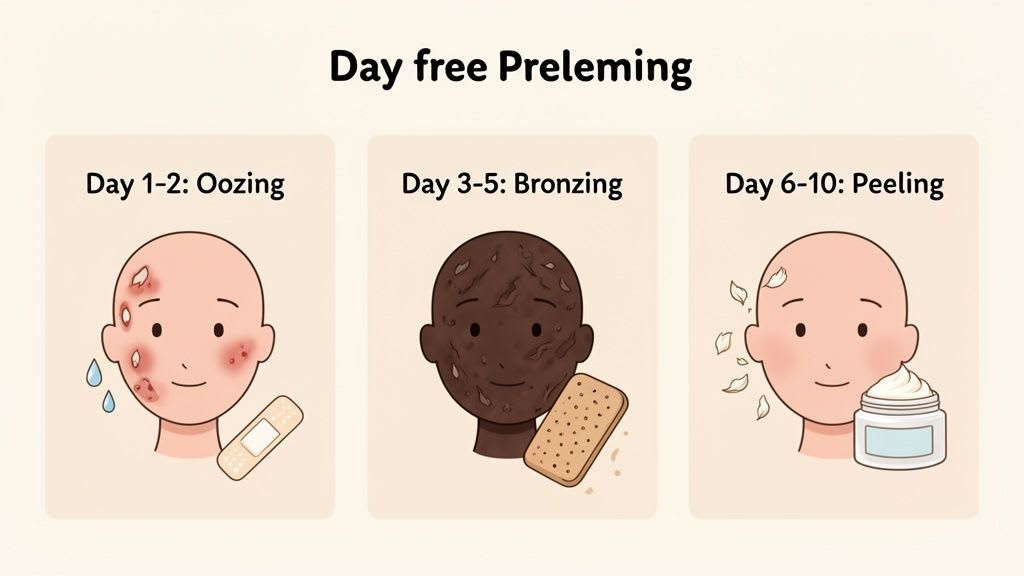
This is a predictable, physiological process. Your only role is to follow your physician's aftercare instructions without deviation.
Day 1-2: "The Oozing Phase"
Immediately post-procedure, the treated area will be raw, intensely red, swollen, and hot—akin to a severe sunburn. It will ooze a yellowish serous fluid. This is expected. Your aftercare protocol, which will include constant application of an occlusive ointment like Aquaphor and potentially vinegar soaks, is not optional. It is your primary defence against infection and is critical for proper re-epithelialization.
Day 3-5: "The Bronzing Phase"
The oozing will subside. Your skin will then develop a dark brown, "bronzed" appearance and feel like sandpaper or a grater. This is the coagulated, denatured tissue preparing to exfoliate. Do not pick, scrub, or peel this layer.
Day 6-10: "The Peeling"
This coarse, dark layer of necrotic tissue will begin to slough off in sheets, revealing fragile, pink, new skin underneath. You must allow this to happen naturally. Forcibly removing it risks scarring and pigmentary complications.
Fractional vs. Fully Ablative: A Critical Distinction
The term "CO2 laser" describes two distinct treatment modalities offered in Swiss clinics: fractional and fully ablative. Understanding this difference is essential for a productive consultation, as it dictates downtime, risk profile, and the number of sessions required.
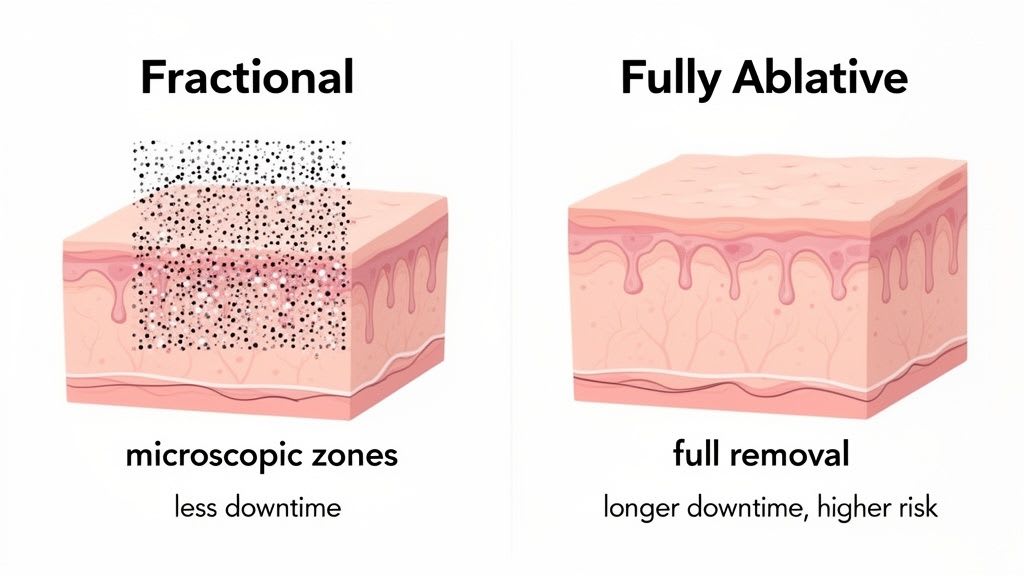
Fully ablative lasers remove 100% of the epidermis over the entire treatment area. This is a highly aggressive, "one-and-done" procedure reserved for severe photoaging or deep scarring, entailing a significant recovery period.
Fractional lasers create microscopic columns of thermal injury (Microscopic Treatment Zones) while leaving the surrounding tissue intact. These "islands" of healthy skin act as a reservoir for rapid healing, dramatically reducing downtime.
Zero-Click Table: Fractional vs. Fully Ablative
This table outlines the primary clinical trade-offs:
| Feature | Fractional CO2 Laser | Fully Ablative CO2 Laser |
|---|---|---|
| Downtime | 5-7 days of social downtime. | 2+ weeks of intensive recovery. |
| Sessions Needed | 3-4 sessions are typically required. | 1 (often referred to as "One-and-Done"). |
| Risk | Lower overall risk. | High risk of hypopigmentation (white spots). |
This is not a patient's choice to make in isolation. It is a clinical decision made with a qualified dermatologist after a thorough assessment of your skin pathology, goals, and capacity for downtime.
Who Can't Have This? Candidacy and Contraindications
The ablative CO2 laser is a powerful medical device, not a universal solution. In Switzerland, patient selection is extremely rigorous to mitigate risk and ensure predictable outcomes. For some individuals, the risks simply outweigh the potential benefits.
Who Can't Have This? The Fitzpatrick Warning
CO2 laser treatment is strictly contraindicated for Fitzpatrick Skin Types IV-VI (olive, brown, or dark skin) without extreme caution and expert hands. The intense thermal energy can easily trigger the melanocytes, leading to Post-Inflammatory Hyperpigmentation (PIH). This complication manifests as dark stains on the skin that can be more distressing than the original condition and are exceptionally difficult to treat.
Other Medical Contraindications
Your general health history is as critical as your skin type. You will be disqualified from treatment if you have:
Active cutaneous infections, including herpes simplex virus (cold sores) or bacterial impetigo.
A known history of keloid or hypertrophic scarring. The controlled injury of the laser could trigger an abnormal, excessive healing response.
Recent use of oral isotretinoin. This medication alters skin healing pathways. A washout period of at least 6-12 months is mandatory before undergoing any ablative laser procedure.
How to Spot a Fake Before/After Photo
When evaluating a clinic's gallery of CO2 laser before and after images, you must adopt a critical, analytical eye. Not all photographic evidence is created equal. Understanding common manipulation tactics is key to setting realistic expectations.
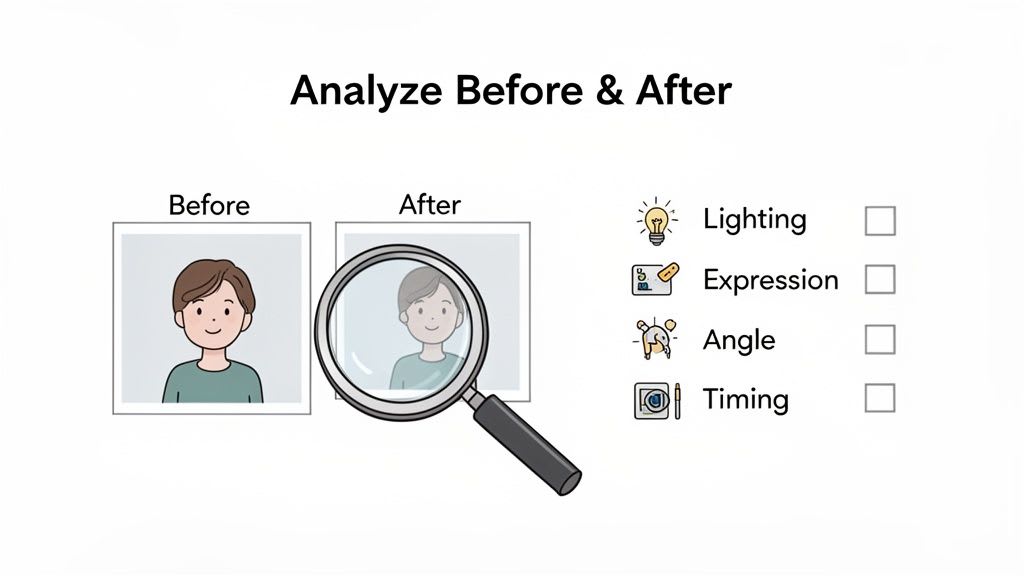
Use this checklist to deconstruct the images you see:
The Flash Effect: Is the 'After' photo washed out with bright, direct flash to hide wrinkles? Scrutinize the lighting. Consistent, diffuse lighting is the hallmark of honest medical photography. A harsh flash in the "after" shot can obliterate fine lines and textural irregularities.
The Expression: Is the patient smiling in the 'Before' (accentuating crow's feet) and neutral in the 'After'? Comparing a dynamic expression to a static one is a classic method of exaggerating results. Both photos should feature the same neutral, relaxed facial posture.
Precision is the foundation of both aesthetic medicine and advanced scientific research. The same principles of accuracy that underpin advanced laser applications in fields like atmospheric science must be applied in the clinic. Demand meticulous care and honest documentation.
Finding a Qualified Laser Specialist in Switzerland
With ablative lasers, the skill of the operator is paramount. The device is merely a tool; the outcome is dictated by the physician's expertise. In Switzerland, where medical standards are exceptionally high, selecting the right practitioner is the single most important variable for safety and success.
This is a serious medical procedure. Your search must be limited to true specialists with extensive experience in laser physics and skin physiology.
The FMH Title is Non-Negotiable
The most critical credential is the FMH (Foederatio Medicorum Helveticorum) title. This designation confirms the physician is a board-certified specialist in dermatology or plastic surgery, having completed rigorous, standardized Swiss postgraduate training. It is your assurance of competence and adherence to the highest national standards of care.
Your Consultation Checklist
The consultation is your opportunity to qualify the physician. A competent specialist will appreciate and welcome incisive questions.
How many ablative CO2 procedures do you perform annually?
What is your protocol for managing potential complications like infection or PIH?
Show me before-and-after photos of your own patients with my skin type and concerns.
Our guide on how to select the right beauty clinic offers a comprehensive framework for making an informed and safe choice.
Frequently Asked Questions (FAQ)
When can I wear makeup?
Makeup is absolutely forbidden until the skin has fully re-epithelialized, which is the process of the new top layer of skin closing over. This typically takes 7 to 10 days. Applying makeup prematurely introduces a high risk of infection and can lead to permanent pigment tattooing under the healing skin.
Does it hurt?
Yes. It is a painful procedure without anaesthesia. Topical numbing cream is mandatory. For more aggressive treatments, some patients require regional nerve blocks or conscious sedation to ensure adequate pain control. This will be determined by your physician.
How long does redness last?
After the peeling phase (around day 10), the new skin will be bright pink or red. This post-procedure erythema is a normal part of the healing process. This 'pinkness' can persist for 4 to 6 weeks, and in some cases, several months, as the new skin matures and the underlying vascular response subsides. These timelines will be discussed in detail during what to expect during a first aesthetic consultation.
Explore More
This article is for informational purposes only and does not replace professional medical advice.