From consultation to aftercarefacial aesthetics: how doctors assess proportions

The path to achieving a natural, balanced look doesn't start with a needle—it starts with a detailed, mathematical assessment. Great aesthetic outcomes are the result of precise measurement and a deep understanding of facial anatomy, not simply adding volume. In a quality Swiss clinic, your unique facial structure is the blueprint for any treatment, ensuring the result is harmonious and authentic.
The Blueprint of Beauty: The Math Behind Aesthetics
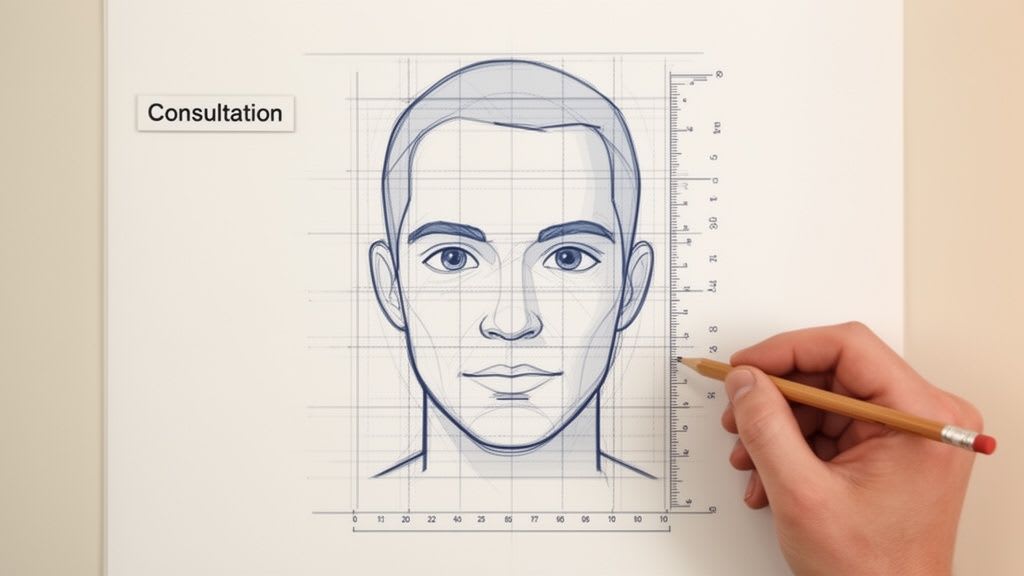
Think of your first consultation as a session where anatomical science and artistry merge. An experienced Swiss doctor analyses your face with the eye of an architect, using time-tested principles to design a treatment plan that is entirely yours. This careful, methodical process is what ensures any enhancement will complement your natural features, not mask them.
This initial meeting lays the groundwork for everything that follows. It's a mix of a detailed conversation and a thorough examination to map out your facial structure. To get a better sense of this vital first step, you can learn more about what to expect during a first aesthetic consultation in our guide.
This patient-focused approach is a cornerstone of Swiss medical standards, making sure your safety and satisfaction are paramount right from the start.
The Art and Science Behind Facial Harmony: The Golden Ratio
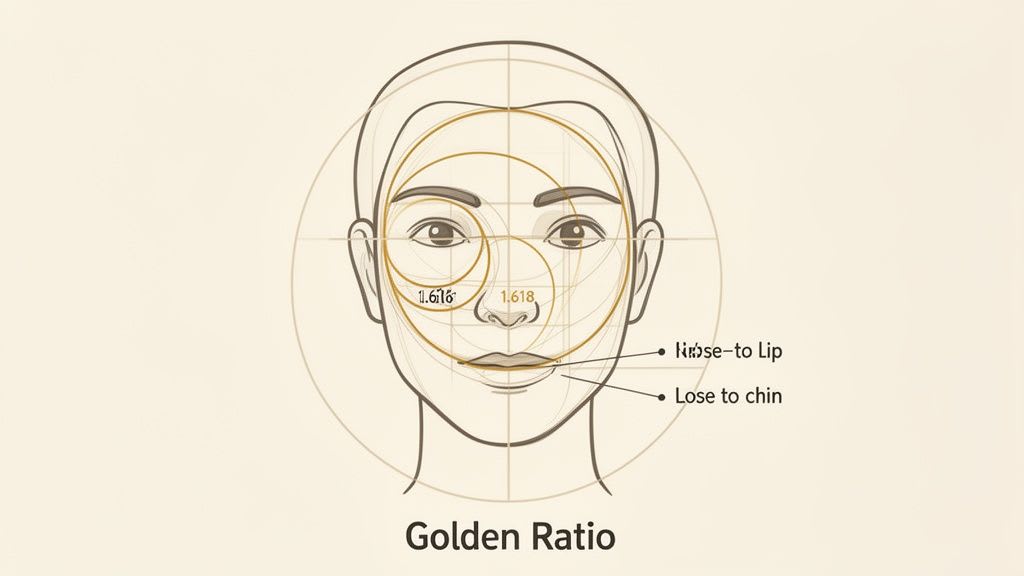
Aesthetic assessment is not guesswork; it is a blend of artistry with established mathematical principles. The goal is never to change who you are, but to use these timeless rules of harmony to enhance your natural beauty for a balanced, refreshed appearance. This precise methodology allows for predictable, harmonious results—the kind of quality and subtlety expected from Swiss medical aesthetics.
Definition: The Golden Ratio (Phi - 1.618)
The Golden Ratio is a mathematical constant, approximately 1.618, found throughout nature and art, which the human eye perceives as inherently balanced and beautiful. Doctors use the Golden Ratio (1:1.618) to calculate the perfect width of the lips relative to the nose, or the chin relative to the lips. This mathematical formula ensures features look balanced, not just 'big'.
Using this ratio, a skilled clinician can precisely calculate how much filler is needed to create balance, not just add volume. It’s the key difference between simply plumping a feature and achieving true facial harmonisation.
The 3 Angles of Assessment: A Comprehensive Protocol
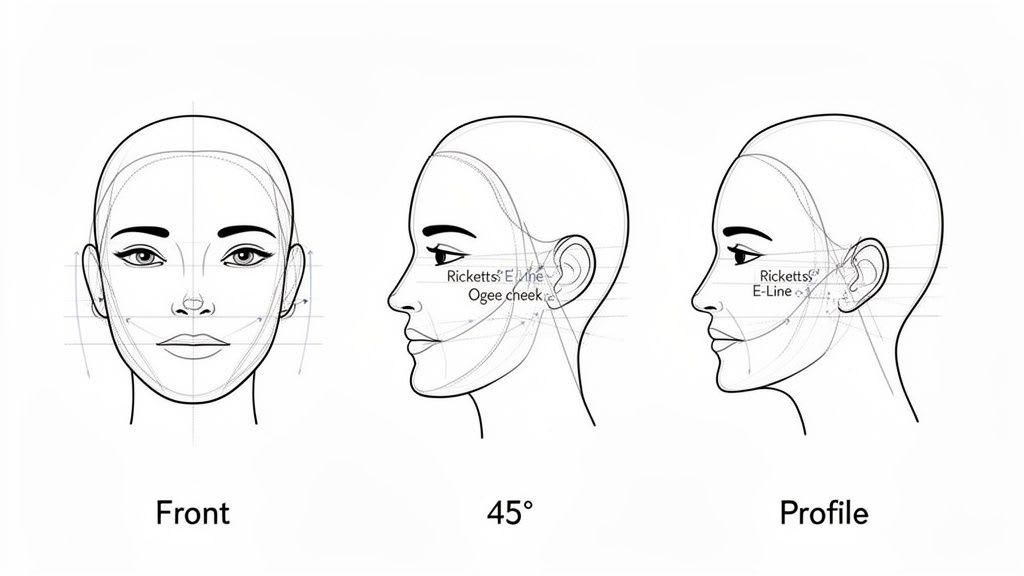
A thorough facial assessment requires more than a frontal glance. In Swiss clinics, practitioners meticulously analyse your features from three key perspectives to build a complete, three-dimensional understanding of your unique anatomy. This isn't about finding flaws; it's about seeing how all features work in concert, ensuring any enhancements look natural from every angle.
Front View: Symmetry & Balance
Looking at the face front-on allows for the assessment of symmetry between the left and right sides. Perfect symmetry is unnatural; however, this view helps identify significant imbalances that may disrupt overall facial harmony, providing a foundational map for treatment.
Profile View: Ricketts' E-Line
The profile view is essential for analysing the projection of the nose, lips, and chin. Doctors use the Ricketts' E-Line—a straight line drawn from the tip of the nose to the tip of the chin. In a classically balanced profile, the lips should sit just behind this line. This is a crucial metric for planning chin or lip enhancements.
45-Degree View: The Ogee Curve
This oblique, three-quarter angle is where facial contours are most apparent. It is the ideal view for observing the Ogee Curve—the gentle, S-shaped curve that flows from the cheekbone down into the mid-face. A full, smooth Ogee Curve is a hallmark of youth, and assessing it from this angle is key to restoring volume naturally.
Masculine vs. Feminine Aesthetics: Customised Proportion Goals
There is no one-size-fits-all approach in facial aesthetics. The clinical goals for enhancing masculine and feminine features differ significantly, and a skilled practitioner in Switzerland understands that respecting these differences is key to achieving natural-looking harmony. A treatment like jawline contouring, for example, is planned with entirely different endpoints depending on the patient's anatomy and goals.
| Facial Feature | Masculine Ideal | Feminine Ideal |
|---|---|---|
| Jawline | Square/Wide (equal to cheek width) | V-Shape (narrower than cheeks) |
| Chin | Broad/Flat | Pointed/Tapered |
| Cheeks | Flat/Angular | High/Rounded |
These are guiding principles, not rigid rules. The most important part of the process is discussing your personal goals to create a plan that reflects your individual vision of beauty.
Why 'Alienization' Happens: Understanding Facial Overfilled Syndrome
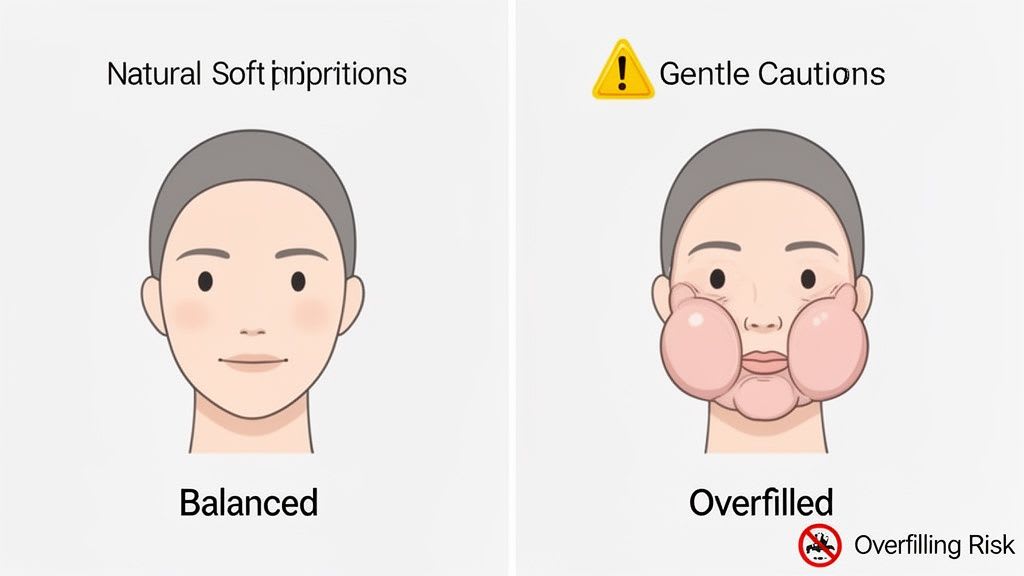
A common concern for patients in Switzerland is the fear of looking unnatural or "done." This puffy, distorted appearance is not an inherent flaw of dermal fillers but the result of poor technique, where an injector ignores facial proportions and simply adds volume.
This phenomenon has a clinical name: Facial Overfilled Syndrome (FOS). It occurs when the mid-face is widened beyond the natural bone structure, disrupting facial contours and causing the eyes to look smaller and disproportionate. The outcome is the antithesis of what a proper aesthetic assessment aims to achieve.
Choosing a practitioner who bases their work on a careful analysis of your unique facial proportions is the most effective way to avoid this. A qualified Swiss doctor will always prioritise balance and harmony over sheer volume, ensuring you look refreshed and authentic.
The Swiss Approach to Patient-Centred Planning
Here in Switzerland, an aesthetic consultation is a precise, discreet, and deeply collaborative process between you and your doctor. The first, and most important, job of a skilled practitioner isn't to suggest treatments, but to listen carefully.
Your doctor's goal is to create a plan with you, not just for you. This comprehensive, 360° assessment helps them see the bigger picture—identifying subtle imbalances you might not even notice yourself—to ensure any result is beautifully natural and harmonious. In fact, studies show that how well a patient feels heard and understood during this stage is the single biggest factor in their ultimate satisfaction. You can read more about this in recent research on consultation dynamics.
This partnership is the hallmark of high-quality Swiss medical care. It turns a standard consultation into a genuine collaboration where your input is essential to crafting the perfect treatment plan.
This meticulous approach is exactly why medical supervision matters in aesthetic treatments. It ensures the final plan is not only safe but also perfectly in tune with what you truly want to achieve.
Frequently Asked Questions About Facial Proportions
Can you fix asymmetry?
Yes, but the goal is harmony, not perfect mathematical symmetry, which can look unnatural. A skilled doctor aims for a "sisters, not twins" balance, enhancing your features to create a pleasing and natural sense of proportion that respects your unique anatomy.
What is the Ogee Curve?
The Ogee Curve is the double-S curve seen on the cheekbone of a youthful face when viewed from a 45-degree angle. It represents the smooth, convex transition from the full cheekbone to the leaner mid-face. Restoring this curve is key to achieving a refreshed, youthful look without overfilling.
Do you measure my face?
Yes, absolutely. Top doctors use precise tools like calipers or advanced 3D imaging to measure facial ratios during the consultation. This mathematical approach provides the anatomical blueprint for a treatment plan grounded in the principles of aesthetic proportion, ensuring safe and beautiful results.
Explore More
This article is for informational purposes only and does not replace professional medical advice.