
Viewing "labiaplasty before and after" photos offers a glimpse into the potential physical transformation, but it only reveals a fraction of the story. The true impact is often less visible—the resolution of daily discomfort, a restored sense of confidence, and the freedom to live without a persistent source of self-consciousness. For many patients in Switzerland, this is a deeply personal journey focused on well-being, not just aesthetics.
Understanding Labiaplasty in the Swiss Context
Before examining before-and-after images, it's crucial to understand what this procedure entails within Switzerland's high-standard medical environment. Labiaplasty is a surgical procedure to alter the shape or reduce the size of the labia minora (inner lips) or, less commonly, the labia majora (outer lips). The objective is to achieve a result that feels more comfortable and appears harmonious with the patient's individual anatomy.
Motivations Beyond the Visual
In Switzerland, the reasons for considering labiaplasty are typically twofold: functional and emotional. A thorough consultation with a qualified surgeon is a medical dialogue designed to understand the underlying issues a patient is facing.
Common reasons include:
Functional Discomfort: Many individuals experience physical irritation, chafing, and pain from enlarged labia during everyday activities like exercise, cycling, or wearing fitted clothing.
Aesthetic Concerns: Feeling self-conscious can significantly affect well-being, influencing everything from swimwear choices to confidence during intimacy.
Asymmetry: A noticeable imbalance can create a sense of unease and a desire for a more symmetrical appearance.
The Swiss medical approach, upheld by organisations like the Swiss Society for Plastic, Reconstructive and Aesthetic Surgery (SSCPRE), prioritises patient safety and natural-looking outcomes. The goal is not to create a standardised or "designer" look, but to achieve a result that resolves the patient's concerns and is tailored to their unique anatomy.
A Growing Trend with a Focus on Safety
Over the past two decades, labiaplasty has become a more common and openly discussed procedure in Switzerland. Research involving Swiss plastic surgeons and gynaecologists has documented a clear increase in these surgeries, particularly for labia minora reduction. You can read more about the study findings on labiaplasty trends in Switzerland to review the data.
This growing interest makes a regulated, professional medical environment more important than ever. In Switzerland, the emphasis is on ensuring the decision is carefully considered, the patient is a suitable candidate, and the surgery is performed by an accredited specialist holding an FMH (Swiss Medical Association) title.
This commitment to exceptional standards is what patients can expect in medical centres across cities like Zurich, Geneva, and Basel. Platforms like BeautyGuide.ch exist to help patients find pre-vetted clinics and surgeons who meet these exacting criteria. A patient's journey should begin with trust and realistic expectations for their labiaplasty before and after results, built on a foundation of health and well-being.
Looking at Before-and-After Photos: A Guide to Seeing What Matters

When exploring labiaplasty, browsing a surgeon's labiaplasty before and after gallery is often one of the first steps. However, looking at these photos effectively is a skill. It requires more than a quick glance; it involves analysing the images with a critical eye.
A well-curated, honest portfolio is a sign of a professional. By reviewing it, you are not just judging the final look; you are gaining insight into a surgeon’s technical skill, consistency, and aesthetic approach. This is how you set clear, realistic expectations for what is achievable.
Look For Consistency, Not Just the 'Perfect' Result
The quality of the photography itself can reveal a great deal about a surgeon's professionalism. Inconsistent photos make a fair comparison impossible and can be a sign of a less meticulous approach.
Pay close attention to these technical details:
Lighting: Is it the same in both the before and after shots? Poor lighting with harsh shadows can hide unevenness, while overly bright light can wash out detail. Look for clear, balanced light in both photos.
Angle: The camera should be in the exact same position. Even a slight change in angle can alter the appearance of the labia, giving a misleading impression of the outcome.
Positioning: Check that the patient’s body is in the same position. Any shift in posture can change how the tissues hang, so matching positions are essential for an honest comparison.
Background: The background should be simple, clean, and identical. This demonstrates a methodical, clinical approach to documenting work.
When a surgeon invests time in creating a consistent, high-quality gallery, it signals a commitment to transparency and respect for the patient's decision-making process.
By focusing on these details first, you are evaluating the surgeon’s professional standards. A surgeon who is meticulous about their photography is often equally meticulous in the operating room.
Analyse the Surgical Result Itself
Once you are confident the photos provide an honest comparison, you can begin to assess the surgeon's work. Look past your initial impression and examine the finer points to get a feel for their aesthetic style and skill level.
Here’s what to look for in the labiaplasty before and after outcomes:
Natural Appearance: Do the results look natural and harmonious, rather than artificial or over-corrected?
Symmetry: While perfect symmetry is rare in nature, has the surgeon created a more balanced and proportionate appearance?
Scar Quality: For this, you need to see photos taken several months post-procedure. Well-healed scars should be faint and carefully placed along the natural edge or within the folds of the labia.
Variety of Cases: A comprehensive gallery showcases a range of patient anatomies. This demonstrates the surgeon's ability to adapt their technique to different bodies and needs.
Viewing a structured gallery, whether online or in person during a consultation, allows you to methodically review a surgeon’s portfolio. You can begin to identify the style and results that align with your goals.
By focusing your search on qualified Swiss surgeons, you can be assured that you are reviewing work that meets the high medical standards and refined aesthetic sensibilities that Switzerland is known for. This empowers you to make a choice based on demonstrated skill and transparent results.
Your Labiaplasty Journey: What to Expect Step by Step
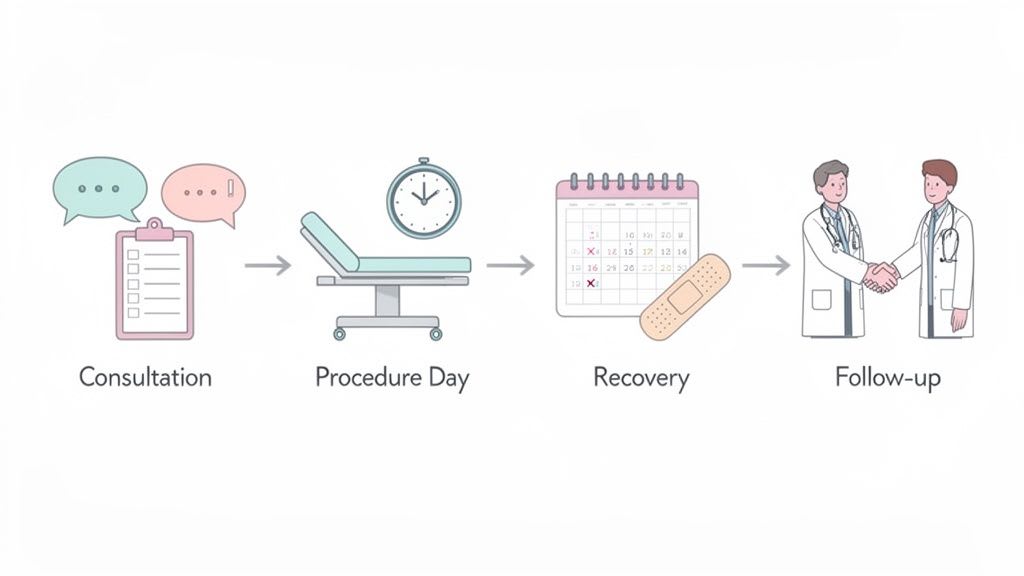
The "before and after" of a labiaplasty is more than just photos; it's an entire journey. In Switzerland, this path is structured around a patient-first approach that prioritises safety, comfort, and exceptional medical care from the initial consultation to the final follow-up.
Knowing what to expect can help you feel prepared and at ease. Each stage is designed to ensure you feel informed, supported, and confident in your decision.
The Initial Consultation: Your Most Important Step
This first meeting with your FMH-certified surgeon is the foundation of your experience. It is a confidential medical discussion where you can build trust, get answers, and ensure your goals align with what surgery can realistically achieve.
A proper consultation at a Swiss clinic will cover your reasons for considering the procedure, your medical history, and a physical examination to determine the best surgical plan for your unique anatomy. Be prepared to discuss any functional discomfort or aesthetic concerns. For a comprehensive look at how to approach this meeting, you can read our guide on what to expect during a first aesthetic consultation.
Key questions to ask your surgeon include:
What are your specific qualifications, and how many labiaplasties have you performed?
Which surgical technique (e.g., trim or wedge) do you recommend for me, and why?
How do you ensure patient safety, and what are the specific risks I should be aware of?
What does the full recovery process entail, and what support does your team provide?
This open dialogue is crucial for setting expectations that are grounded in medical reality.
The Procedure Day: What to Expect
On the day of your surgery, the focus is on your well-being and comfort. Labiaplasty is typically an outpatient procedure performed in a certified clinic or hospital, meaning you can return home the same day.
Most often, the procedure is performed under local anaesthesia with sedation. This numbs the area completely while you remain in a calm, relaxed state. In some cases, general anaesthesia may be recommended. Your surgeon and anaesthetist will have determined the best approach for you during your consultation.
The surgery itself is precise. The surgeon carefully removes the excess tissue and closes the incisions with fine, dissolvable sutures, taking great care to minimise scarring and preserve sensation.
The Recovery Journey: A Realistic Timeline
The "after" phase of your labiaplasty is a healing process that requires patience. Your final results will take several months to fully emerge. While everyone's body heals differently, the recovery generally follows a predictable pattern.
A common misconception is that the result seen one week after surgery is the final one. In reality, the tissues need weeks to settle and months for all residual swelling to resolve. Understanding this timeline is key to a positive experience.
Below is a typical recovery timeline. Remember, this is a general guide, and your surgeon will provide instructions tailored specifically to you.
Labiaplasty Recovery Timeline
| Timeframe | Expected Experience | Activity Level & Restrictions |
|---|---|---|
| Week 1 | Swelling, bruising, and discomfort are most prominent in the first 48-72 hours, managed with pain medication and cool compresses. | Strict rest is crucial. Avoid any strenuous movement. Most patients take this full week off from work. |
| Weeks 2-3 | Swelling and bruising begin to subside noticeably. Discomfort should be mild and easily manageable. | Return to a desk job and light daily activities is often possible. Continue to avoid heavy lifting, exercise, or pressure on the area. |
| Weeks 4-6 | Most visible swelling has resolved. The incisions are healing, but the tissue is still delicate and remodelling. | With your surgeon's approval, you can slowly reintroduce light exercise. Sexual activity and tampons are restricted for the full six weeks. |
| After 6 Weeks | You are usually cleared to resume all normal activities, including intense workouts and intimacy. | Minor, subtle swelling might persist for 3-6 months as the tissues fully settle. |
The final, stable result of your labiaplasty is generally apparent around the six-month mark. Over the following 6-12 months, the tissues will continue to soften, and any scar lines will fade and become inconspicuous.
Determining If You Are A Suitable Candidate
A successful labiaplasty outcome begins with a careful and honest assessment of your candidacy for the procedure. In Switzerland, qualified surgeons take this responsibility very seriously. The evaluation involves understanding your motivations, your health, and your expectations to ensure this decision is right for you.
Your personal motivation is the most important factor in this discussion.
Common Functional And Aesthetic Motivations
In Swiss clinics, most patients present with a combination of functional discomfort and aesthetic concerns. Understanding how these factors intertwine is a key part of the assessment.
Functional reasons relate to physical discomfort that interferes with daily life:
Chronic Irritation: A constant feeling of chafing or rubbing from clothing.
Discomfort During Activities: Painful pulling or pinching during exercise such as cycling or running.
Interference with Intimacy: Physical discomfort during sexual activity.
Aesthetic motivations are equally valid and are connected to self-confidence and emotional well-being:
A desire for a more symmetrical appearance.
Feeling self-conscious in certain clothing or during intimate moments.
Wanting to restore a pre-childbirth appearance.
Research confirms that for the right candidate, this procedure can have a profound positive impact. Studies have documented significant improvements in genital self-image, sexual function, and overall quality of life post-surgery. To explore this topic further, our guide on medical vs. non-medical aesthetic treatments and what patients should know may be helpful.
Factors That May Indicate Unsuitability
An ethical surgeon's duty of care includes knowing when to advise against surgery. In Switzerland, patient well-being is paramount, and a responsible surgeon will identify when labiaplasty is not the appropriate choice.
A responsible surgeon will decline to operate if they believe the procedure is not in the patient's best interest. This is a hallmark of excellent medical practice.
Reasons why labiaplasty might not be right for you at this time include:
Unrealistic Expectations: If expectations are based on digitally altered images or an anatomically impossible ideal, a surgeon will help you understand what is realistically achievable.
External Pressure: The decision must be entirely your own, free from pressure from a partner, social media, or others.
Signs of Body Dysmorphic Disorder (BDD): This is a mental health condition where an individual has an obsessive focus on a perceived physical flaw. Surgeons are trained to recognise potential signs and will prioritise mental health by recommending psychological support instead of surgery.
Age and Physical Development: Patients must be over 18 and have completed their physical development to ensure stable results.
Pregnancy and Childbirth Plans: While labiaplasty does not prevent future childbirth, pregnancy and delivery can alter the results. Your surgeon will discuss your family planning goals to determine the best timing for the procedure.
Ultimately, determining your candidacy is a collaborative process between you and a trusted, FMH-certified specialist to ensure your journey is safe, positive, and genuinely enhances your quality of life.
Understanding Labiaplasty Costs in Switzerland
The cost of a labiaplasty in Switzerland reflects the country's high standards for medical excellence, surgeon expertise, and patient safety. Reputable Swiss clinics provide transparent, all-inclusive cost estimates to build trust and ensure there are no surprises.
The total price for a labiaplasty in Switzerland generally falls within a specific range. This figure is not arbitrary; it covers your entire journey from start to finish.
Breaking Down the All-Inclusive Price
Your cost estimate should be an itemised list detailing exactly what your investment covers.
Surgeon's Fee: This reflects the years of specialised training, skill, and artistry of your FMH-certified surgeon. It is an investment in their experience to perform this delicate surgery with precision.
Anaesthesia Fees: This covers the services of a specialist anaesthetist and the type of anaesthesia used, whether it's local anaesthesia with sedation or a general anaesthetic.
Clinic & Facility Costs: This fee ensures your procedure is performed in a top-tier, certified operating theatre. It includes the sterile environment, advanced medical equipment, and the dedicated recovery room staff.
Complete Aftercare: All follow-up appointments should be included. This covers check-ups to monitor healing, suture removal if necessary, and final consultations to ensure a successful recovery.
By bundling all costs, the clinic provides a straightforward financial plan, allowing you to focus on your procedure and recovery without the stress of unexpected bills.
Insurance Coverage and Medical Necessity
It is important to have realistic expectations regarding insurance. As labiaplasty is typically considered an aesthetic procedure, it is rarely covered by basic Swiss health insurance (Grundversicherung). In very specific cases where a significant, medically documented functional impairment exists that has not responded to other treatments, coverage may be considered.
For a procedure to have any chance of insurance coverage, a formal request must be submitted by your doctor to the insurance company’s medical advisor (médecin-conseil / Vertrauensarzt). This is a rigorous process requiring extensive proof of physical symptoms.
For the vast majority of patients seeking this surgery for a combination of aesthetic and comfort-related reasons, it is best to plan for it as a self-funded investment in your well-being. The price reflects the quality, safety, and level of care provided within the Swiss healthcare system.
During your consultation, the clinic team can walk you through your detailed cost estimate and discuss any available payment options, ensuring you can make a confident and informed decision.
How to Choose a Qualified Surgeon in Switzerland
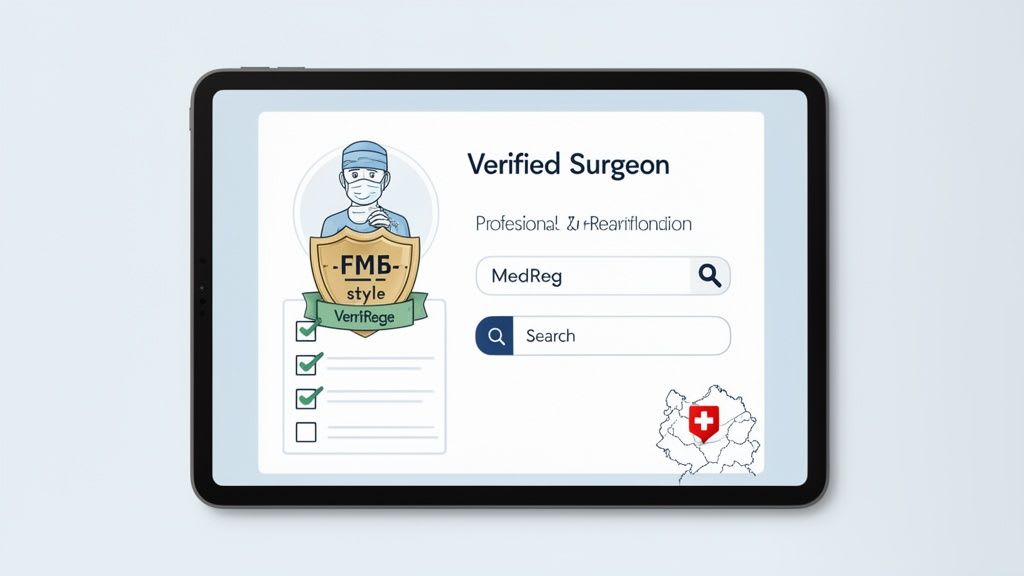
Your choice of surgeon is the single most important decision in your labiaplasty journey. A successful outcome—one that looks natural, feels comfortable, and resolves functional issues—depends almost entirely on the skill and experience of the professional you select.
While Swiss medical standards are exceptionally high, it is still essential for patients to know what to look for. This involves verifying qualifications, evaluating real-world experience, and finding a surgeon whose aesthetic approach aligns with your goals.
The FMH Title: Your Non-Negotiable Starting Point
In Switzerland, the gold standard for a medical specialist is their FMH title. This designation from the Swiss Medical Association confirms that a doctor has completed years of rigorous, specialised training beyond medical school. For a labiaplasty, you should only consider surgeons holding one of two key FMH titles.
Your surgeon must be a board-certified:
Specialist in Plastic, Reconstructive and Aesthetic Surgery (FMH)
Specialist in Gynaecology and Obstetrics (FMH), with a demonstrable specialisation and advanced training in intimate surgery.
This certification is a fundamental assurance of safety and competence. You can and should verify any doctor's credentials yourself using the public MedReg database, which is managed by the Federal Office of Public Health (FOPH).
Evaluating Real Experience and Reviewing Their Work
Once you have confirmed credentials, it is time to assess their specific experience with labiaplasty. A reputable surgeon will be transparent about their work and should have a "labiaplasty before and after" gallery that demonstrates their skill and aesthetic style.
Remember, a consultation is a two-way discussion. While the surgeon assesses your candidacy, you should also be evaluating if they are the right surgeon for you. Pay attention to their communication style, empathy, and the thoroughness of their answers.
When you review their portfolio or discuss their experience, consider these points:
Consistency: Are the results consistently natural-looking and symmetrical across different patients?
Technique: Can they explain the different surgical techniques (e.g., trim vs. wedge) and articulate why one is better suited to your anatomy?
* Professionalism: Do you feel heard? A good surgeon listens carefully to your concerns and provides clear, honest answers about risks, recovery, and realistic outcomes.
Finding a specialist in Zurich, Geneva, or another Swiss city who meets all these criteria is crucial. For more context on the high standards in this field, our guide to Swiss plastic surgery offers helpful information.
Platforms like BeautyGuide.ch perform much of this initial verification for you, connecting you with trusted, FMH-qualified specialists. This allows you to focus on the most personal aspect: finding an expert whose approach and results inspire your complete confidence.
Your Labiaplasty Questions, Answered
It is completely normal to have questions when considering a medical procedure. Making an informed decision is the most important step. Here are straightforward answers to common queries about labiaplasty.
Will it affect sensation or my sex life?
When performed by a highly skilled, FMH-certified surgeon, a labiaplasty should not negatively affect sensation. Surgeons in Switzerland are trained to work exclusively on the labial tissue, meticulously avoiding the clitoris and major nerves responsible for sexual sensation. In fact, many women report that intimacy becomes more comfortable and enjoyable post-recovery, as the source of physical discomfort or self-consciousness has been resolved.
How obvious will the scars be?
A surgeon's objective is to create a completely natural-looking result, which includes concealing any evidence of surgery. Using either the trim or wedge technique, incisions are strategically placed along the natural edge of the labia or within a natural fold. While scars may be pink initially, they typically fade over 6-12 months into fine, pale lines that are very difficult to detect.
What is the pain and recovery really like?
The surgery itself is performed under anaesthesia and is not painful. Post-procedure, you can expect some discomfort, swelling, and soreness for the first week, which is typically well-managed with prescribed pain medication. Most women feel comfortable enough to return to a desk job and light activities within 5-7 days. Patience is key; you will need to avoid strenuous exercise, swimming, and certain other activities for about 4-6 weeks to ensure proper healing.
When will I see the final 'after' result?
You will notice a significant change once the initial swelling subsides in the first few weeks, but this is not the final outcome. Healing is a gradual process. The tissues need time to soften and settle, and any residual swelling will slowly disappear over 3 to 6 months. The complete, final result—when scars have fully matured and tissues feel soft and natural—can take up to a year to be fully realised.
Switzerland's standards for medical care are exceptionally high. For educational purposes, understanding how aesthetic medicine is approached in other regions can provide valuable context. Looking into top medical tourism destinations can offer a broader perspective on global practices. This wider view often reinforces the value of choosing treatment in a country with stringent regulations and a reputation for medical excellence.
This article is for informational purposes only and does not replace professional medical advice.